
Streamlined Vetting for Federal Hiring: Balancing Speed, Compliance, and Quality

Federal Hiring Vetting Process Faster, Compliant Hiring
Federal hiring has a timing problem.
Programs need skilled people now. Contract start dates do not move because a background investigation takes longer than expected. Vacant positions increase delivery risk, place more work on existing teams, and create pressure to make faster hiring decisions.
Federal vetting exists for a reason, you know. Agencies and contractors have to verify that folks stepping into sensitive roles do actually meet the right expectations around trustworthiness, suitability, access, and day to day conduct.
So, speeding up hiring can’t really mean weakening those checks, not at all. The actual aim is a workflow that nudges qualified people ahead, while not inventing avoidable hold ups, compliance missteps, or wrongheaded hiring calls.
That requires more than faster paperwork. It requires accurate position requirements, prepared candidates, clean submissions, strong coordination, and realistic workforce planning.

Federal Vetting Is More Than a Background Check

Federal hiring can involve several separate determinations depending on the role:
  • Suitability for federal employment. 
  • Fitness for contractor work. 
  • Credentialing for access to federal systems or facilities. 
  • Public Trust review. 
  • Eligibility for access to classified information. 
  • Agency-specific screening. 
  • Drug testing, medical review, or polygraph requirements. 
Hiring teams often creates confusion by treating these requirements as interchangeable.
A Public Trust determination is not a security clearance. A Secret clearance does not automatically satisfy every agency’s access requirement.
A candidate who already has current Top-Secret eligibility might still need extra processing for Sensitive Compartmented Information, plus a polygraph, or even a customer with specific access decision. In your job description, you should clearly spell out the exact requirement.
Do not write active clearance preferred when the person cannot perform the work without current eligibility. Do not request TS/SCI when Secret access is enough. Inflated clearance requirements reduce the candidate pool and increase compensation pressure without improving contract performance.
Before recruiting starts, confirm four points:
  1. What investigation or eligibility level does the position require? 
  2. Must the candidate hold it before submission? 
  3. Is interim access permitted? 
  4. Can the candidate perform unclassified work while processing continues? 
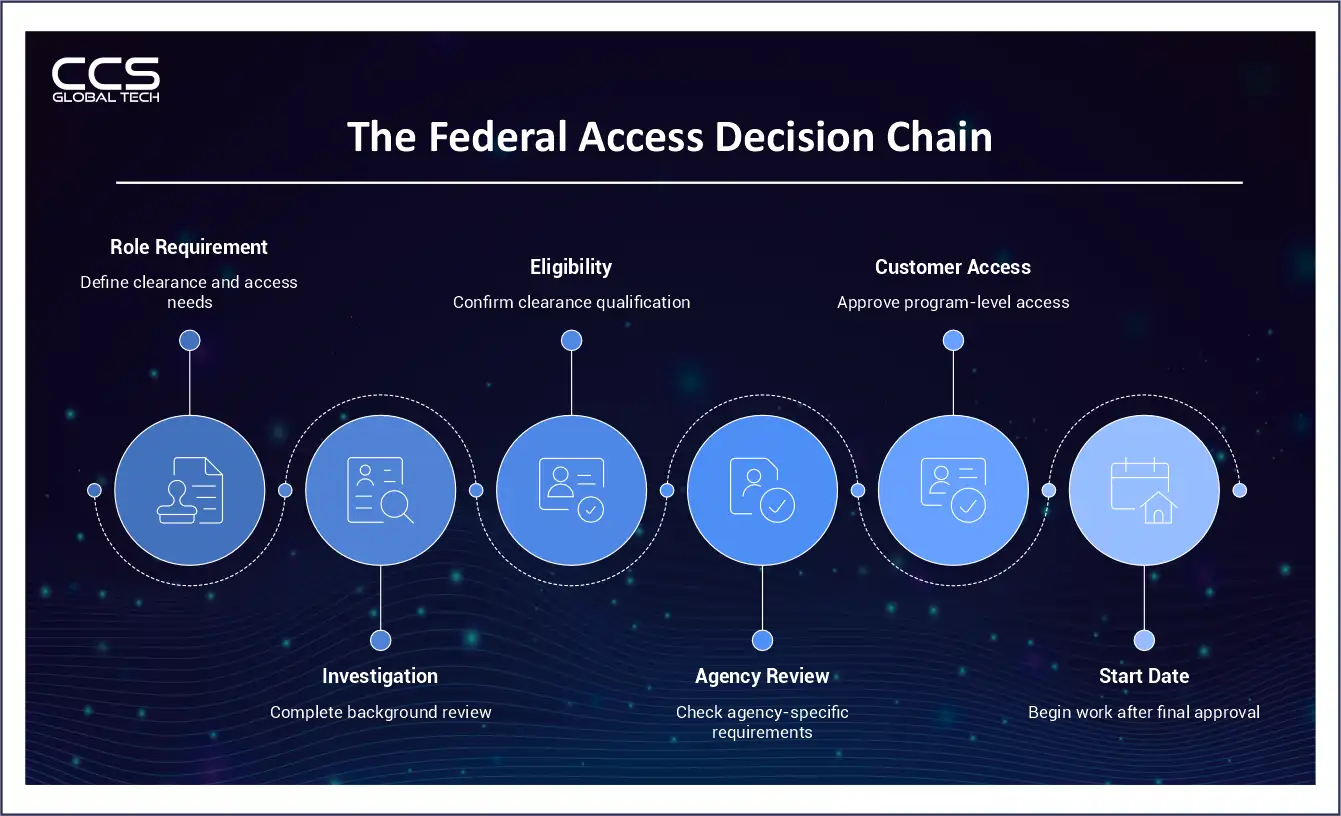
Those answers affect your recruiting strategy, proposed start date, and candidate communication.
The Federal Access Decision Chain

Current Timelines Still Require Workforce Planning

Federal personnel vetting has made some progress here and there, but the end-to-end timelines still seem to run pretty long, even when everything is moving.
In the FY 2026 Q2 personnel vetting report, the average end-to-end processing time was 92 days for initial Secret cases and 205 days for initial Top-Secret cases, if you look at the fastest 90 percent of cases.
End-to-end time means the whole chain: initiation, investigation, and adjudication, all counted together. The investigation side has improved in a sharper way though.
DCSA said that the High-Risk investigation time dropped from 157 days to 60 days, and that the Moderate Risk investigation time fell from 59 days to 44 days. For the FY 2026 targets, it’s basically set to 60 days for High-Risk cases, while Moderate Risk cases are pegged at 20 days.
This distinction matters.
Even a quick investigation doesn’t necessarily ensure a quick hiring process. Time can still be built during the questionnaire initiation process, fingerprinting, documentation retrieval, agency review, adjudication, access processing, and the customer onboarding process.
The hiring manager must monitor all processes independently. A pending clearance process doesn’t give any information about the actual progress of the process and possible steps to take for moving it forward.

Preliminary Decisions Help, but They Are Not Guaranteed

It is not necessary for many candidates to wait until the entire process completes before getting started.
According to the report FY 2026 Q2, about 80 percent of employees going through the process of vetting can join their duties without getting the complete results of the vetting process.
This is done using the Preliminary Determination which is done on the basis of preliminary details like forms, fingerprints, and records check.
Ask the customer:
  • Does the contract permit interim access? 
  • Which duties can begin before final eligibility? 
  • Does the facility require final access before entry? 
  • Are unclassified work packages available? 
  • Who owns the preliminary decision? 
  • What happens if interim access is not granted? 

A candidate should also ask these questions before accepting an offer. A conditional offer with no interim work option carries a different financial risk than a role with an unclassified start path.
Never promise an interim clearance. It remains a government decision, and some candidates will not receive one even when their final case is later approved.

Clean Applications Prevent Avoidable Delay

You cannot control the government’s workload. You can control submission quality.
Incomplete or inconsistent forms create follow-up work. Every missing address, unexplained employment gap, incorrect supervisor number, and vague travel date gives an investigator another item to resolve.
Candidates should gather records before completing the questionnaire:
  • Full address history with exact dates 
  • Employment history and supervisor details 
  • Education records 
  • Foreign travel dates and destinations 
  • Foreign contacts where reporting applies 
  • Police or court records 
  • Current credit information 
  • Military service records 
  • Names and contact details for references 
Guessing creates risk. A date that is off by one week may seem minor, but several conflicting dates across employment, residence, and travel sections raise questions about the reliability of the submission.
Disclosure matters too.
A financial issue , past drug use, workplace trouble, or a foreign relationship does not automatically mean the case is over or something.
The adjudicative process instead looks at context and how often it happened, plus how recent it is, how serious it was, and what corrective action was actually taken. An omission creates a separate concern about honesty and judgment.
Recruiters and security staff should encourage accuracy without trying to coach candidates toward a preferred answer. The candidate must provide complete and truthful information.

Compliance Begins Before Candidate Submission

Fast hiring often breaks down because recruiters work from an incomplete requirement.
A request might state that the position needs a cleared cloud engineer, but leave out the clearance level, required certifications, customer approval process, work location, citizenship requirement, and start restrictions.
Recruiters then submit people who look qualified on paper but cannot meet the contract terms.
Before sourcing begins, build a compliance checklist covering:
  • Labor category requirements
  • Education and experience minimums 
  • Citizenship restrictions 
  • Required clearance and access level 
  • Investigation recency requirements 
  • DoD 8140 or contract-specific certifications 
  • Worksite and remote-work rules 
  • Travel requirements 
  • Drug screening 
  • Customer approval steps 
  • Organizational conflict restrictions 
  • Start-date conditions  
This review protects speed. It prevents teams from spending days interviewing a candidate who fails a mandatory requirement discovered at the end.
Your applicant tracking system should capture these fields in a consistent format. Free-text notes create room for missed details and different interpretations.

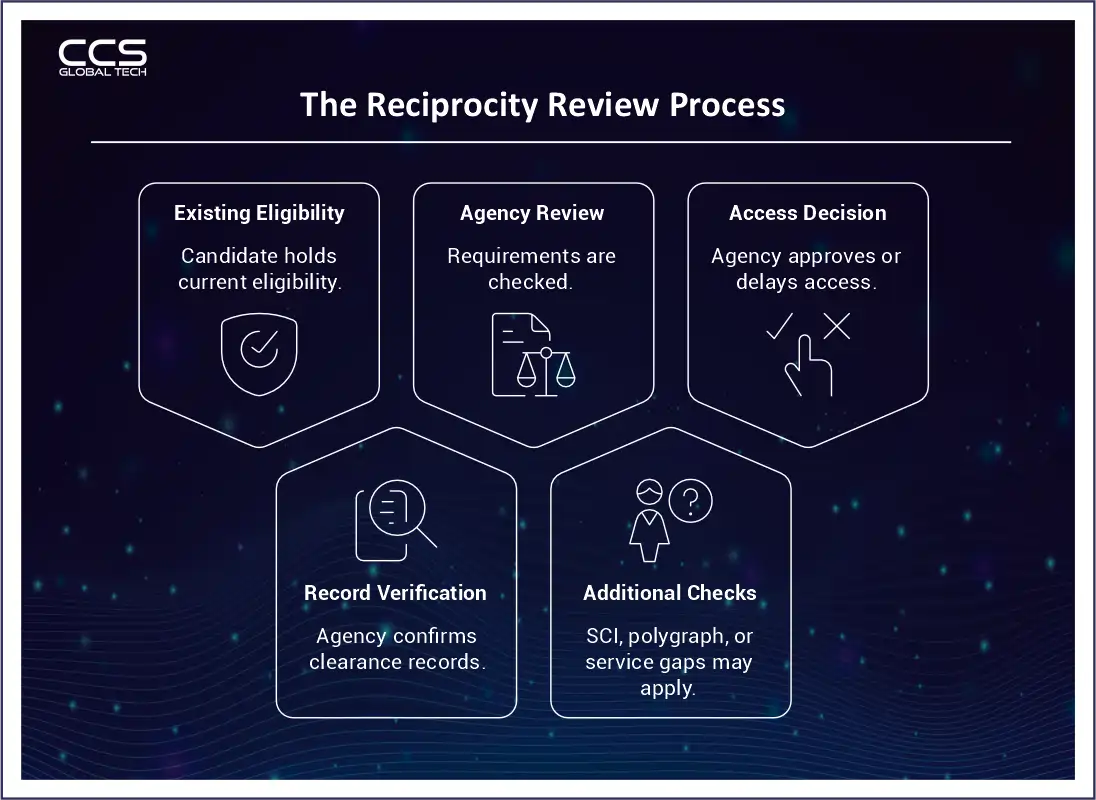
Reciprocity Should Help, but Contractors Still Face Friction

A person moving between agencies should not always need a new investigation. Federal policy supports reciprocity, meaning agencies generally accept qualifying vetting decisions made by other agencies.
The practice remains uneven.
GAO found that reciprocity data were incomplete and inconsistent. In its survey, 28 of 31 agencies reported that information technology systems sometimes lacked the complete information needed for reciprocity decisions. Contractors also reported limited updates when those decisions were delayed.
This creates a frustrating situation for employers and candidates. A person may already hold current eligibility but still wait for an agency to verify records, confirm access, or resolve missing data.
Before presenting a candidate as immediately deployable, verify:
  • Current eligibility level
  • Owning or servicing agency 
  • Investigation type and close date 
  • Current access status 
  • Time since the person last held a cleared position 
  • SCI or polygraph status 
  • Whether the new customer accepts reciprocity 
  • Any known break in service  
Current eligibility and active access are related, but they are not the same. Recruiters should avoid using active clearance as a broad label without checking the underlying status.

Technology Modernization Is Still Incomplete

The government’s personnel vetting reforms depend heavily on the National Background Investigation Services platform, known as NBIS.
The development of NBIS by DoD began in 2016. The development of NBIS was put on hold by DCSA in 2024 due to failure to meet several milestones and changes were made in the strategy. In February 2026, GAO indicated that the program was yet to have a credible timeline even though the aim now is to finish the development process in fiscal year 2027.
The cost implication is significant. The cost of development of NBIS by DoD will be an estimated $2.2 billion from fiscal year 2017 to 2031, adding to an already existing expenditure of $2.4 billion for NBIS and legacy system up to 2024.
Impact on Hiring: This is due to the fact that NBIS will support the Trusted Workforce 2.0 initiative.
Federal contractors should plan around the system that exists today. Do not build staffing plans around expected modernization benefits that have not reached your customer.

Quality Still Determines Contract Performance

Hiring faster has little value when the person fails technically, leaves within three months, or cannot work within the customer’s environment.
A clearance confirms eligibility for access. It does not confirm technical competence, communication skills, contract knowledge, or role fit.
Every cleared candidate should still go through a structured quality review:
  • Technical assessment tied to the actual work
  • Verification of certifications 
  • Employment and project history review 
  • Clearance status confirmation 
  • Behavioral interview 
  • Mission and workplace fit assessment 
  • Compensation and location alignment 
  • Availability confirmation 
  • Reference checks where appropriate  
Avoid broad technical interviews that test trivia unrelated to the role.
Supporting a classified Windows environment as a systems administrator, you should be evaluated on identity management stuff, patching routines, how they handle incidents, the level of documentation, and day to day secure operations.
Meanwhile a cloud security engineer really should be asked to talk through architecture choices, logging depth, identity controls, the kind of configuration risk they consider, and the compliance requirements they must meet Quality also gets easier to measure when every candidate gets the same kind of core questions, plus the same scoring criteria, every time.

Build a Hiring Process That Handles Delay

A strong cleared hiring process assumes that some cases will take longer than planned.
Use these practices:
  • Recruit before the vacancy becomes urgent.
  • Maintain backup candidates for high-risk roles. 
  • Separate cleared and uncleared work where the contract allows it. 
  • Give candidates weekly updates, even when no status has changed. 
  • Track time spent in each processing stage. 
  • Escalate missing information quickly. 
  • Coordinate recruiters, program managers, security officers, and customers. 
  • Keep warm talent pools for recurring labor categories. 
  • Review candidate drop-off and offer-decline reasons. 
  • Forecast attrition before option years and recompetes.  
Speed comes from preparation and fewer handoff failures. It does not come from pressuring security teams to bypass required steps.

How CCS Global Tech Supports Federal Staffing?

Federal contractors often need qualified people before traditional recruiting pipelines produce them.
CCS Global Tech supports government agencies and federal contractors with cleared and non-cleared staffing across software development, infrastructure, systems administration, project management, technical leadership, and related federal IT functions. The company provides temporary staffing, permanent hiring, and managed staffing support.
Its federal staffing process includes candidate sourcing, behavioral and technical assessment, clearance-focused screening, and deployment preparation.
For contract, contract-to-hire, direct-hire, and executive search requirements, CCS Global Tech offers dedicated federal recruiting support and account management. Its federal staffing materials describe a recruiting organization of more than 75 specialists, including professionals with military and federal contracting backgrounds.
When your contract requires cleared technical talent, the right staffing partner should understand the labor category, access requirement, deployment timeline, and customer environment before presenting a candidate.
Facing issues in building a qualified talent pipeline for your current and upcoming federal requirements?

FAQs

Q1. How can federal hiring teams speed up vetting without increasing risk?

A. Federal hiring teams can move faster by confirming role requirements early, checking clearance fit before interviews, collecting complete candidate information, and keeping recruiters, program leaders, and security teams aligned from the start. 

A. Vetting slows down when clearance requirements are unclear, candidate records are incomplete, systems do not share enough information, or hiring teams wait too long to involve security and compliance stakeholders. 

A. Teams should confirm clearance level, investigation status, polygraph requirements, citizenship, certifications, location, work history, availability, and whether the candidate meets the contract labor category. 

A. Clearance reciprocity can help qualified candidates move faster when a prior clearance or vetting decision is accepted instead of starting the process again. It saves time, reduces duplicate work, and supports faster onboarding. 

A. Reciprocity issues can happen when agency systems lack complete data, records are inconsistent, requirements differ by agency, or hiring teams cannot quickly verify whether a prior decision meets the new role’s needs. 

A. Recruiters can reduce delays by asking the right clearance questions early, submitting complete candidate profiles, matching resumes to labor categories, and avoiding candidates who do not meet the must-have requirements. 

A. Program managers help by clarifying role priorities, reviewing resumes quickly, separating must-have skills from nice-to-have skills, and giving fast interview feedback so strong candidates do not drop out. 

A. Security teams can help by validating clearance details early, flagging documentation gaps, explaining agency-specific requirements, and guiding recruiters before candidates reach the offer stage. 

A. Contractors should communicate regularly, explain each step, set realistic expectations, and move quickly when documents or decisions are needed. Long silence during vetting often pushes candidates toward other offers. 

A. The right balance is a structured process that moves quickly but does not skip required checks. Speed comes from preparation, clean documentation, and clear ownership, not from cutting corners.