

Skip to content

Active Clearance vs. Clearance Eligibility: What Cleared Job Seekers Need to Know in 2027

Active Clearance vs. Clearance Eligibility 2027 Guide

A candidate tells us she holds a TS/SCI. Her last cleared job ended fourteen months ago. She is not wrong, exactly, and she is not quite right either.

What she holds is eligibility. Whether it becomes an active clearance again depends on a sponsoring employer, a real requirement for access, and a record in a government database that neither she nor we control.
Understanding active clearance vs. clearance eligibility is the difference between describing yourself accurately to a recruiter and losing an offer when the facility security officer runs your record.
The rules also moved this year. DCSA ended legacy periodic reinvestigations for contractor personnel, added a grace period before continuous vetting drops someone, and kept the 24-month window that decides whether you get picked up quickly or start over.
At CCS Global Tech, we work with cleared professionals and service members who are moving into civilian life. We place them on federal contracts each week. You will hear these terms a lot in our intake calls.
This page explains what each label means. It also covers what can change over time. It ends with tips on how to talk about your own status in a clear and truthful way.

Active Clearance vs. Clearance Eligibility at a Glance

Status 

What it means 

Can you work on classified material? 

What it takes to use 

Active 

Eligible, sponsored, and currently in access for a position that requires it 

Yes, within your need-to-know 

Nothing further 

Current 

Eligible, not in access, and inside the 24-month window since leaving access 

No 

A sponsor with a requirement who requests reinstatement 

Expired or inactive 

More than 24 months out of access, or investigation outside scope 

No 

A new investigation, handled as an initial case 

Eligible (adjudicated, never in access) 

Investigation favorably adjudicated, but access never granted 

No 

Sponsorship, need-to-know, briefing, and a signed SF-312 

Keep that table in mind. Every section below explains one of its rows.

What Is an Active Security Clearance?

Definition of an Active Clearance

An active clearance means three things are true at the same moment. You hold a favorable eligibility determination. An employer or agency sponsors you for a position requiring classified access. And you are currently in access, meaning you have been briefed and signed the Classified Information Nondisclosure Agreement, the SF-312.
The SF-312 point surprises people. A favorably adjudicated investigation does not put anyone in access. Access begins after the security briefing and a properly executed nondisclosure agreement, which ODNI explains in its SF-312 guidance. Until then, you are eligible and nothing more.
Active status also stays tied to a position. The organization grants access for specific work and a specific need-to-know. Change programs or lose the requirement, and access can end even though your eligibility record remains.

Requirements to Maintain an Active Clearance

Holding active status is ongoing work rather than a one-time event.
Stay enrolled in continuous vetting– Automated records checks run while you are enrolled, covering criminal, financial, and public records.
Submit the five-year questionnaire update– Under DCSA’s April and May 2026 guidance, NISP contractor personnel no longer undergo legacy periodic reinvestigations. Instead they submit an updated Personnel Vetting Questionnaire, currently the SF-86 eApp and releases, every five years regardless of eligibility level. DISS uses the recorded PVQ date to calculate when the next one is due, not the old investigation date.
Report required events– Foreign travel, foreign contacts, financial trouble, arrests, and other reportable events go to your FSO. Continuous vetting catches many of these anyway, and unreported items found later create a candor problem worse than the original event.
Keep your need-to-know– Access tracks the job. Lose the position and access ends.

What Is Security Clearance Eligibility?

Definition of Clearance Eligibility

Eligibility is the adjudicative decision. After an investigation, an adjudicator reviews the file against the national adjudicative guidelines and decides whether you can be trusted with classified information at a given level. That determination is your eligibility.
Eligibility is what travels with you between jobs. Access does not. When recruiters say a clearance is “portable,” they mean eligibility can be picked up by a new sponsor, usually without a new investigation, as long as it is still inside the window.

How Security Clearance Eligibility Is Obtained?
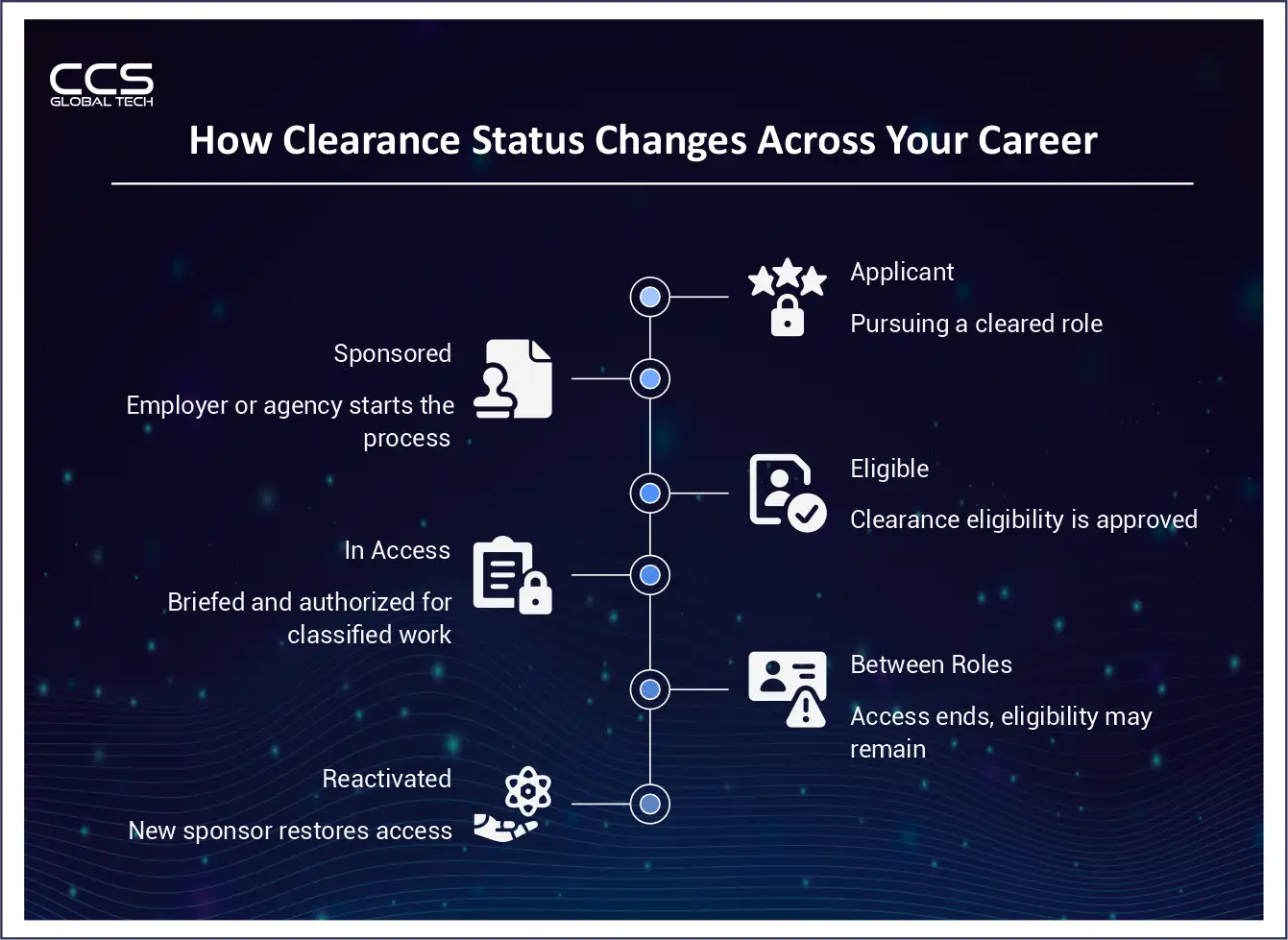
You cannot apply for a clearance on your own. A government agency or a contractor holding a facility clearance has to sponsor you for a position that requires one.
The sequence runs like this. The sponsor initiates the case. You complete the questionnaire, currently the SF-86 through eApp. Investigators conduct the investigation at the required tier, Tier 3 for Secret or Tier 5 for Top Secret. An adjudicator reviews the results and grants or denies eligibility. For SCI or special access programs, additional steps such as a polygraph and program indoctrination follow.
Processing time varies by level and by agency. We covered current timelines in our post on security clearance processing delays.
How Clearance Status Changes Across Your Career

Key Differences Between Active Clearance and Clearance Eligibility

Current Usage vs. Potential Access

Active clearance describes what you are doing right now: working with classified information under a sponsor. Eligibility describes what you could do if the right position came along.
That difference drives hiring speed. An active candidate can often start on a contract without waiting on reinstatement paperwork. An eligible candidate can usually start soon, but only after a sponsor requests reinstatement and the record transfers.

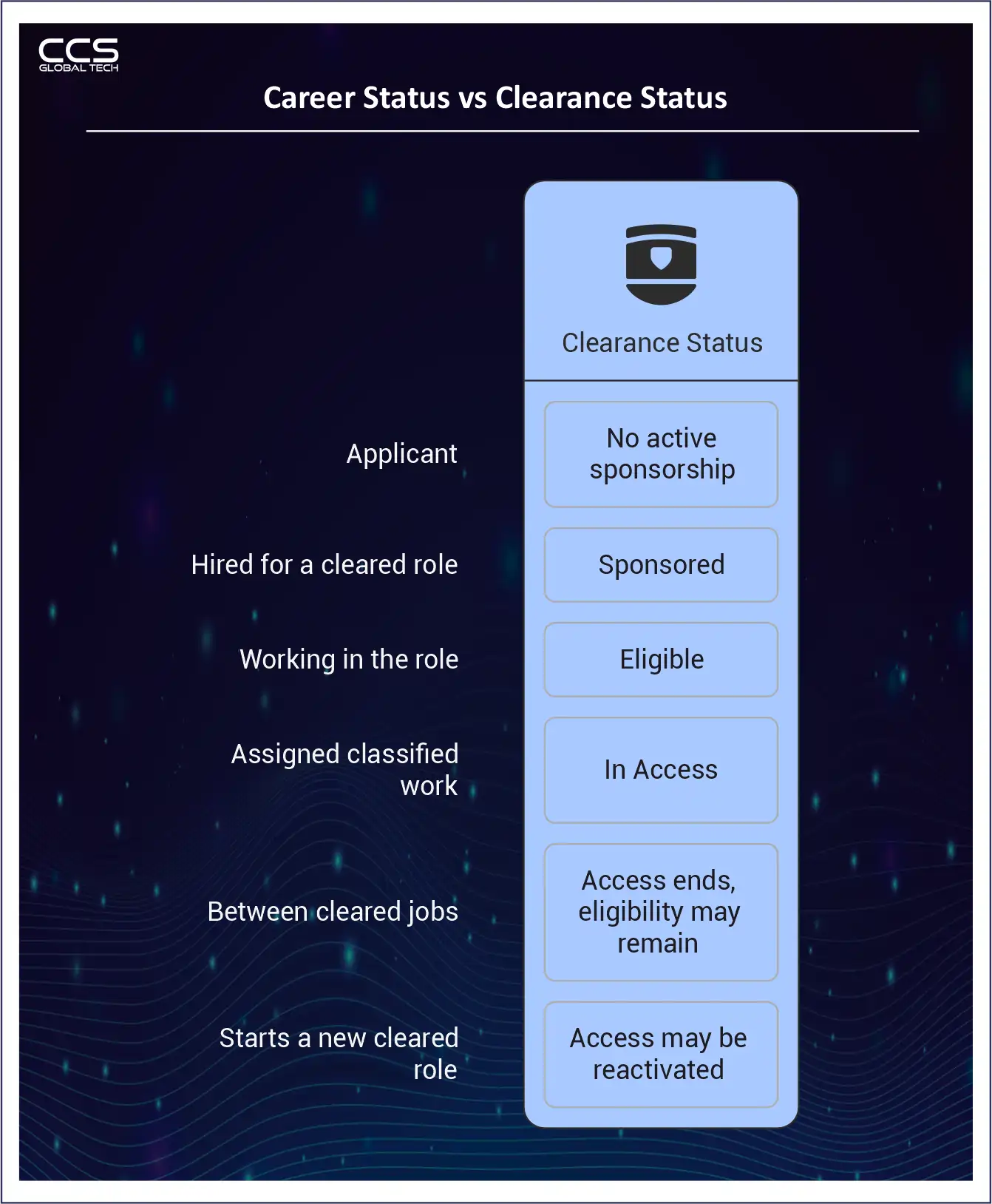
Employment Status and Clearance Status

Your clearance status follows your employment in a cleared role, not your employment in general. You can hold a full-time job in the private sector and keep current eligibility for a while. You can also work for a defense contractor in an unclassified role and hold no active clearance at all.
Leaving a cleared job does not revoke anything. Separation is an administrative termination, which SEAD 7 distinguishes from a denial or revocation. A revocation carries at least a one-year period of ineligibility. An administrative termination carries none. The two are recorded differently for exactly that reason.

How Long Clearance Eligibility Lasts After You Leave a Cleared Job?

The practical timeline after access ends looks like this:

Time since leaving access 

Typical status 

What reactivation involves 

0 to 45 days 

Still enrolled in continuous vetting 

DCSA’s 2026 grace period before CV unenrollment 

45 days to 24 months 

Current eligibility, not in access 

New sponsor requests reinstatement, usually no new investigation 

Beyond 24 months 

Expired or inactive 

Treated as an initial clearance case with a new investigation 

Two details sit behind that table. DCSA now allows a 45-day grace period after affiliation ends before continuous vetting status changes to unenrolled, and it says that status change alone does not alter eligibility. And for cleared industry applicants, DCSA treats a previously terminated clearance older than 24 months as an initial clearance case.
One more clock runs underneath. Continuous vetting stops refreshing your record once you are out of enrollment, so the investigation behind your eligibility starts aging. Every month out of a cleared seat counts against you, and nothing you do alone resets it.

Turning Clearance Eligibility into an Active Clearance

Steps to Reactivate a Security Clearance

Find a sponsor with a real requirement– Only an agency or a contractor with a facility clearance and an open position at your level can request reinstatement. Recruiters, staffing firms without that position, and you personally cannot.
Give the FSO accurate details– Your clearance level, investigation type and date, polygraph type and date if any, and the date you left your last cleared role. Round numbers and guesses slow things down.
Let the FSO verify the record– The FSO checks the system of record, which is DISS for Defense, Scattered Castles for the intelligence community, or OPM’s Central Verification System for other agencies.
Complete any required update– If your five-year questionnaire date has passed or adverse information surfaced, expect to submit an updated questionnaire before reinstatement completes.
Get briefed and sign the SF-312– Access starts here, not at the offer letter.

Common Clearance Reactivation Scenarios

Laid off from a cleared contractor, hired again within a year– The most straightforward case. The new FSO requests reinstatement, and if the record is in order, access follows once you are briefed.
Separating from the military– Separation starts the same 24-month window. Veterans who line up a cleared position before or shortly after leaving service keep the most options.
Moving between Defense and the intelligence community– Reciprocity applies, but programs can add their own requirements, such as a different polygraph or SCI indoctrination, before granting access.
Upgrading from Secret to Top Secret– This is a new investigation at the higher tier, not a reactivation. Your Secret eligibility helps, but it does not substitute for a Tier 5.
Coming back after two and a half years out– Beyond 24 months, plan for a full new investigation and the timeline that comes with it.

Factors That Affect Your Security Clearance Status

Investigation Age and the 2027 Five-Year Questionnaire Rule

The old five-year and ten-year reinvestigation cycles no longer describe how contractor clearances work. DCSA’s 2026 guidance replaced periodic reinvestigations for NISP contractor personnel with continuous vetting plus an updated questionnaire every five years at every eligibility level.
This does not mean clearances last forever. It means an anniversary date alone no longer ends an otherwise favorable eligibility. If you are out of enrollment and the investigation behind your eligibility keeps aging, reactivation gets harder regardless of the questionnaire schedule.

Employment Gaps and Security Clearance Status

A gap in cleared employment is the single biggest risk to your status. The first 45 days carry little consequences. Past that, you are counting down the 24-month window, and your investigation is aging without continuous vetting refreshing it.
The best protection is simple and hard: line up the next cleared requirement before the gap does the damage. If you know a contract is ending, start the search three months out, not the week your badge gets turned in.

Continuous Vetting and Clearance Maintenance
Continuous vetting replaced the long quiet periods between reinvestigations with ongoing automated checks. It works only while you are enrolled, which means it helps you most when you stay in cleared work.
It also changes how reporting works. Issues that once surfaced every five or ten years now surface close to real time. Reporting a problem yourself, with context, is almost always better than having an automated check to find it first.

Common Misconceptions About Security Clearance Status

A candidate tells us she holds a TS/SCI. Her last cleared job ended fourteen months ago. She is not wrong, exactly, and she is not quite right either.

What she holds is eligibility. Whether it becomes an active clearance again depends on a sponsoring employer, a real requirement for access, and a record in a government database that neither she nor we control.
Understanding active clearance vs. clearance eligibility is the difference between describing yourself accurately to a recruiter and losing an offer when the facility security officer runs your record.
The rules also moved this year. DCSA ended legacy periodic reinvestigations for contractor personnel, added a grace period before continuous vetting drops someone, and kept the 24-month window that decides whether you get picked up quickly or start over.
At CCS Global Tech, we work with cleared professionals and service members who are moving into civilian life. We place them on federal contracts each week. You will hear these terms a lot in our intake calls.
This page explains what each label means. It also covers what can change over time. It ends with tips on how to talk about your own status in a clear and truthful way.

Active Clearance vs. Clearance Eligibility at a Glance

Status 

What it means 

Can you work on classified material? 

What it takes to use 

Active 

Eligible, sponsored, and currently in access for a position that requires it 

Yes, within your need-to-know 

Nothing further 

Current 

Eligible, not in access, and inside the 24-month window since leaving access 

No 

A sponsor with a requirement who requests reinstatement 

Expired or inactive 

More than 24 months out of access, or investigation outside scope 

No 

A new investigation, handled as an initial case 

Eligible (adjudicated, never in access) 

Investigation favorably adjudicated, but access never granted 

No 

Sponsorship, need-to-know, briefing, and a signed SF-312 

Keep that table in mind. Every section below explains one of its rows.

What Is an Active Security Clearance?

Definition of an Active Clearance

An active clearance means three things are true at the same moment. You hold a favorable eligibility determination. An employer or agency sponsors you for a position requiring classified access. And you are currently in access, meaning you have been briefed and signed the Classified Information Nondisclosure Agreement, the SF-312.
The SF-312 point surprises people. A favorably adjudicated investigation does not put anyone in access. Access begins after the security briefing and a properly executed nondisclosure agreement, which ODNI explains in its SF-312 guidance. Until then, you are eligible and nothing more.
Active status also stays tied to a position. The organization grants access for specific work and a specific need-to-know. Change programs or lose the requirement, and access can end even though your eligibility record remains.

Requirements to Maintain an Active Clearance

Holding active status is ongoing work rather than a one-time event.
Stay enrolled in continuous vetting– Automated records checks run while you are enrolled, covering criminal, financial, and public records.
Submit the five-year questionnaire update– Under DCSA’s April and May 2026 guidance, NISP contractor personnel no longer undergo legacy periodic reinvestigations. Instead they submit an updated Personnel Vetting Questionnaire, currently the SF-86 eApp and releases, every five years regardless of eligibility level. DISS uses the recorded PVQ date to calculate when the next one is due, not the old investigation date.
Report required events– Foreign travel, foreign contacts, financial trouble, arrests, and other reportable events go to your FSO. Continuous vetting catches many of these anyway, and unreported items found later create a candor problem worse than the original event.
Keep your need-to-know– Access tracks the job. Lose the position and access ends.

What Is Security Clearance Eligibility?

Definition of Clearance Eligibility

Eligibility is the adjudicative decision. After an investigation, an adjudicator reviews the file against the national adjudicative guidelines and decides whether you can be trusted with classified information at a given level. That determination is your eligibility.
Eligibility is what travels with you between jobs. Access does not. When recruiters say a clearance is “portable,” they mean eligibility can be picked up by a new sponsor, usually without a new investigation, as long as it is still inside the window.

How Security Clearance Eligibility Is Obtained?

You cannot apply for a clearance on your own. A government agency or a contractor holding a facility clearance has to sponsor you for a position that requires one.
The sequence runs like this. The sponsor initiates the case. You complete the questionnaire, currently the SF-86 through eApp. Investigators conduct the investigation at the required tier, Tier 3 for Secret or Tier 5 for Top Secret. An adjudicator reviews the results and grants or denies eligibility. For SCI or special access programs, additional steps such as a polygraph and program indoctrination follow.
Processing time varies by level and by agency. We covered current timelines in our post on security clearance processing delays.
How Clearance Status Changes Across Your Career

Key Differences Between Active Clearance and Clearance Eligibility

Current Usage vs. Potential Access

Active clearance describes what you are doing right now: working with classified information under a sponsor. Eligibility describes what you could do if the right position came along.
That difference drives hiring speed. An active candidate can often start on a contract without waiting on reinstatement paperwork. An eligible candidate can usually start soon, but only after a sponsor requests reinstatement and the record transfers.

Employment Status and Clearance Status

Your clearance status follows your employment in a cleared role, not your employment in general. You can hold a full-time job in the private sector and keep current eligibility for a while. You can also work for a defense contractor in an unclassified role and hold no active clearance at all.
Leaving a cleared job does not revoke anything. Separation is an administrative termination, which SEAD 7 distinguishes from a denial or revocation. A revocation carries at least a one-year period of ineligibility. An administrative termination carries none. The two are recorded differently for exactly that reason.

How Long Clearance Eligibility Lasts After You Leave a Cleared Job?

The practical timeline after access ends looks like this:

Time since leaving access 

Typical status 

What reactivation involves 

0 to 45 days 

Still enrolled in continuous vetting 

DCSA’s 2026 grace period before CV unenrollment 

45 days to 24 months 

Current eligibility, not in access 

New sponsor requests reinstatement, usually no new investigation 

Beyond 24 months 

Expired or inactive 

Treated as an initial clearance case with a new investigation 

Two details sit behind that table. DCSA now allows a 45-day grace period after affiliation ends before continuous vetting status changes to unenrolled, and it says that status change alone does not alter eligibility. And for cleared industry applicants, DCSA treats a previously terminated clearance older than 24 months as an initial clearance case.
One more clock runs underneath. Continuous vetting stops refreshing your record once you are out of enrollment, so the investigation behind your eligibility starts aging. Every month out of a cleared seat counts against you, and nothing you do alone resets it.

Turning Clearance Eligibility into an Active Clearance

Steps to Reactivate a Security Clearance

Find a sponsor with a real requirement– Only an agency or a contractor with a facility clearance and an open position at your level can request reinstatement. Recruiters, staffing firms without that position, and you personally cannot.
Give the FSO accurate details– Your clearance level, investigation type and date, polygraph type and date if any, and the date you left your last cleared role. Round numbers and guesses slow things down.
Let the FSO verify the record– The FSO checks the system of record, which is DISS for Defense, Scattered Castles for the intelligence community, or OPM’s Central Verification System for other agencies.
Complete any required update– If your five-year questionnaire date has passed or adverse information surfaced, expect to submit an updated questionnaire before reinstatement completes.
Get briefed and sign the SF-312– Access starts here, not at the offer letter.

Common Clearance Reactivation Scenarios

Laid off from a cleared contractor, hired again within a year– The most straightforward case. The new FSO requests reinstatement, and if the record is in order, access follows once you are briefed.
Separating from the military– Separation starts the same 24-month window. Veterans who line up a cleared position before or shortly after leaving service keep the most options.
Moving between Defense and the intelligence community– Reciprocity applies, but programs can add their own requirements, such as a different polygraph or SCI indoctrination, before granting access.
Upgrading from Secret to Top Secret– This is a new investigation at the higher tier, not a reactivation. Your Secret eligibility helps, but it does not substitute for a Tier 5.
Coming back after two and a half years out– Beyond 24 months, plan for a full new investigation and the timeline that comes with it.

Factors That Affect Your Security Clearance Status

Investigation Age and the 2027 Five-Year Questionnaire Rule

The old five-year and ten-year reinvestigation cycles no longer describe how contractor clearances work. DCSA’s 2026 guidance replaced periodic reinvestigations for NISP contractor personnel with continuous vetting plus an updated questionnaire every five years at every eligibility level.
This does not mean clearances last forever. It means an anniversary date alone no longer ends an otherwise favorable eligibility. If you are out of enrollment and the investigation behind your eligibility keeps aging, reactivation gets harder regardless of the questionnaire schedule.

Employment Gaps and Security Clearance Status

A gap in cleared employment is the single biggest risk to your status. The first 45 days carry little consequences. Past that, you are counting down the 24-month window, and your investigation is aging without continuous vetting refreshing it.
The best protection is simple and hard: line up the next cleared requirement before the gap does the damage. If you know a contract is ending, start the search three months out, not the week your badge gets turned in.

Continuous Vetting and Clearance Maintenance

Continuous vetting replaced the long quiet periods between reinvestigations with ongoing automated checks. It works only while you are enrolled, which means it helps you most when you stay in cleared work.
It also changes how reporting works. Issues that once surfaced every five or ten years now surface close to real time. Reporting a problem yourself, with context, is almost always better than having an automated check to find it first.

Common Misconceptions About Security Clearance Status

"Current" vs. "Active": The Most Misused Clearance Terms

Candidates use these words interchangeably. FSOs do not. “Active” means you are in access today. “Current” means you are eligible, out of access, and inside the window. Calling a current clearance active on a resume creates a mismatch the FSO will find in the first records check.
Job postings add a third meaning. If a job listing says “clearance eligible,” it usually means the employer is willing to sponsor the person through the required checks. It does not always mean the candidate already has an adjudicated clearance. Take a close look at the wording. If anything is unclear, contact the recruiter and ask what they expect.

Can You Hold Clearance Eligibility Without a Job?

Yes, for a limited time. Eligibility survives the end of a cleared job, which is what makes the 24-month window meaningful. What you cannot do is keep it alive without a sponsor, sponsor yourself, or pay to have it maintained.
Anyone offering to “hold” your clearance without a genuine requirement for access is describing something the system does not allow.

What the Distinction Means for Cleared Job Seekers?

How Active Clearances Affect Hiring Decisions?

Hiring managers on federal programs care about time to productive work, and active status shortens it most. On a contract with open billets and a customer watching fill rates, a candidate who can be in access in days wins over an equally qualified candidate who needs weeks of reinstatement.
That speed premium is why recruiters ask when your last cleared role ended before they ask almost anything else. They are estimating how quickly you can start billing.

Clearance Eligibility as a Competitive Advantage

Current eligibility is still a significant advantage. A candidate who needs reinstatement is far ahead of one who needs a brand new Top Secret investigation, which can take many months.
To use that advantage well, state your status precisely, give dates, and apply before the window gets short. A candidate at month six of the window gets treated very differently from one at month twenty-two.

How to Describe Your Clearance Status on a Resume?

Precision builds trust. Vague claims get checked and discounted. Here is wording we recommend to candidates:

Your situation 

Write it like this 

In access today 

Active TS/SCI with CI polygraph, in access through present 

Out of access, inside 24 months 

Current TS/SCI eligibility, last in access March 2026 

Out of access, beyond 24 months 

Previously held TS/SCI, last in access 2023 

Adjudicated but never briefed 

Favorably adjudicated for Secret eligibility, not yet in access 

Include the investigation type and date if you know them, and the polygraph type and date if you had one. Leave out anything sensitive, such as your SSN or case numbers.
If you are unsure of your exact status, say “last in access” with a date and let the FSO confirm the rest, or request your records from DCSA through a Privacy Act request, as ClearanceJobs outlines in its guide to checking clearance status.

Protect Your Window

If you hold current eligibility, the most valuable thing you own is time. Write down the date your last cleared role ended, count forward 24 months, and start your search with that date in view rather than after most of it is gone.
If you are still in access and a contract end is coming, start looking three months ahead. The candidates who move directly from one cleared seat to the next keep continuous vetting running and never face the question at all.
CCS Global Tech works with transitioning veterans and cleared professionals across federal programs, and we partner with Hire Heroes USA and REBOOT on veteran employment.
Our veteran staffing team can help you place your eligibility with a sponsor while the window is still open.

Frequently Asked Questions

Q1- What is the difference between an active clearance and clearance eligibility?

A- Eligibility is the adjudicative decision that you can be trusted with classified information at a given level. An active clearance means you hold that eligibility, have a sponsor with a requirement, and are currently in access after a briefing and a signed SF-312. 

A- Generally 24 months. DCSA also allows a 45-day grace period before continuous vetting unenrolls you. Beyond 24 months, DCSA treats a terminated industrial clearance as an initial case requiring a new investigation. 

A- No. Only a government agency or a contractor with a facility clearance and a position requiring your level can request reinstatement. The Facility Security Officer manages the process and verifies your record in the system of record. 

A- Not for NISP contractor personnel. DCSA’s April and May 2026 guidance replaced legacy periodic reinvestigations with continuous vetting plus an updated Personnel Vetting Questionnaire every five years, regardless of eligibility level. 

A- Current means you hold eligibility but are not in access, and you are still inside the 24-month window since leaving access. A new sponsor can usually request reinstatement without a new investigation. 

A- No. Separation is an administrative termination, which SEAD 7 distinguishes from a revocation. It starts the 24-month window but carries no period of ineligibility, unlike a revocation. 

A- Usually that the employer will sponsor a candidate able to pass an investigation. It does not always mean you must already hold adjudicated eligibility. Ask the recruiter to confirm what the posting requires. 

A- Ask a Facility Security Officer, current or former, to verify your record in DISS or the relevant system. You can also submit a Privacy Act request to DCSA for your investigation and adjudication records. 

A- No. Moving to Top Secret requires a new Tier 5 investigation. Existing Secret eligibility helps the process but does not replace the higher-level investigation. 

A- No. Use “current” with the date you were last in access. Calling a clearance active when you are out of access creates a mismatch the FSO will find in the first records check, and it costs credibility.