


Skip to content

Veteran Employee Retention: Strategies for Federal Contractors

Veteran Employee Retention A Guide for Federal Contractors
Most articles about keeping veteran staff start with the same stat: 43 percent of veterans leave their first civilian job within a year, and as many as 80 percent leave within two years.
Before you plan any kind of retention effort, it helps to look at two parts of that figure. First, the number traces back to a VetAdvisor and Syracuse University IVMF survey. Roughly 1,400 vets took part. The survey took place from December 2013 to February 2014. The pattern is real. The percentages are twelve years old.
And it usually gets read backward. A Center for a New American Security analysis, based on three surveys of nearly 1,800 veterans, managers, and recruiters, found that veteran turnover is comparable to civilians starting their first full-time job, and that most departures were for positive reasons: more money, more responsibility, a better location.
The researchers found no indication that veterans leave for negative reasons tied to their veteran status.
So, veterans are not hard to keep. First, civilian jobs frequently underuse them, and people who are underused leave. That distinction changes what you should do about it.
For federal contractors, retention also carries weight most employers never face. It is written into your compliance obligations, and the rules changed twice in the last eighteen months.

Why Veterans Leave Federal Contractor Roles?

Research in the Journal of Veterans Studies found that veterans who perceived themselves as underemployed were significantly more likely to experience turnover, and those who were both underemployed and dissatisfied with compensation were more likely still.
The IVMF survey pointed the same way. Most people, nine in ten, said the top part of civilian work was getting a chance to use what they learned in the service. The main problem they pointed to was tougher. They struggled to find jobs that fit what they were trained to do in the military.
Federal contracting has a specific version of this problem. A former Air Force cyber operator with a TS/SCI clearance gets placed on a tier-one help desk because the clearance cleared the requisition, and nobody read the rest of the record. The billet fills. The person leaves in seven months.
The clearance is access, not qualification. Treating it as the qualification is the most expensive mistake in cleared staffing, and it arrives as turnover roughly eight months later.

How Veteran Retention Affects Your Recompete and Past Performance?
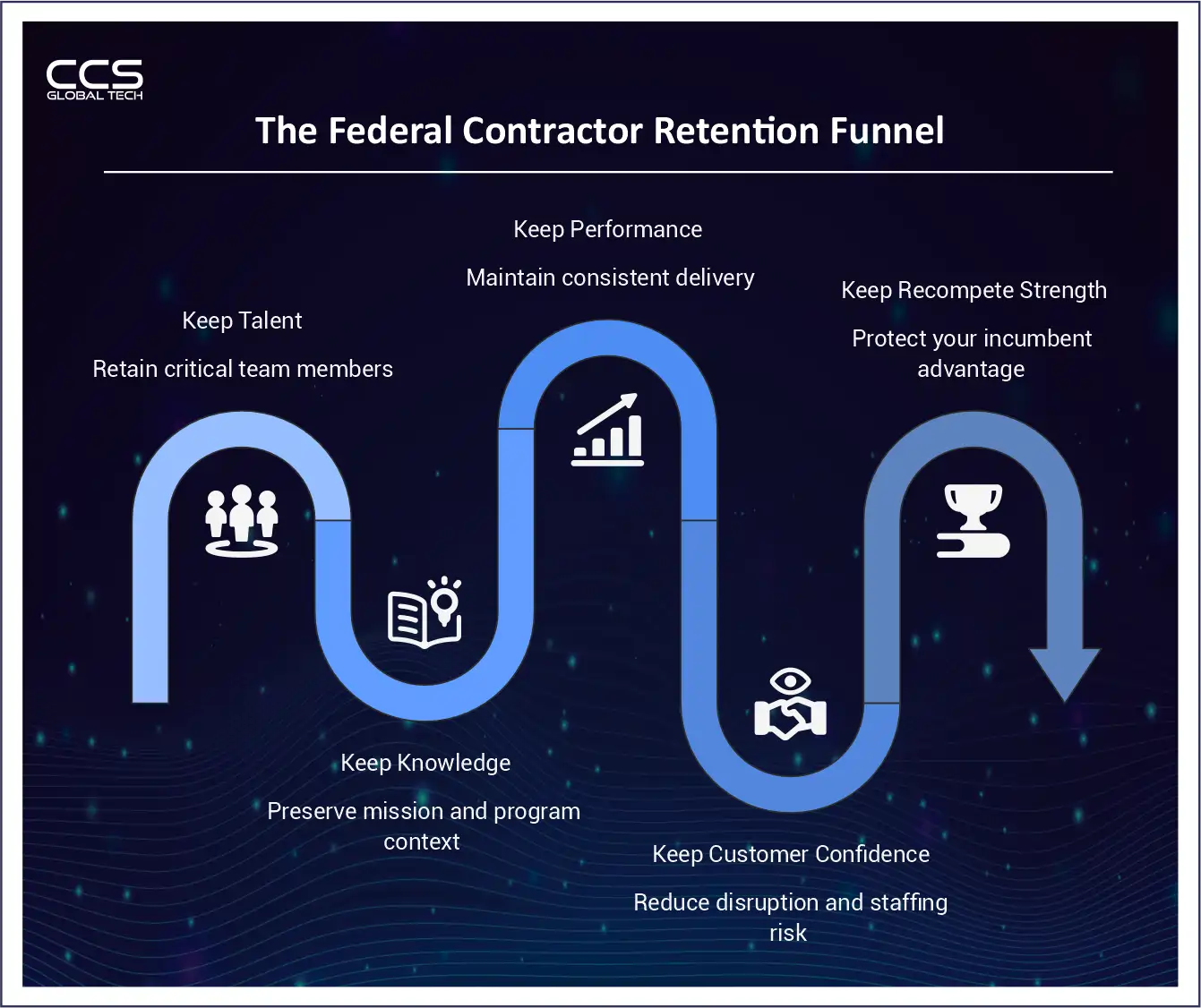
Retention is not only an HR cost line for a federal contractor. It shows up in your bids.
Past performance narratives depend on continuity– An evaluator reading about a program that churned through three lead engineers in two years draws a conclusion about your execution risk. Stable teams read as lower risk, and in best-value procurements that difference is scorable.
Key personnel commitments are retention commitments– When you name individuals in a proposal, you are betting they will still be there at award and through the base year. Losing named key personnel between submission and start creates substitution requests that cost credibility with the contracting officer.
Ramp cost is real money– Replacing a cleared engineer mid-program means requisition time, clearance verification, onboarding, and a productivity gap. On a firm-fixed-price contract you absorb the whole thing.
Incumbent capture depends on the people– When a contract recompetes, the incumbent’s advantage is a team that already knows the mission. If half that team left in the preceding year, the advantage is gone and so is much of the win probability.
This reframes the business case. Veteran retention spending is not a benefits expense competing with other benefits. It protects revenue you have already won.
The Federal Contractor Retention Funnel

9 Veteran Employee Retention Strategies for Federal Contractors

1. Match the Role to Demonstrated Scope, Not the Clearance

Read the full record before placing anyone. A staff sergeant who ran a maintenance section supervised people, managed a budget, and owned readiness reporting. That is a supervisory profile.
Ask two questions at intake: what did you own, and how many people or systems depended on you. The answers usually reveal a gap between what the person did and what the requisition offers.
When there is a gap, name it. “This role sits below your last scope, and here is the path to the one that matters in 14 months” retains people. Silence does not.

2. Build the Career Path Before the Start Date

Lack of advancement is the reason veterans cite most consistently for leaving. Military careers run on visible progression: rank, time in grade, published requirements. Contract work often looks arbitrary next to that.
Give every veteran hire a written path at 30 days covering the next role, its requirements, and roughly when it becomes available. Vagueness reads as absence. Someone who cannot see the next step assumes there is not one.

3. Treat Contract Transitions as a Retention Event

This one is specific to your business, and most contractors handle it badly.
When a contract ends, recompetes, or changes scope, your veteran employees face uncertainty resembling the transition they already went through once. Handled well, a contract end becomes an internal move. Handled badly, it becomes a resignation to whoever called first.
Start redeployment conversations 90 days before contract end, not two weeks. Keep a bench view of who is coming available and which programs need them. Contractors who do this hold people across contracts for years.

4. Protect Clearance Continuity

A clearance lapse is a retention event disguised as paperwork. Cleared professionals know their clearance is their most portable asset, and they act quickly when it looks at risk.
Set recurring review dates and handle them like you do contract check points. When someone switches from one program to another, explain how the two parts overlap and how they support each other, in simple terms.
If a gap between assignments is coming, say what happens to the clearance during that window before the employee asks. Uncertainty here sends people to recruiters faster than compensation does.

5. Assign a Veteran Mentor in Week One

Match every new veteran hire with a person who went through the same shift two to five years ago. This is not a first week shadowing plan. It is a steady contact for the first year. The point is translation.
A mentor can explain why a program manager writes a command as a question. A mentor can also clarify when “let’s review this” is really a no. They can point out which meetings pull real weight. That kind of know how does not show up in a handbook. It can be the difference between feeling capable and feeling stuck by the third month.

6. Train the Managers, Not Just the Veterans

Most veteran programs train the veteran to adapt and leave the manager untouched. That is backwards, because the manager controls the daily experience.
Managers need three things. An understanding of what a military role actually involved, so they stop under-assigning work. Awareness that direct, concise communication is a norm rather than bluntness.
And clarity on what they cannot ask about disability, deployment, or Guard and Reserve obligations. That third item protects the employee and protects you.

7. Use Your VEVRAA Outreach Partners for Retention

VEVRAA requires documented outreach to veteran organizations under 41 CFR 60-300.44(f). Most contractors treat it as a recruiting checkbox.
Those same relationships support retention. Veteran service organizations run mentorship networks, certification support, and peer communities your employees can use after hire. Invite partners to speak internally.
Sponsor certification paths through them. The compliance documentation writes itself and the employee gets something real.

8. Run Stay Interviews at 60 Days, 6 Months, and 12 Months

Exit interviews explain departures after they are irreversible. Stay interviews catch the problem while it is still a conversation.
Three questions do most of the work. What part of your military experience are you not using here? What would make you take a recruiter’s call? What surprised you about working here?
The first question predicts turnover better than any engagement score, because it measures the underemployment gap directly.

9. Build a Pipeline Through SkillBridge

DoD SkillBridge lets service members spend up to their final 180 days of service in a civilian work placement while the military continues paying them.
For retention, the value is the trial period on both sides. The service member learns what the work actually involves before committing, and you see performance before extending an offer.
People who arrive through a SkillBridge placement start with realistic expectations, which removes the expectation gap that drives a good share of first-year departures.

Military Spouse Retention Strategies for Federal Contractors
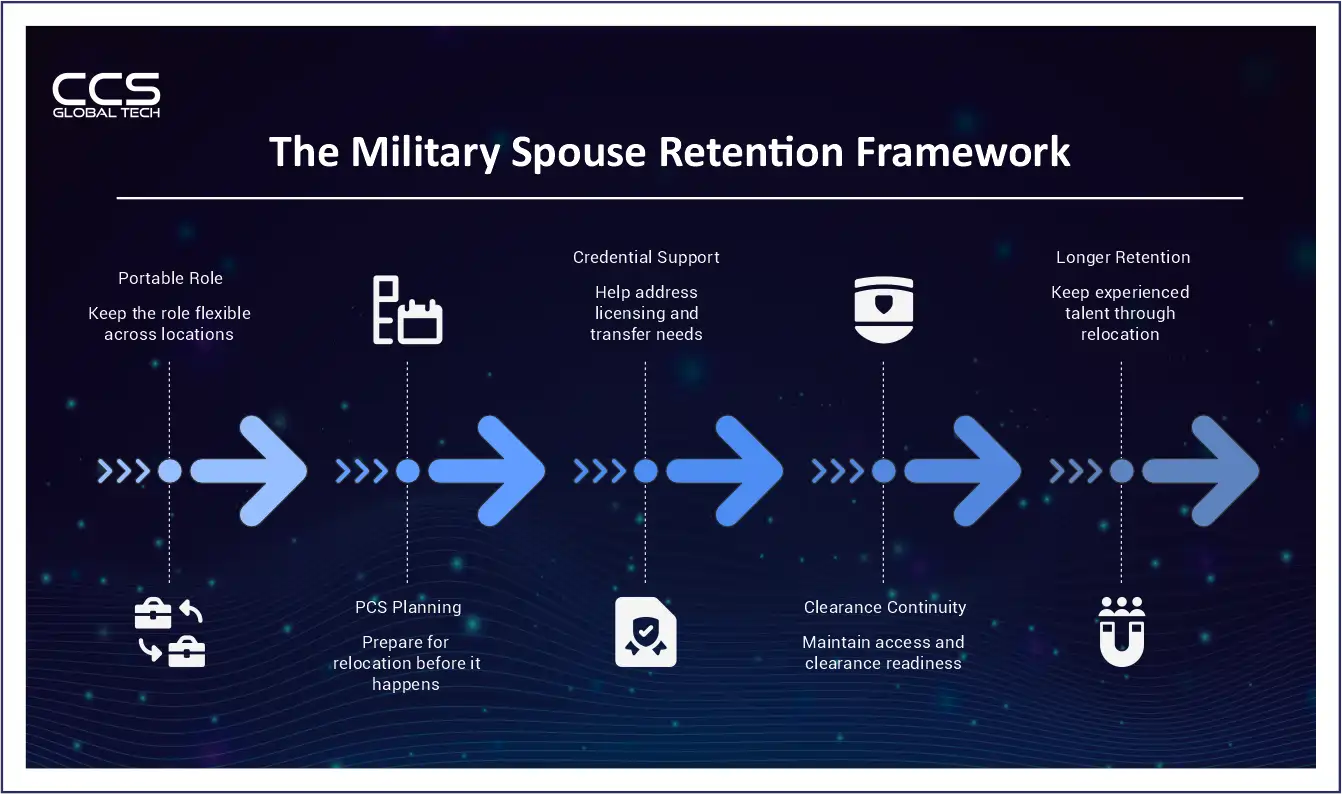
Military spouses are the most overlooked part of this workforce and often the hardest hit by rigid policies.
The structural problem is relocation. A PCS move every two to three years ends most traditional careers, which is why spouse underemployment runs far above the civilian rate. For a contractor, that mobility can be an asset rather than a liability if your policies allow it.
Make roles portable where the contract allows– If the work can be performed remotely under the contract’s security requirements, say so explicitly in the job description and the offer. A spouse who knows the role survives a PCS stays through one.
Plan for the move instead of reacting to it– Spouses usually know about a PCS months ahead. Ask, and build the transition rather than receiving a resignation.
Join the Military Spouse Employment Partnership– MSEP, run through the Defense Department’s Spouse Education and Career Opportunities program, connects employers with spouse candidates. It is a recruiting channel and a retention signal at the same time.
Check state licensing and credential portability– For roles requiring certification, know what transfers across state lines. A spouse who cannot practice after a move leaves a job they otherwise wanted.
Recognize the security clearance advantage– Many spouses hold clearances or are straightforward to clear given their existing background. In a market where clearance timelines drive staffing risk, that matters.

The First 90 Days of Veteran Retention

Most turnover decisions form early, long before the resignation.

Timeframe 

What should happen 

Before day one 

Role scope confirmed against actual military responsibility; mentor assigned; manager briefed 

Week 1 

Mentor introduction; clear explanation of how work gets assigned and reviewed 

Day 30 

Written career path conversation; clearance timeline explained 

Day 60 

Formal stay interview; check whether assigned work matches capability 

Day 90 

Scope adjustment if the role runs below capability; confirm next-step timing 

The day 90 scope adjustment is the highest-leverage item on that table and the one most often skipped, because a quietly overqualified person rarely complains. They just take the next call.

Veteran Retention Metrics Federal Contractors Should Track

Track each of these separately for protected veterans and for everyone else. The comparison is the finding.
Retention at 12 and 24 months– The two-year mark is where the historical pattern shows the gap.
Retention by program and by manager– Company-level numbers hide the contract or supervisor where the problem sits.
Internal mobility rate– Share of veteran employees who moved to higher-scope roles within 18 months. This is the direct counter to the advancement complaint.
Time from hire to first scope increase– A long interval predicts departure.
Key personnel retention through base year– Directly tied to proposal credibility.
Self-identification rate– Required for VEVRAA reporting and a signal in itself. Low self-ID usually means employees are unsure how the data will be used.
Capture a baseline before changing anything. Without it you cannot show OFCCP an assessment or show your CFO a result.

Veteran Retention Mistakes That Cost Federal Contractors

Hiring to the benchmark and stopping– The 5.1 percent benchmark measures hiring. It says nothing about whether those people are still there in 18 months.
Treating the clearance as the qualification– Placing cleared veterans below demonstrated scope produces turnover on a predictable schedule.
Thanking people for their service and nothing else– Recognition without advancement reads as decoration. Veterans notice the distance between the Memorial Day post and the promotion list.
Letting contract transitions surprise people– A 90-day notice keeps someone. A two-week notice loses them.
Skipping manager training– The manager determines the daily experience. Training the veteran alone puts the burden on the person with the least control.
Assuming spouse roles cannot be portable– Many can be, within the contract’s security terms. Not asking the question costs you the employee at the next PCS.

The Final Say

Pull one number this week: 24-month retention for protected veterans against 24-month retention for everyone else, cut by program. If there is a gap, the next question is whether the roles matched the scope those people actually brought.
That single comparison usually tells you more than a new program would, and it gives you something to show during a compliance evaluation.
CCS Global Tech has placed veterans and cleared professionals across federal, state, and local programs since 1997, and partners with Hire Heroes USA and REBOOT on veteran employment.
Our veteran staffing team works on role match rather than requisition fill, because the second one comes back as turnover. Need more clarity?

Frequently Asked Questions

Q1- Why do veterans leave their first civilian job?

A- Most cite lack of advancement and work that does not use their military skills. Research links underemployment directly to higher turnover. Analysis also shows many departures are for positive reasons such as better pay or responsibility, which points to role mismatch rather than poor adjustment. 

A- VEVRAA requires covered contractors to take affirmative action to recruit, hire, promote, and retain protected veterans. Most compliance programs concentrate on hiring, but retention and advancement sit inside the same statutory obligation. 

A- The national benchmark is 5.1 percent, effective July 30, 2025, down from 5.2 percent. Contractors may instead set a custom benchmark using local veteran availability and their own hiring data under OFCCP’s regulations. 

A- No. Executive Order 11246 covered race and gender affirmative action and was rescinded in 2025. VEVRAA is a statute passed by Congress, so its benchmark and tracking duties remain in force. Compliance evaluations resumed in July 2025. 

A- Basic duties apply at $200,000, raised from $150,000 on October 1, 2025. A written affirmative action program is required at $200,000 plus 50 or more employees. 

A- No. The benchmark is an assessment tool. Findings come from failing to assess outreach, document the analysis, and act on it. A documented gap with a plan is defensible. 

A- Past performance narratives depend on team continuity, key personnel commitments assume those people stay, and incumbent advantage rests on a team that knows the mission. Heavy turnover in the year before a recompete erodes all three. 

A- Match the role to demonstrated scope rather than the clearance, protect clearance continuity between assignments, start redeployment conversations 90 days before contract end, and provide a written advancement path. Cleared professionals have the most outside options. 

A- SkillBridge lets service members spend up to their final 180 days in a civilian work placement while the military continues paying them. Both sides get a trial period, which removes the expectation gap driving many first-year departures. 

A- Make roles portable across a PCS where contract security terms allow, plan for announced moves instead of reacting, join the Military Spouse Employment Partnership, and check credential portability across states for licensed roles.