

Skip to content

How Staffing Delays Put Federal Contract Performance at Risk?

How Staffing Delays Put Federal Contract Performance at Risk
You won the award. The performance period started three weeks ago. Eleven of your nineteen billets are filled.
Every week that gap stays open, three things happen at once. You do not bill the hours. The government notices. And the record of that gap goes into a file that will be read during your next recompete.
Staffing delay is usually treated as a recruiting problem inside federal contracting organizations. It is a contract performance problem that happens to be staffed by recruiters, and the distinction matters because the remedies sit in different places.
This post covers where federal staffing delays come from in 2026, what they actually cost across the contract lifecycle, and what reduces them.

Why Staffing Delays Are Structural in Federal Contracting?

The binding constraint on most cleared programs is not candidate supply. It is the personnel vetting system.
The Security, Suitability, and Credentialing Performance Accountability Council reported government-wide end-to-end processing of 104 days for a Secret clearance in its FY 2026 Q1 progress report, with Top Secret at 205 days.
DCSA industry figures for the same period ran higher, at 156 days for Secret and 227 days for Top Secret, and those figures describe the fastest 90 percent of cases. The remaining tenth takes longer, sometimes considerably.
Set that against the statutory aim. The Intelligence Reform and Terrorism P+9-revention Act established a 60-day timeliness goal. Actual performance runs two to four times that for Secret and well beyond it for Top Secret.
Three details matter more than the headline averages for anyone building a staffing plan:
  • Adjudication is now the bottleneck– DCSA’s Q1 FY 2026 data showed investigation processing improving year over year while adjudication timelines increased. A faster investigation sitting in an adjudication queue produces no improvement for the program manager waiting on a start date. 
  • Reciprocity underdelivers– Trusted Workforce 2.0 promised “clear once, trusted everywhere.” Moving an already-cleared person between employers should take 30 to 75 days. In practice it frequently runs 90 to 150 days because of document transfer and security file review between agencies. Better than a fresh investigation, and not the instant handover the policy implied. 
  • Polygraph and program-specific vetting stack on top– For a candidate who does not already hold TS/SCI with polygraph, planning ranges run 12 to 18 months. No recruiting process compresses that. 
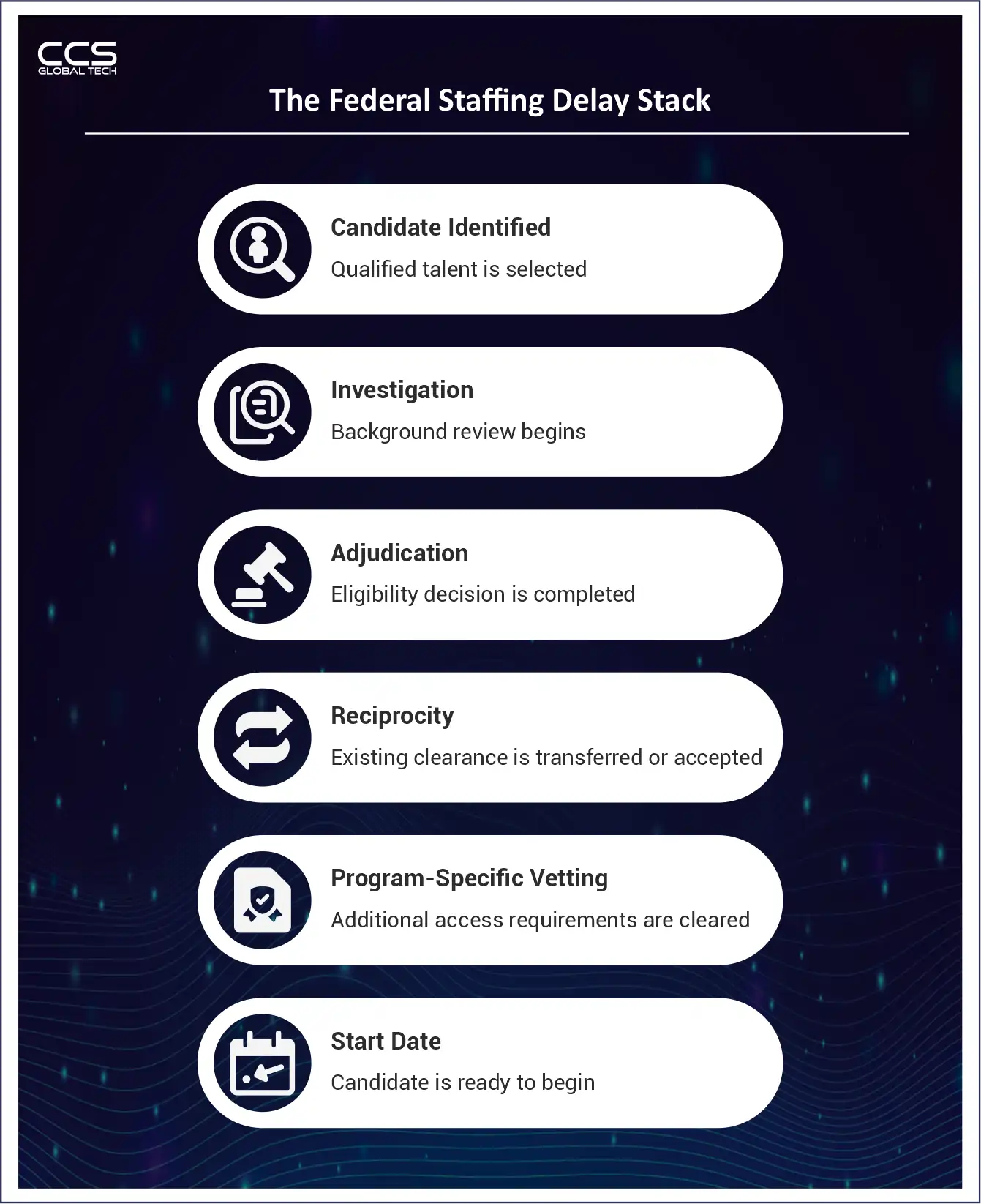
The Federal Staffing Delay Stack

The 2026 Reporting Change That Will Make Clearance Timelines Look Worse

This one has barely been covered and it will affect staffing plans written this year.
The Performance Accountability Council has historically reported timeliness based on the fastest 90 percent of cases. Beginning with the FY 2026 Q3 report, the council is revising that basis to cover 100 percent of cases and has stated that the change will decrease reported timeliness. The accompanying metrics supplement puts it more directly: timeliness will be hurt.
Nothing about the underlying process is getting slower. The measurement is getting honest.
Two practical consequences. If your staffing plan, your bid assumptions, or your customer commitments rest on figures published before Q3 FY 2026, the numbers you quote next quarter will look like a regression that never happened. And if you are briefing a contracting officer on expected fill timelines, say now that the reporting basis is changing. Explaining it in advance is a credibility builder. Explaining it afterward sounds like an excuse.
There is a related measurement problem worth knowing about. The council’s FY 2026 Q1 report put government-wide Secret end-to-end at 104 days. Its Q2 report printed 92 days for that same quarter, with no note acknowledging the revision. Twelve days will not break a hiring plan, but it tells you something useful: there is no single authoritative processing time to plan against. Build ranges, not point estimates.

How Staffing Delays Damage Federal Contract Performance?

The costs arrive in a sequence, and most contractors only feel the first one.
Unbilled revenue- On time-and-materials and labor-hour contracts, an empty billet bills nothing. A single unfilled senior engineer position at a $165 loaded hourly rate costs roughly $28,600 a month in revenue you already competed for and won.
Work redistributed to the wrong people- Staff already on the contract absorb the gap. Senior people perform junior work, quality drifts, and the highest performers, who have the most outside options, start taking calls.
Deliverable slippage- Once milestones move, the conversation shifts from staffing to performance. The government stops asking when you will fill the role and starts asking whether you can execute.
Formal contract remedies- Persistent shortfalls draw a cure notice or a show cause notice. Both create a documented record and a deadline. Service contracts commonly allow deductions for unperformed work, so the shortfall becomes a reduction in payment rather than a deferral.
CPARS- This is the expensive one, and it outlives the contract. Performance assessments feed the past performance record agencies evaluate on future solicitations. A marginal rating tied to staffing follows you into every bid for years, and it is far harder to remove than to earn.
Recompete position- Incumbent advantage rests on a team that knows the mission. A contract that ran understaffed gives an evaluator a reason to view your execution as risky and a competitor a story to tell against you.
The cost sequence is worth internalizing, because the last two items are typically 10 to 50 times more expensive than the first, and they are the ones that never appear in a staffing report.

Where Federal Staffing Delays Actually Originate

Source of delay 

What it looks like 

Typical impact 

Clearance processing 

Candidate accepted, waiting on investigation or adjudication 

3 to 12 months depending on tier 

Reciprocity friction 

Cleared candidate moving between agencies or employers 

90 to 150 days against an expected 30 to 75 

Key personnel attrition 

Named staff take other roles between proposal and award 

Immediate substitution request 

Compressed phase-in 

30-day transition on a contract needing 60 

Shortfall visible on day one 

Requisition mismatch 

Labor category written to the RFP rather than the market 

Positions that cannot be filled at the bid rate 

Compensation lag 

Bid rates set 9 to 18 months before performance 

Offers declined, restart of search 

Incumbent capture failure 

Existing staff not retained through transition 

Full rebuild of a working team 

Slow internal approvals 

Offer approval chains measured in weeks 

Candidates accept elsewhere 

The bottom four are within your control and they cause more delay in aggregate than clearance processing does. That is an uncomfortable finding and a useful one, because clearance timelines are weather and internal process is a decision.

The Phase-In Period Where Staffing Delays Become Performance Failures

Transition is where most federal staffing problems turn into contract problems.
Phase-in periods are frequently compressed, sometimes to 30 days on programs that realistically need 60 to 90. The work in that window is substantial: onboarding, badging, system access, clearance crossovers, and incumbent capture conversations, all running in parallel while the outgoing contractor’s team decides whether to stay.
Three failure patterns repeat:
Incumbent capture treated as a formality. Assuming the incumbent’s staff will roll over, then discovering in week two that the losing contractor made retention offers in week one. Start those conversations the day after award, not the week before transition.
Badging and access treated as administrative. A cleared person who cannot get on site or into the system is not billable. These processes have their own queues and they do not compress because your schedule is tight.
No shortfall communication plan. The contracting officer learns about the gap from a status report rather than from you. A staffing risk you raise yourself with a mitigation plan attached is a management conversation. The same risk discovered independently is a performance conversation.

Key Personnel Risk When Named Staff Do Not Start
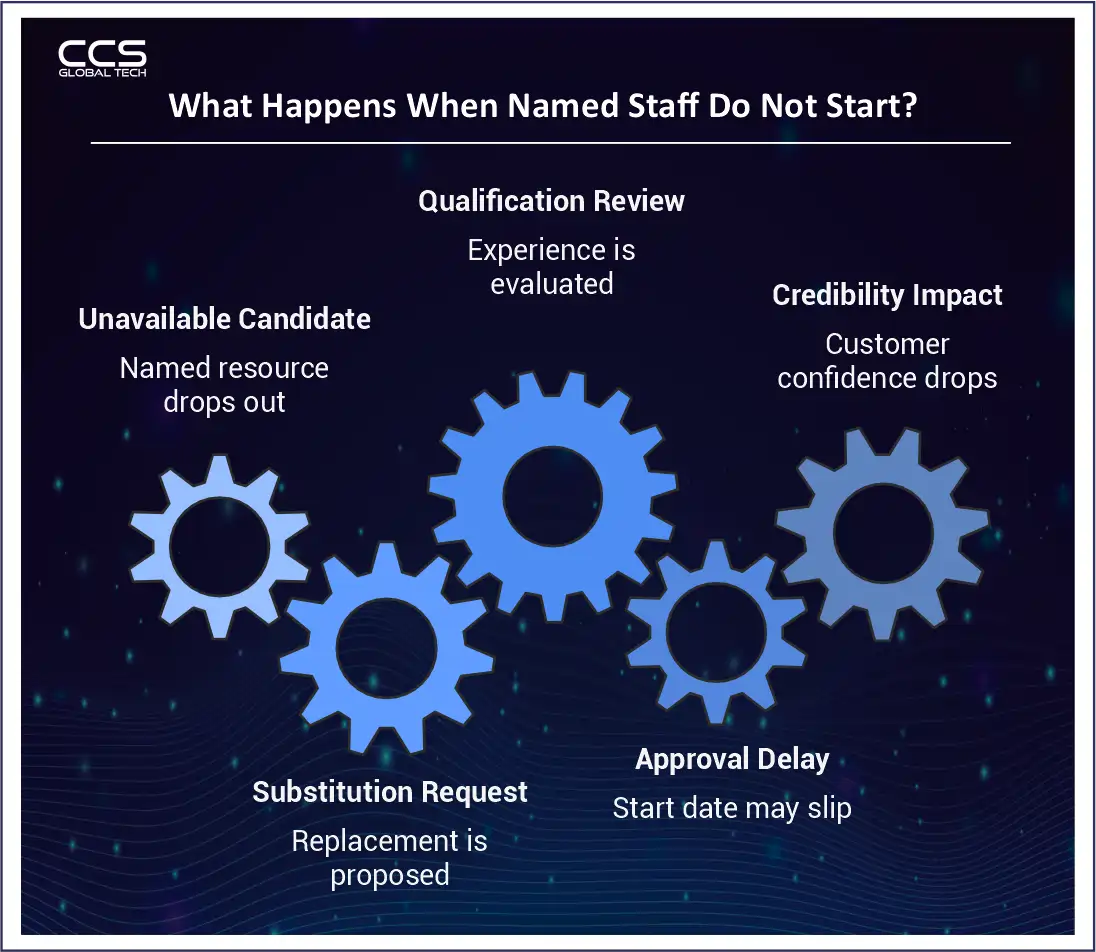
Naming individuals in a proposal creates a commitment you carry into performance, and the gap between submission and start is where that commitment breaks.
Federal solicitations routinely require key personnel by name with resumes and commitment letters. Award can come six to twelve months after submission. People move.
When named key personnel do not start, you submit a substitution request, the contracting officer evaluates whether the replacement is equally qualified, and you spend credibility you would rather save. Repeated substitutions across contracts build a reputation that affects how future proposals get read.
Four practices reduce the exposure. Keep contact with named individuals on a defined cadence between submission and award rather than going quiet after the letter is signed. Identify a qualified alternate for each key position before you need one.
Be explicit in the proposal about the timeframe a commitment covers. And when someone does become unavailable, notify the contracting officer promptly with a substitute already identified, because the speed and completeness of that notification is what the customer remembers.

8 Strategies to Reduce Staffing Delays on Federal Contracts

1. Start Clearance Processing Before You Need the Person

The single highest-leverage change most contractors can make. Sponsor candidates against anticipated need rather than against a filled requisition, where the contract vehicle and your own risk tolerance allow it. A pipeline of in-process candidates converts a 156-day problem into a 30-day problem at the moment of award.

2. Build the Staffing Plan Against Ranges, Not Averages

Published processing times describe the fastest 90 percent of cases. Plan against the slower tail. Use a range for each labor category by clearance tier, state the assumption in your internal plan, and revisit quarterly, particularly given the reporting basis change arriving in FY 2026 Q3.

3. Maintain a Cleared Bench

Bench cost is real and so is the alternative. A small cleared bench covering your most frequent labor categories converts award-to-start from a recruiting cycle into a reassignment. The calculation is simple: compare bench carrying cost against unbilled revenue plus the CPARS exposure of a 90-day vacancy.

4. Price Compensation to Performance, Not to Bid Date

Rates set 9 to 18 months before performance frequently lose to the market by the time you are hiring. Review compensation assumptions between submission and award, and build escalation into your pricing where the vehicle permits. A position that cannot be filled at the bid rate is a staffing delay you created at pricing.

5. Start Incumbent Capture on Award Day

The incumbent’s staff already hold the clearances, the badges, the system access, and the mission knowledge. They are also being called by the losing contractor. Have a named owner, a prepared message, and a compensation position ready before award, not after.

6. Compress Your Internal Approval Chain

Measure the elapsed time from candidate acceptance to signed offer. Anything past five business days is losing you candidates in a market where cleared professionals hold multiple offers. This is the cheapest fix available and it requires a decision rather than a budget.

7. Write Requisitions to the Market, Not Only to the RFP

In many bids, the job descriptions in the solicitation are copied, and they end up pointing to a person who is not actually needed at the number you put in. Ask a recruiter to check each requisition for whether it can be filled before it is posted. If there is a mismatch, mark it early so the team can still change the plan.

8. Report Staffing Risk Before the Customer Finds It

Send the contracting officer a monthly staffing update. List the roles that are already filled. Also note the candidates in progress and the date you expect them to start. Include any open gaps and what you plan to do to close them. Contractors who do this get treated as partners managing a hard problem. Contractors who go quiet get cure notices.

Federal Staffing Metrics That Predict Performance Risk

Time to fill by clearance tier. One number for the whole portfolio hides everything. Track uncleared, Secret, TS, and TS/SCI with polygraph separately.
Time from acceptance to start. Isolates clearance and onboarding drag from recruiting drag. These need different fixes.
Fill rate at end of phase-in. The single best predictor of first-year performance problems.
Offer acceptance rate. A falling rate usually means your compensation assumptions have aged out.
In-process pipeline depth by labor category. How many candidates are in clearance processing against anticipated need.
Key personnel retention from proposal to 6 months post-award. Directly tied to substitution risk and customer credibility.
Vacancy days by contract. Convert to unbilled revenue so the finance conversation uses one number everyone recognizes.
Baseline these before changing anything. Without a baseline you cannot show improvement to a customer or a result to your CFO.

The Final Say

Pull two numbers this week. Your fill rate at the end of phase-in for the last three contracts you started, and your median elapsed time from candidate acceptance to signed offer.
The first tells you whether staffing delay is already affecting performance. The second tells you how much of the problem is yours to fix rather than the vetting system’s. Most contractors find the second number more uncomfortable than they expected, which is good news, because internal process is the part you control.
CCS Global Tech has staffed federal, state, and local programs since 1997, including cleared placements for defense and intelligence customers. Our federal staffing team works on pipeline depth and phase-in readiness rather than requisition response.

Frequently Asked Questions

Q1 - How long do security clearances take in 2026?

A- The Performance Accountability Council reported government-wide end-to-end processing of 104 days for Secret and 205 days for Top Secret in FY 2026 Q1. DCSA industry figures ran higher at 156 and 227 days. All of these describe the fastest 90 percent of cases. 

A- They are not necessarily getting worse. Beginning with the FY 2026 Q3 report, the Performance Accountability Council is changing its basis from the fastest 90 percent of cases to 100 percent, and has said reported timeliness will decrease as a result. The measurement is changing rather than the process. 

A–Consequences escalate from unbilled revenue to deliverable slippage, then to formal remedies such as a cure notice or show cause notice, possible deductions for unperformed work, an adverse CPARS assessment, and a weakened recompete position. 

A- Performance assessments capture staffing shortfalls that affect deliverables or schedule. Those assessments feed the past performance record agencies evaluate on future solicitations, so a rating tied to staffing follows a contractor into subsequent bids for years. 

A- A cure notice is a written notification that a contractor is failing to perform and must correct the condition within a stated period. Persistent staffing shortfalls affecting deliverables are a common trigger, and the notice creates a documented record regardless of how it resolves. 

A- Crossover for an already-cleared candidate is intended to run 30 to 75 days. In practice it frequently takes 90 to 150 days because of document transfer and security file review between agencies. It remains substantially faster than a new investigation. 

A- Clearance processing is the largest single factor on cleared programs, but compressed phase-in periods, stale compensation assumptions, slow internal approvals, and requisitions written to the solicitation rather than the labor market often account for more delay in aggregate, and all four are controllable. 

A- Notify the contracting officer promptly with a qualified substitute already identified. Maintain contact with named individuals between submission and award, and identify alternates for each key position in advance rather than after the departure. 

A- It depends on your labor category concentration and contract cadence. Compare bench carrying cost against unbilled revenue from a typical vacancy plus the past performance exposure of an extended gap. For contractors with recurring demand in the same categories, the math usually favors a bench. 

A- As early as your contract vehicle and risk tolerance permit. Sponsoring against anticipated need rather than a filled requisition converts a multi-month wait at award into a much shorter one, which is the difference between a staffed phase-in and a shortfall.