
Why Security Clearance Processing Delays Continue to Impact Federal Hiring?

Security Clearance Delays Explained 2026 Guide for Applicants
The government had established an aim of processing a Secret clearance within 40 days and Top Secret clearance within 75 days. However, during the first quarter of the fiscal year 2026, the average number of days was 156 days and 227 days for Secret and Top Secret respectively, and such statistics apply to the fastest 90 percent of all industry cases.
The remaining 10 percent take longer, sometimes very much longer. For veterans who wait for their clearance or managers who keep an open billet for one, this difference is the issue of concern.
This is where things get confusing. The backlog that generated many headlines is largely gone.
As per the report of DCSA, by January 2026 the backlog of initial investigations had decreased to about 100,000 cases, which is almost 65 percent less than the backlog at the beginning of 2025 and far from the maximum of 725,000 cases registered in 2018. How come?
The delay did not disappear. It moved. It is no longer one giant queue. It is spread across the start of the process, the investigation itself, and the adjudication at the end, and each stage stalls for its own reasons.

The IT system the reforms depend on is years late
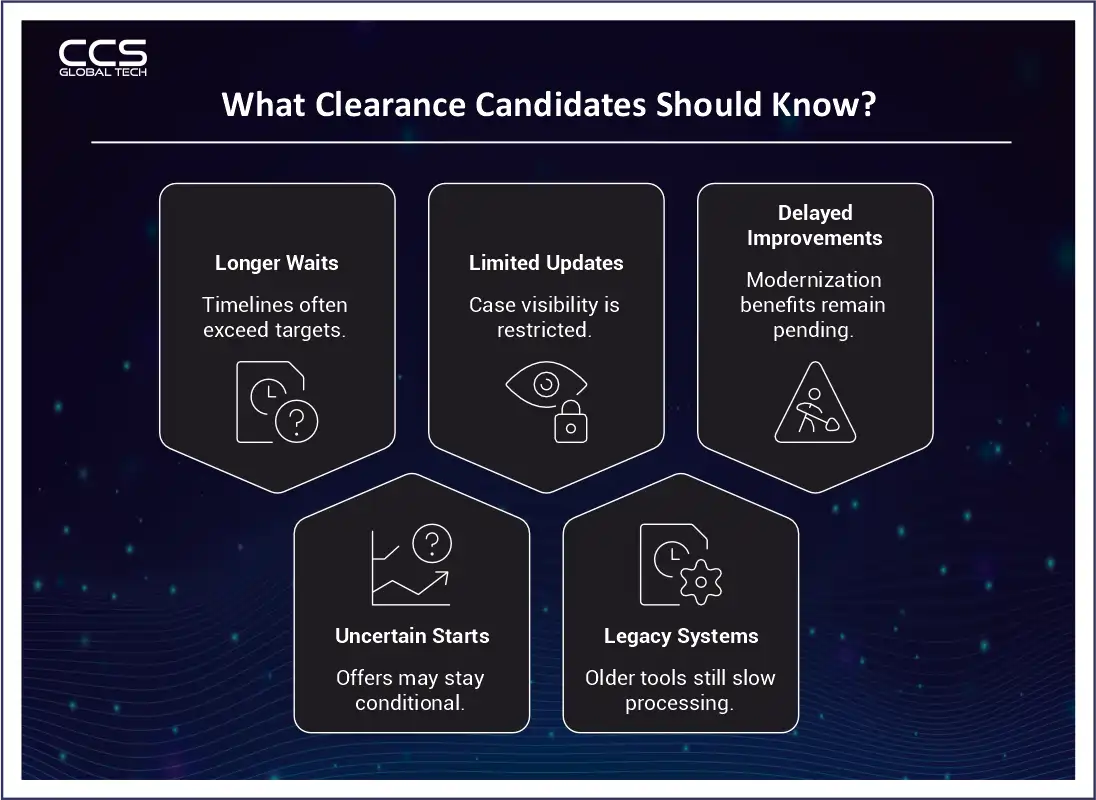
Most of the modernization that was supposed to speed up clearances runs on one system: the National Background Investigation Services, or NBIS. DoD has been building it since 2016. It was supposed to be operational in 2019. 
As of early 2026, it is not really finished yet. DCSA kinda paused development in 2024 then it restarted in mid 2025, and now they are aiming for completion in fiscal year 2027 or 2028, while the older legacy systems are supposed to retire no later than fiscal 2028.
The spending basically says the same thing. DoD put about $2.4 billion into NBIS and the legacy systems through fiscal 2024, and then it projects another $2.2 billion through fiscal 2031.
GAO has kept the personnel vetting process on its High-Risk List since 2018, and in February 2026 it told Congress that DCSA still does not have a reliable schedule for getting the system done.
And on top of that, DCSA has had no permanent director since David Cattler retired on September 30, 2025 so right now the most troubled IT program in federal personnel security is without settled leadership, in the exact moment it needs solid decisions.
This reaches your timeline directly. The reforms meant to help you, faster reciprocity and continuous vetting, all run on NBIS. When the system slips, the reforms slip with it.
What Clearance Candidates Should Know

Where your time actually goes that causes Security Clearance Processing delays?

A clearance is not one step. It is three, and each one stalls for a different reason.
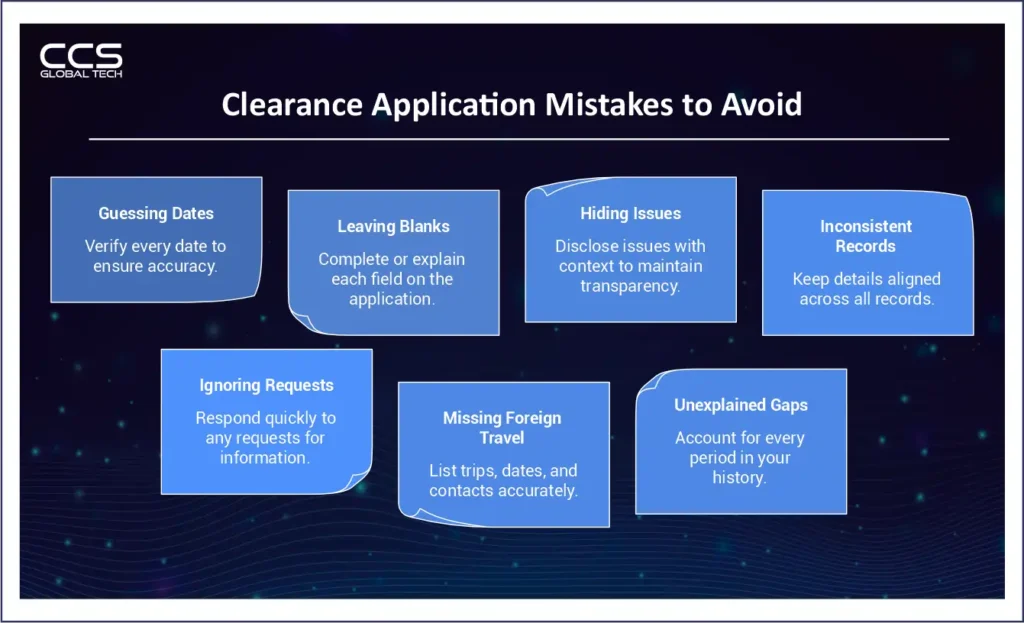
The first is the questionnaire. You fill out the SF-86, now being replaced by the Personnel Vetting Questionnaire, which began taking submissions in fiscal 2026.
It covers 7 to 10 years of your life depending on the section: every address, every job with supervisor contacts, foreign travel, foreign contacts, and finances. A single missing residence or an unexplained gap sends the case back to you for clarification before the investigation even begins. The government cannot move a file it has to keep returning.
The second is the investigation. A Secret needs a Tier 3 investigation. A Top Secret needs a Tier 5, which goes back 10 years, interviews more people, and verifies more records. Foreign contacts, overseas travel, and financial flags each add real time because each one requires separate verification.
The third is adjudication, and this is the stage people forget. Even as investigation times fell in early 2026, adjudication times rose. An adjudicator reviews the completed file against 13 guidelines using a whole-person standard.
A clean file moves fast. A file with one open question waits in a separate queue. For TS/SCI roles that require a full-scope polygraph at agencies like NSA or CIA, the polygraph scheduling and review can push total elapsed time to 14 to 22 months.
The result is a process that is predictable on average and highly variable in practice. Two veterans with similar records can finish six months apart because one had a clean SF-86 and strong sponsorship and the other had an unverified address from 2019.

What the Security Clearance Processing delay does to hiring?

About 3.7 million people hold clearance eligibility today. When processing a new one takes 227 days at the fast end, the hiring damage is concrete.
Candidates withdraw. A cleared professional with a current Top Secret has options, and few will wait eight months for a start date when a reciprocity-eligible role can bring them on in weeks.
Contract performance suffers. When a contractor wins an award that requires cleared staff on site by a set date, every delayed clearance is an empty seat the company cannot bill and the government is not getting work from. Recruiting costs climb too, because every withdrawal means starting the search again.
In a pretty common scenario, a veteran steps out of active duty with a solid record and then takes a TS/SCI analyst job with a contractor. The SF-86 is squeaky clean, the sponsorship checks out, and the paperwork never really throws up a red flag, not even a small one.
Still, that person can end up waiting around nine months from the time they submit until the final eligibility decision, because the whole stack takes time: Tier 5, then SCI adjudication, then the polygraph scheduling part.
During that stretch the contractor keeps a funded role open but empty, the program ends up running under-staffed, and the veteran has to get by on interim pay or on some unclassified assignment if the company has it available. Nobody messed up, no one clearly did something wrong. The kicker is that the timeline alone creates the expense.
Reciprocity was supposed to ease the worst of this. The stated goal of Trusted Workforce 2.0 is “clear once, trusted everywhere.” In practice, a transfer that should take 30 to 75 days often runs 90 to 150 because of file transfers and security reviews between agencies. That is better than a fresh investigation, but it is not the quick handover the policy promised.

What you can do as a candidate?

You cannot control DCSA’s caseload. You can control the things that send your file back.
Fill out the questionnaire like an investigator will check every line, because they will. Before anything else, pull your own records first, get a current credit report, a list of every address with the exact move-in and move-out dates, plus supervisor names and numbers for each job. Also, make sure you have the dates for any foreign travel, not just the general timeframe.
Disclose issues rather than hide them. An omission discovered later is treated more seriously than the underlying issue itself, and unexplained gaps are the most common reason a case stalls early.
Ask your employer two direct questions before you accept an offer. First, will you be eligible for an interim clearance while the investigation runs?
An interim Secret, and sometimes an interim Top Secret, can let you start work in weeks instead of months, though it is not available for SCI access. Second, can you begin on unclassified work while you wait? Many contractors allow it, and it keeps you earning while the file moves.
If you already hold a clearance, protect it. A clearance tied to a position goes inactive about 24 months after you leave the sponsoring job. Stay inside that window and reciprocity stays available. Let it lapse and you are back to a full investigation, with the full wait that comes with it.

What you can do as a hiring manager?

Plan for the exception, not the average. If your task order needs cleared staff, build the real 156 to 227 day timeline into your proposal and your start dates, not the 40 to 75 day goal that exists on paper.
Sponsor interim clearances wherever the role and the candidate’s record allow it, because an interim is often the difference between a start date this quarter and next quarter. Tell candidates the truth about timelines in the offer itself, because the withdrawals that hurt most are the ones driven by surprise.
And stay in real contact with cleared candidates during the wait, because a competitor with an interim-eligible role can bring them on faster while you go quiet.

The honest outlook

The direction is right and the pace is slow. Investigation times are improving, the backlog is down, and continuous vetting now covers more than 3.8 million people, which reduces the reinvestigation load over time.
Take the recent gains with some caution though. GAO said the average times for initial Top Secret clearances moved a little longer from fiscal 2022 through 2025, so that recent quarterly dip to 227 days it’s kind of sitting on top of a multi year climb, not a clean steady decline. One good quarter is not a fixed system.
But the system that ties the reforms together will not be finished until 2027 or 2028 at the earliest, adjudication is still running above target, and DCSA leadership is unsettled. For at least the next two years, plan your hiring and your own career moves around a clearance process that works, just not quickly.
The people who do best here are the ones who prepare for the slow version of the timeline and treat a faster result as the bonus.

Where CCS Global Tech fits?

If you staff cleared federal work, the delay described above is your risk to manage, and a pre-vetted talent pool is the practical hedge against it. CCS Global Tech has placed cleared and veteran professionals on federal projects for more than 25 years, with a database of over 100,000 consultants, more than 7,000 veteran placements, and work across 100-plus federal and state clients.
The recruiting team runs more than 100 specialists, including over 40 who focus only on cleared talent. That depth matters most when timing is the problem. CCS keeps a pre-screened pool of veteran candidates with active clearances at the Public Trust, Secret, and Top Secret levels.
That helps keep a reciprocity-eligible candidate inside the 24-month reactivation window and lets you put billable staff on a contract closer to Day 1 instead of waiting out a full Tier 5 investigation.
If you are a contractor working to meet a Day 1 readiness requirement, or a veteran with an active clearance looking for your next role, feel free to connect with our team.

FAQs

Q1- Why do security clearance processing delays continue to affect federal hiring?

A- Security clearance delays slow hiring because many federal and contractor roles require eligibility before a candidate starts sensitive work. Even after an employer selects a candidate, the investigation, review, and adjudication stages can extend the onboarding timeline. 

A- Common causes include incomplete applications, missing records, employment or address verification issues, foreign contacts, financial concerns, investigator workload, agency backlogs, and cases that require additional review. 

A- Delays leave funded positions unfilled, slow project delivery, increase recruiting costs, and place more pressure on employees who already hold active clearances. Contractors may also lose candidates who accept faster opportunities elsewhere. 

A- Candidates may face uncertain start dates, delayed income, repeated document requests, and limited communication during the review process. Some candidates also need to decide whether to wait or continue applying for other roles. 

A- It depends on the employer, contract, position, and agency rules. Some candidates perform unclassified work while waiting. Others cannot begin until they receive an interim or final eligibility decision. 

A- An interim clearance is a temporary eligibility decision based on an initial review. A final clearance follows the full investigation and adjudication process. An interim decision is not guaranteed and may be withdrawn if new concerns arise. 

A- Interim eligibility may be withheld when the initial review identifies information requiring further investigation. This does not always mean the final clearance will be denied. It means the case needs more review before access is granted. 

A- Yes. Missing dates, unexplained employment gaps, incomplete addresses, inconsistent answers, and omitted foreign contacts can trigger follow-up requests. Accurate and complete information helps prevent avoidable delays. 

A- Foreign travel and contacts do not automatically prevent clearance eligibility. They may require additional review, especially when information is incomplete or the relationship creates a potential security concern. 

A- Financial issues may receive added review when they suggest unresolved debt, fraud, unexplained income, or vulnerability to pressure. Investigators often consider the circumstances, corrective actions, and whether the issue remains ongoing.