


How Veterans Can Build a Strong BLUF Resume for Civilian Jobs?

How Veterans Can Build a Strong BLUF Resume for Civilian Jobs
Recruiters usually spend just 30 seconds in the initial phase of considering the CV, and 80% of them fail to pass the initial screening process according to the study conducted in 2026.
It is well established that the recruiters spend 6 seconds considering your CV. Treat that number as dated.
Here’s what most transition guides won’t tell you. You already know how to write for that constraint. The military drilled it into you. It’s called BLUF, bottom line up front, and it’s the same discipline that makes a briefing or a memo useful to a commander with thirty seconds to make a call.
Most veterans apply it perfectly in uniform and abandon it completely on their resume, reverting to the chronological, build-up-to-the-point format civilian resume templates default to. That’s backwards. It’s costing you interviews.

Table of Contents

What BLUF Actually Means?

The BLUF concept is embedded in military communication through its established standards and procedures for more than half a century. The United States Army regulation, AR 25-50, which covers all aspects of official military correspondence in the army, explicitly includes this practice: state your conclusion upfront and then prove it.
While other services call it differently, they operate on exactly the same principles: give the reader an immediate answer, then explain why. In a BLUF letter, you inform the reader what kind of decision should be made or what took place before going on to justify it.
A resume built on the opposite principle, chronological narrative, education first, then a slow build through your career, buries the answer a recruiter needs at the bottom of a document they’re only going to look at for 30 seconds. You’re asking them to work for information they should get in the first line. They won’t do that work. They’ll move to the next resume in the stack.
You already ran this exact logic under far higher stakes. A situation report doesn’t open with a backstory. It opens with status, then location, then what’s needed. A civilian hiring manager isn’t reading your resume under fire, but they’re reading it with the same triage mindset. Know a clear comparison between BLUF resume and traditional resume.
BLUF Resume vs Traditional Resume

Traditional Resume 

BLUF Resume 

Builds slowly through career history 

Leads with your strongest value 

Makes recruiters search for fit 

Shows role alignment immediately 

Starts with background details 

Starts with skills, impact, and results 

Lists responsibilities 

Highlights measurable achievements 

Answers “What have you done?” 

Answers “Why should we interview you?” 

Why BLUF Resume Format Wins in a Civilian Hiring Process?
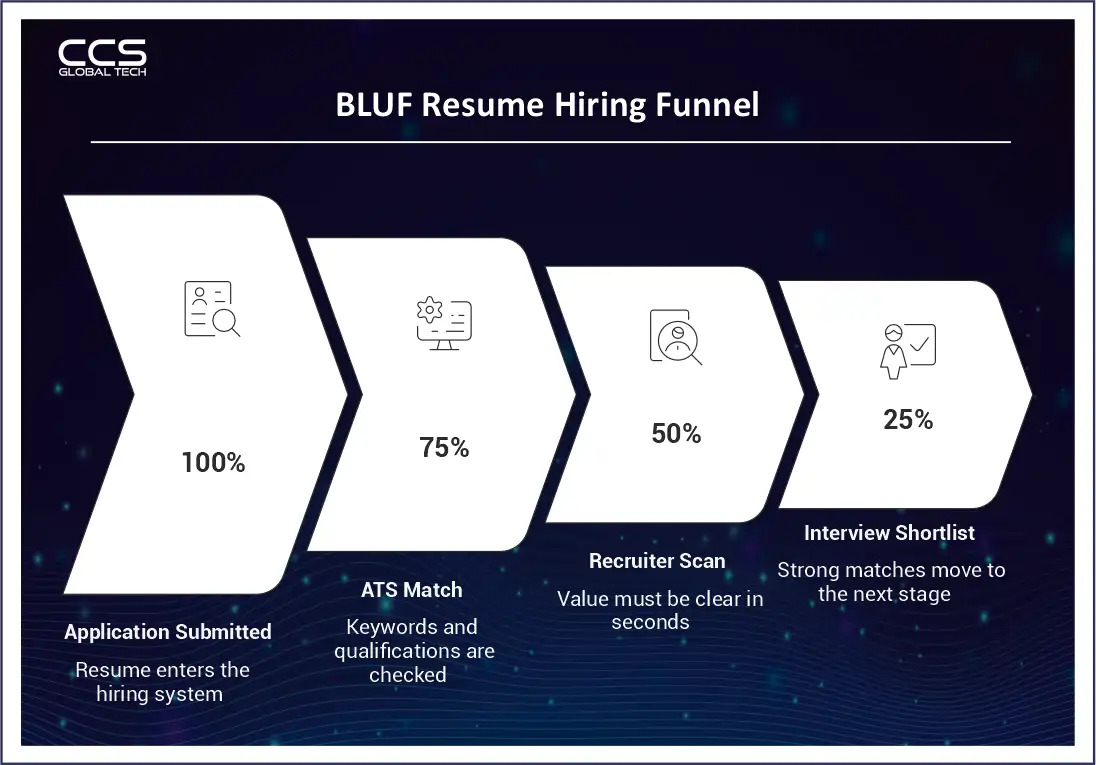
The recruiter who is reading your resume is doing the exact same thing as you when you read the BLUF memo: trying to find the answer and, based on that, determining whether it is worth spending the rest of their precious seconds on the information provided. If you can give the recruiter the answer in the first three lines, you will make it past the filter that discards 80 percent of the applicants.
This approach applies not only to the person reading the resume but also to applicant tracking systems, which automatically determine the keyword density and relevance of a resume before it is even opened.
BLUF formatting helps with both filters at once. Not because you’re gaming a system. Because leading with your strongest, most specific claim is simply how information gets processed fastest, by a machine or a person.
BLUF Resume Hiring Funnel

Building Your Resume's BLUF

Your summary is your bottom line

The two or three lines at the top of your resume are your BLUF statement. Don’t waste them on a generic opening like “results-driven professional seeking a challenging opportunity.” That tells a recruiter nothing they can act on in the seconds they’re giving you.
State your value directly instead. “Cybersecurity operations leader with an active Top Secret clearance and eight years managing 24/7 SOC teams for DoD systems, reducing incident response time by 40 percent.” That’s a bottom line. A recruiter can decide in one read whether you’re worth the next 25 seconds.

Bullets should lead with the result, not the task

Each bullet of your experience should match the style of your training: begin with the results, followed by the action behind the results. A couple examples will make the formula clear.
Weak: “Responsibility for coordinating logistics for a 200-member team.” Strong: “Increased resupply efficiency of equipment by 30% due to reorganization of logistics coordination for a 200-member team.”
Weak: “Assisted with network security monitoring for a joint task force.” Strong: “Cut network intrusion response time by 45 percent by redesigning monitoring protocols for a joint task force.”
Weak: “Managed training schedules for incoming personnel.” Strong: “Reduced onboarding time by three weeks by rebuilding the training schedule for incoming personnel.”
Every strong version gives the recruiter the bottom line, the number, before they’ve invested any real reading time. Every weak version makes them dig for it, and most won’t.
Run down your existing resume one bullet at a time and figure out what results each claims. If you can’t figure out a result, quantify or eliminate that bullet point. A line with no measurable outcome is the kind of filler a 30-second scan skips right past anyway.

Put your clearance and credentials where they'll actually be seen

If you have an active security clearance, this should be placed in your summary or directly beneath it, rather than in your skills toward the bottom third of the page.
The same applies to certifications that are directly applicable to the position: Security+; PMP; certification on a cloud-based platform. This is precisely what will make it through a quick scan. A recruiter who has to hunt for your clearance status on page two has usually already moved on.

BLUF applies to your cover letter too

If you’re still writing a cover letter that starts off with “I am writing to express my interest,” you’re burying the bottom line once more, only this time in a different kind of letter. Start your letter as you start every piece of writing: the position, why you’re the perfect candidate, and what makes you most qualified, all in one sentence.

“As a cleared cyber security operations specialist with 40% faster incident resolution for a Department of Defense SOC team, I’m applying for your Security Operations Manager position.” All that comes after that sentence is just details, which the reader may or may not want to read.

BLUF applies to your cover letter too

BLUF doesn’t stop at the sentence level. It should decide the order of your entire resume too. However, if your best qualification for your new position is not your most recent job, then an exclusively reverse chronological format simply ends up hiding your bottom line behind a job that does not back you up in any way.
An alternative format where the relevant experience is highlighted at the beginning and then supplemented by a brief chronological list of other jobs below, would employ the same reasoning that the rest of your resume already follows. This matters most for veterans moving into a technical field where their most recent role wasn’t their most technical one.
Your skills section deserves the same treatment. An endless list without any hierarchy of every instrument and process you’ve utilized is the same as writing a report that lacks any conclusion and leaves everything for the reader to decipher on their own. Place the three or four skills that are really relevant to the position at the top of the list, in the order you like.

Common Mistakes That Undo the BLUF Instinct

Starting with education instead of impact

Most resume templates put education at or near the top by default. Unless you’re a very recent graduate with limited work history, that’s the wrong bottom line to lead with. Your degree isn’t what a hiring manager needs to know in the first ten seconds. What you’ve done with your career is.

Writing bullets as duty descriptions instead of outcomes

This is by far the most common resume cliché among veterans, and it is the polar opposite of BLUF. “Responsible for,” “duties included,” and “tasked with” all say what you were told to do but not what was done because of it. Rewrite each one to begin with the result.

Explaining before stating

Some civilian resume conventions favor a narrative lead-in, a sentence of context before the actual point. That’s the reverse of what you were trained to do, and the reverse of what a 30-second reader needs. State the outcome. Then give the one line of context that supports it, if there’s room.

Considering that the summary is an afterthought

Many veterans have managed to write a powerful, results-oriented experience section but just placed a generic two-sentence summary at the top just to fulfill a formality.
That summary is the first thing read, and for 80 percent of applications, the last thing read too. Write it last, after you know exactly what your strongest claims are. Treat it with the same weight you’d give the first line of an actual BLUF memo.

Letting rank and jargon carry the weight instead of the outcome
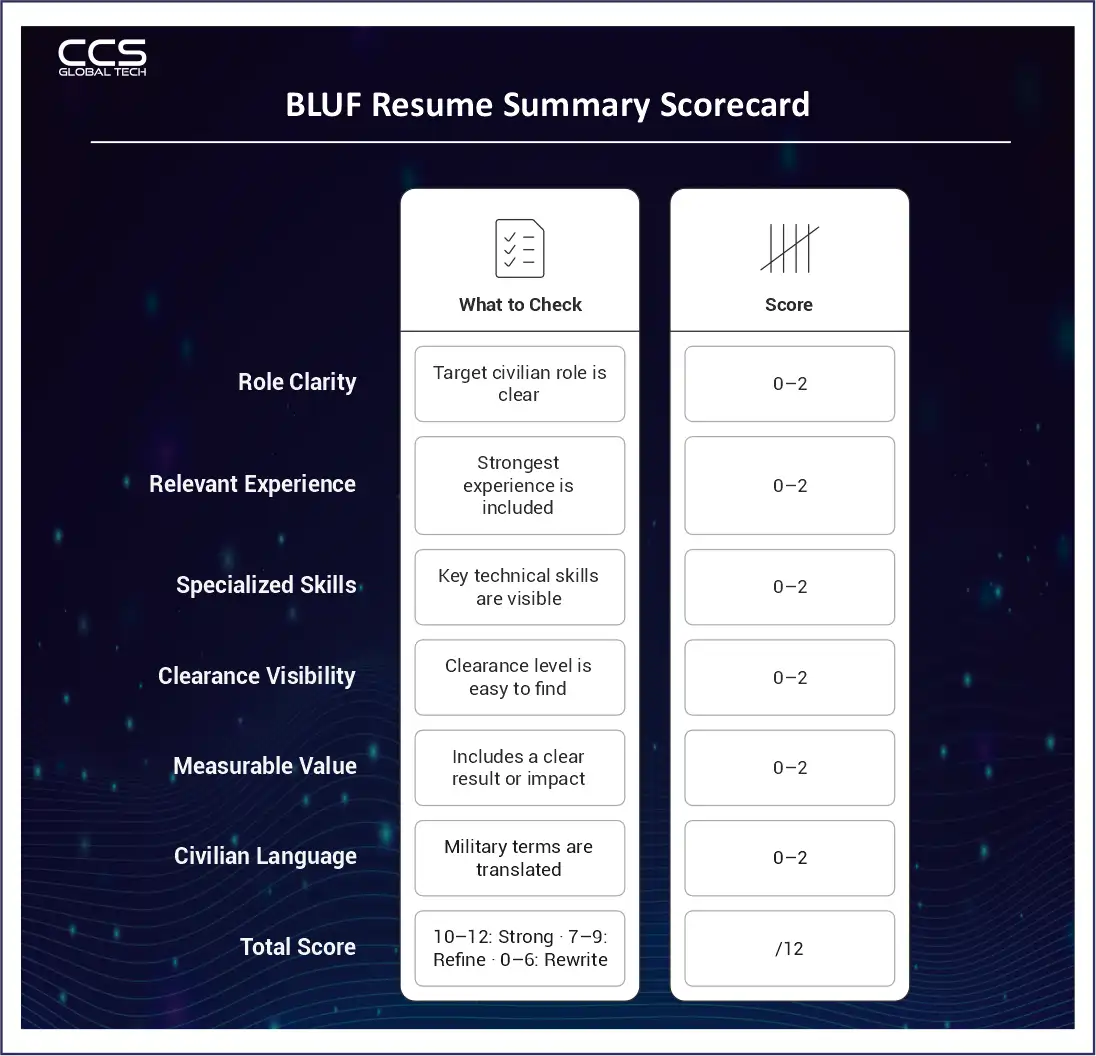
A rank or an MOS code means something to another service member. It means nothing to a civilian recruiter scanning for relevant experience in ten seconds. Lead with what the rank or role actually produced, not the title itself.

The Practical Checklist

  1. Rewrite your summary as a genuine bottom line: role, clearance status if applicable, one quantified achievement, in two to three lines.
  2. Each and every bullet needs an outcome that is quantifiable. Where it doesn’t, number it or delete it.  
  3. Make sure that your clearance level and certifications required by the job get put in your summary or in the line following the summary.  
  4. Delete all instances of “responsible for” and “duties included” and write in actual results instead.  
  5. Rearrange your skills in such a way that the three or four most relevant skills go first. 
  6. Use the answer-first rule not only in your resume but also in the opening sentence of your cover letter.  

Conclusion

BLUF isn’t a resume trick. It’s a discipline you already have, applied to a document where most veterans quietly stop using it the moment they take the uniform off. The recruiter reading your resume has the same thirty seconds and the same instinct to look for the answer first that a commander reading your briefing did.
Give it to them the same way you always have. You didn’t forget how. You just stopped applying it to the one document where it matters most right now.
CCS Global Tech works with veterans and cleared professionals on exactly this kind of resume translation as part of our staffing process, because a strong candidate with a buried resume still loses out to a weaker candidate who led with the right line.
If you want a second set of eyes on your resume or you’re ready to talk about roles that fit your background and clearance, we will help you out.

FAQs

Q1. What does BLUF mean in a civilian resume?

A. BLUF means putting your strongest and most relevant qualifications first. The opening lines should quickly explain the role you fit, the experience you bring, and the value you offer. 

A. Place it at the top of the resume in the professional headline and summary. Recruiters should understand your civilian career fit before reviewing your work history. 

A. Include your target role, years of relevant experience, specialized skills, clearance status when relevant, and one measurable achievement. 

A. Keep it to three or four focused lines. Each line should add useful information rather than repeat general traits such as hardworking, dedicated, or dependable. 

A. Include rank only when it adds meaningful context. Civilian employers usually care more about leadership scope, technical expertise, team size, and measurable results. 

A. Pair the military title with a civilian equivalent. For example, translate a logistics role into supply chain operations, inventory management, or program coordination. 

A. Yes, when the position requires or values a clearance. State the clearance level clearly without adding sensitive or unnecessary details. 

A. Use the formula action + scale + result. Replace duty statements with outcomes that show the size, difficulty, and impact of your work. 

A. Use team size, budget, asset value, locations supported, time saved, error reduction, readiness levels, project volume, or performance improvements. 

A. Yes. Keep your work history in reverse chronological order, but lead each section and bullet with the most relevant result instead of background details.