
Federal Statistics in the AI Era: What the 2026 Numbers Actually Mean for Cleared Talent

Federal AI Jobs - What 2026 Numbers Mean for Cleared Talent
Every federal contracting conversation right now eventually turns to AI. Those discussions usually revolve around vibes and not figures. Here are the figures, and what they really mean when it comes to recruiting cleared personnel or developing a career in this domain in 2026.

The short version: federal AI spending didn’t grow this year. It detonated. The parts of the system that are supposed to supply the people who do this work, the clearance pipeline, the cleared labor pool, haven’t moved anywhere near as fast. That gap is where the real opportunity sits. It’s also where most of the friction lives.

Table of Contents

The Spending Number That Changes Everything
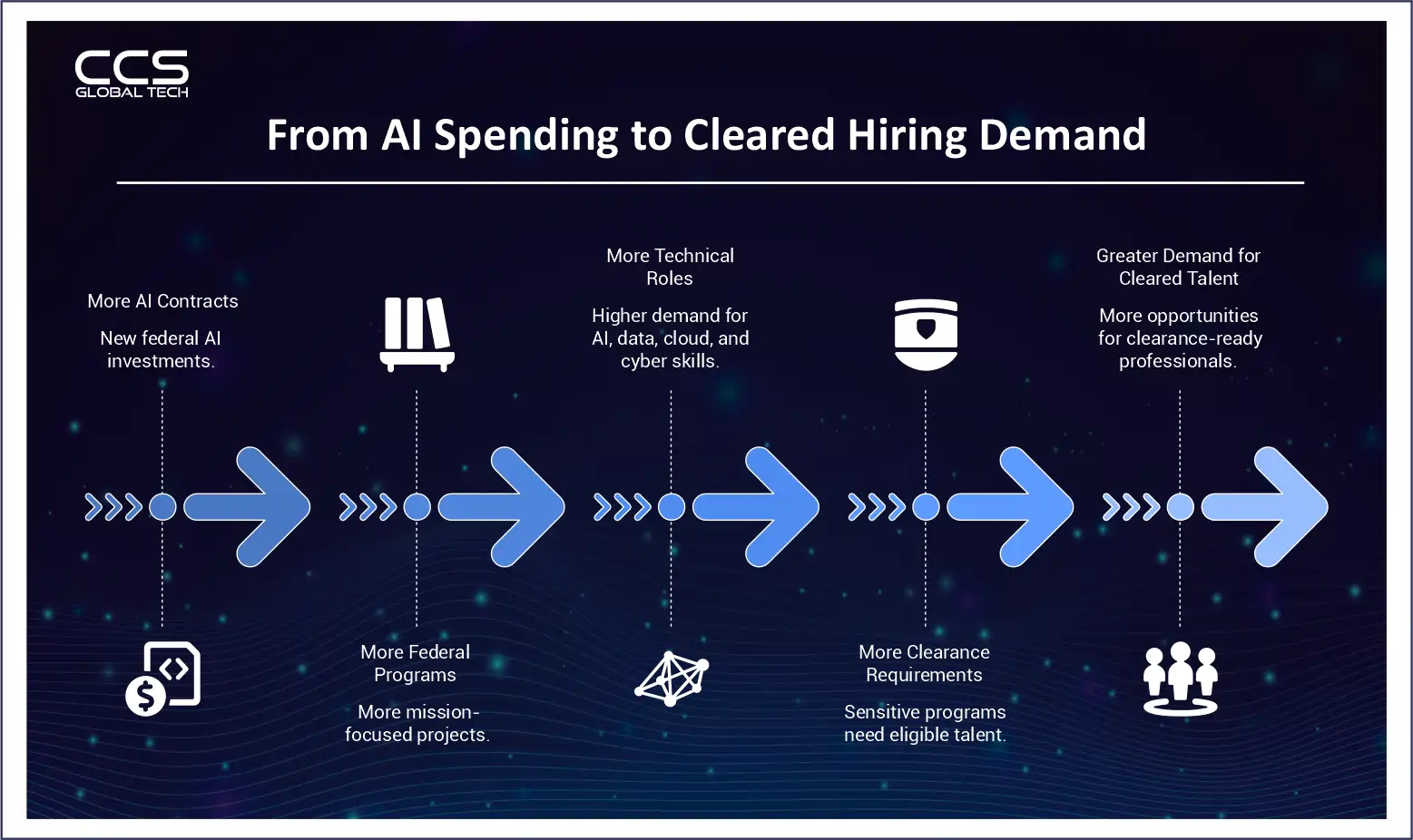
Since 2022, Brookings has analyzed how federal AI spending works. Brookings’ analysis of 2026 provides the most insightful information on where this spending has been going. Funds for AI contracts grew from $355 million in 2024 to $7.2 billion in 2026. It means that within just two years the growth was 966 percent. The potential contract award value was even more impressive from $4.6 billion to $91.8 billion, 1,912 percent.
One department drove almost all of it. Of the amount spent, $90.7 billion went to the Department of Defense, which marked a growth by 1,605 percent from the previous year and amounted to 1,319 out of 1,743 federal AI contracts. Every other agency combined, Commerce, HHS, NASA, the rest, is a rounding error against that number.
Here’s the part that matters for hiring: 28 federal agencies now hold active AI contracts, up from 23 in 2024 and just 17 in 2022. That’s real, broad-based demand, not a single flashy DoD program. But defense is where the money and the clearance requirements both concentrate. This AI boom is happening almost entirely inside the world your candidates already have to be eligible to work in.
From AI Spending to Cleared Hiring Demand

What the Money Is Actually Buying?

Contract dollars don’t hire themselves. Someone has to build, secure, and govern these systems. Federal agencies are explicit that this work requires people who understand both AI and government constraints at once. Skills alone don’t cut it if you can’t pass a background investigation.
Most of this contracting flows through a small set of vehicles: OTAs (Other Transaction Authority) for fast, non-traditional awards, IDIQs for large multi-year task order contracts, and BAA solicitations for research-heavy work. The Chief Digital and Artificial Intelligence Office, CDAO, sits at the center of a large share of DoD’s AI acquisition.
If you’re a contractor and you don’t already have a read on which of these vehicles your target agencies favor, that’s worth fixing before you worry about headcount.
The roles multiplying fastest track closely with what CCS Global Tech already places veterans into: cybersecurity engineers who can secure AI pipelines, cloud infrastructure engineers who can stand up the compute these systems run on, solution architects who understand both the technical stack and federal compliance frameworks like FedRAMP.
Add model governance and AI assurance roles to that list. When federal AI makes a consequential call, a targeting recommendation, a fraud flag, a resource allocation decision, an agency has to explain how it got there. Someone has to build and document that trail.
None of these are theoretical demands. It’s contract-backed, budget-backed demand, concentrated in the exact sector where a clearance is the price of admission.

The Wage Signal Is Already Showing Up

If you want proof this demand is real and not just a budget line waiting to be spent, look at pay. Lightcast’s analysis of 1.3 billion job postings found that postings requiring AI skills offer a 28 percent salary premium, close to $18,000 more a year, over comparable roles that don’t.
Postings asking for two or more AI skills carry an even bigger premium. PwC’s own 2026 Global AI Jobs Barometer puts the AI wage premium higher still and rising fast: up from 25 percent in 2024 to well over 50 percent this year.
The exact number depends on which firm’s methodology you trust. The direction doesn’t. Employers are paying real money, right now, for people who can combine technical AI skills with the domain knowledge to apply them.
In the federal space, that domain knowledge includes knowing how to operate inside a classified or compliance-heavy environment. A cleared candidate with AI-adjacent skills isn’t competing against the entire tech labor market. They’re competing in a much smaller pool, against a much bigger wave of demand.

The Cleared Population Isn't Growing to Match It
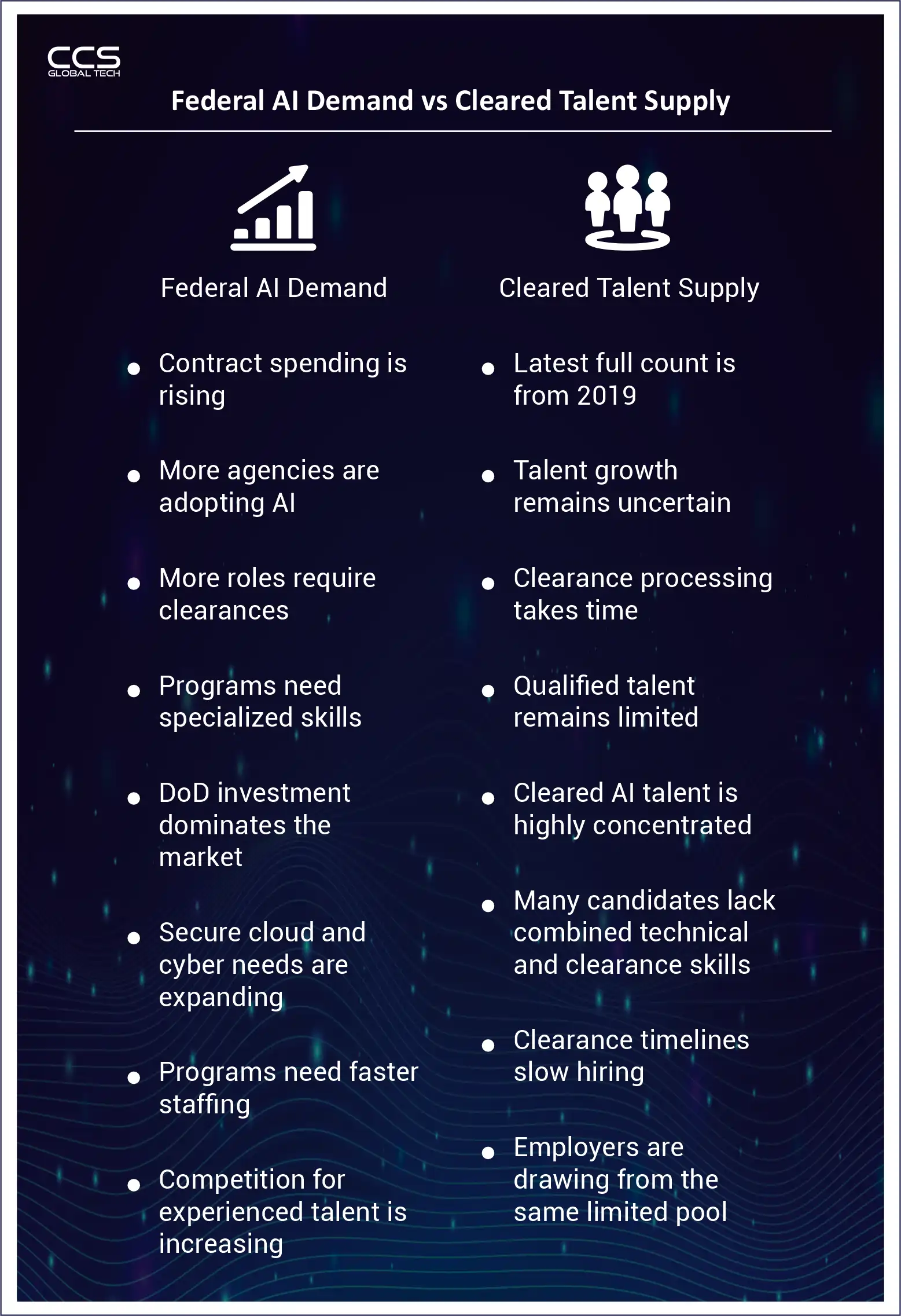
Here’s where you need to be skeptical of anything you read online, including some of it on industry blogs that should know better. You’ll see the figure “5.1 million Americans hold a security clearance” repeated constantly. That number is real. It’s also not current. It’s the historical peak from October 2013.
The most recent figure released by the Office of the Director of National Intelligence is that for Fiscal Year 2019, where 4,243,937 people were cleared, marking just a 4.2% increase over the previous fiscal year.
ODNI hasn’t released a more current comprehensive report since. That gap matters. It means the industry is planning hiring pipelines against a headcount that’s several years out of date, in a market where demand is compounding by the billions annually.
One thing has genuinely improved underneath that stale headline number: continuous vetting. More than two million cleared individuals, close to half the total cleared population as of the last full accounting, are now enrolled in automated, ongoing monitoring instead of waiting years for a periodic reinvestigation.
That shift is itself an AI-era story: continuous vetting runs on automated record checks against credit, criminal, and foreign travel data, flagging issues in near real time instead of once every five years. It’s one of the few places where AI-adjacent automation is already making the cleared workforce easier to manage, even while the raw supply of cleared people hasn’t been recounted in years.
Read the overall gap correctly and it’s not a research inconvenience. It’s a signal. The cleared population almost certainly hasn’t kept pace with a spending curve that grew nearly twentyfold in potential contract value over two years. Supply and demand were already tight before AI contracting exploded. They’re tighter now.

The Bottleneck Nobody Wants to Say Out Loud: Processing Time

You can have all the budget in the world and still not staff a program if the people who’d fill it are stuck in the queue. DCSA’s own Q1 FY2026 numbers, covering the fastest 90 percent of industry cases, show Secret clearances averaging 156 days and Top Secret averaging 227 days.
The government’s own stated goals are 40 days for Secret and 75 for Top Secret. Neither number is close. Top Secret timelines actually got worse across FY2022 through FY2025 before that recent quarterly dip, according to GAO’s continued oversight of the process.
There’s real progress underneath the frustrating headline. DCSA’s pending investigation inventory peaked at roughly 291,200 cases in September 2024, the highest level since FY2019, and a dedicated effort brought that down to about 222,700 by April 2025. That’s a 24 percent reduction in seven months. Genuinely fast progress, by government standards.
Progress and pain coexist here. That’s the honest read. If you’re staffing an AI-adjacent program against a Q3 delivery date, plan around a Top Secret candidate taking the better part of a year to clear, not the 75-day target on a government slide deck. The people who do best in this market build their hiring and career timelines around the slow version of the system. They treat anything faster as a bonus, not a plan.
What this looks like on the ground?
A mid-size contractor wins a task order to build AI-assisted threat detection for a DoD component. The contract funds four cleared engineering seats starting in 90 days. Three candidates already hold an active Secret clearance from prior roles and can start under reciprocity within a few weeks.
The fourth is a strong technical hire with no clearance history, and the investigation alone runs past the contract’s own start date before adjudication even begins. The gap doesn’t kill the contract.
It does mean the fourth seat sits open for months, the existing team absorbs the overflow, and the program manager spends real time explaining the delay to a customer who read the same 75-day target you did. None of this shows up in the spending numbers. It shows up in the delivery schedule.

Where Veterans Actually Fit This Picture

This is where the numbers stop being abstract for a lot of readers. According to the 2025 annual report from the Bureau of Labor Statistics on the status of veteran employment in the US, veteran unemployment increased from 3.0% in 2024 to 3.5% in 2025 and is still consistent with the general labor force. According to the Department of Labor, the total number of veterans in 2024 was 17.26 million out of which 8.04 were employed.
Those top-line numbers undersell the real advantage veterans carry into this specific AI hiring wave. Many separate from service already holding an active or recently lapsed clearance, which under Trusted Workforce 2.0 reciprocity rules can transfer to a new sponsor far faster than starting an investigation from zero.
Military technical training, network administration, intelligence analysis, systems engineering, maps directly onto the cybersecurity, cloud, and infrastructure roles driving this contracting surge.
Put a veteran with a current clearance next to the fourth candidate in the scenario above, and the math isn’t close. In a hiring environment where the clearance pipeline is the real constraint, a candidate who already cleared that hurdle isn’t just a good hire. They’re often the only hire that fits the timeline at all.

What This Actually Means for You?

If you’re an employer, work from this list:
  1. Your limiting factor isn’t budget anymore. The contract money is real and it’s not slowing down. Your bottleneck is finding candidates who are already cleared or close to it. 
  2. Source veterans and cleared professionals first, not as an afterthought once the general applicant pool runs dry. The clearance head start is worth more than most resume gaps. 
  3. Plan every AI-adjacent req around the slow clearance timeline, not the government’s stated target. Build in six to nine months for Top Secret roles as your default assumption, not your worst case. 
If you’re a candidate, work from this one:
  1. Get your clearance paperwork clean before you need it. Pull your own credit report, resolve anything outstanding, and know your own record before an investigator finds it for you. 
  2. Understand exactly where your existing eligibility stands and whether reciprocity applies to your next move. A lapsed clearance inside 24 months is a very different starting point than one that’s expired for years. 
  3. Build AI-adjacent skills on top of whatever technical foundation you already have. The roles growing fastest sit at the intersection of AI and a specific domain, cybersecurity, cloud, infrastructure, not in pure AI research. 
Either way, the numbers point the same direction. Federal AI spending grew by double and triple digits across every measure that matters in 2026.
The clearance system that’s supposed to supply the workforce for that spending is improving, but slowly, and against a population count that hasn’t been fully recounted since before most of this AI boom started. That mismatch is the whole story right now.
CCS Global Tech has spent more than 25 years inside exactly this gap, connecting cleared and veteran talent with the federal and defense contractors who need them.
If you’re building a team for AI-driven federal work, or you’re a veteran ready to put a technical background and a clearance to work, Veteran Staffing at CCS Global Tech is built for precisely this moment. Need more clarity?

FAQs

Q1. What does the growth in federal AI spending mean for cleared professionals?

A. It signals stronger demand for professionals who combine an active clearance with AI, data, cloud, cybersecurity, engineering, or federal program experience. Federal AI contract obligations reached $7.2 billion in 2026, while potential contract value reached $91.8 billion. 

A. The Department of Defense holds 1,319 of the 1,743 AI contracts reviewed for 2026 and accounts for $90.7 billion in potential contract value. This concentrates many AI opportunities within defense programs where security clearances are often required. 

A. Demand is likely to grow for AI engineers, data scientists, data engineers, cloud architects, cybersecurity professionals, MLOps specialists, systems engineers, technical program managers, and AI governance professionals. 

A. No. A clearance provides eligibility for sensitive work, but employers still look for technical ability, relevant certifications, mission experience, communication skills, and evidence of successful delivery. 

A. Priority skills include Python, SQL, machine learning, data engineering, cloud platforms, cybersecurity, DevSecOps, MLOps, data governance, responsible AI, and secure system design. 

A. No. Federal AI programs also need project managers, cybersecurity specialists, cloud professionals, data analysts, systems administrators, compliance experts, acquisition professionals, and subject matter experts. 

A. Obligated spending is funding the government has formally committed. Potential contract value represents the maximum value a contract might reach when options, extensions, and future work are included. It should not be treated as money already spent. 

A. The number of federal agencies holding AI contracts grew from 17 in 2022 to 23 in 2024 and 28 in 2026. This shows that AI adoption is expanding across government, although defense continues to dominate spending. 

A. No. Civilian agencies also use AI for healthcare, transportation, research, fraud detection, public services, regulation, and scientific analysis. However, DoD currently holds most federal AI contract value. 

A. No. That figure reflects an older historical count. The latest comprehensive public ODNI report covers fiscal year 2019, so current cleared workforce estimates should be treated cautiously.