


Understanding the Full Scope Polygraph: What You Need to Know

Understanding the Full Scope Polygraph
There is a moment in every federal hiring process where the paperwork stops and something far more personal begins. That moment, for thousands of candidates and agencies every year, is the polygraph examination. And not just any polygraph- the Full Scope Polygraph. It is the most thorough, most scrutinized, and most misunderstood step in the entire security clearance process.
If you work in federal contracting, government staffing, or intelligence community programs, you have probably encountered this requirement more times than you can count. Yet the questions around it never seem to go away. What exactly does it cover? How is it different from a Counterintelligence (CI) polygraph? Why does it take so long? And what does it mean when a candidate “fails” one?
We have spent years navigating this landscape alongside agencies, defense contractors, and cleared professionals. What follows is a straightforward, honest look at the Full Scope Polygraph – what it is, what it means in practice, and why it matters more than ever right now.

What Is a Full Scope Polygraph, Exactly?
A Full Scope Polygraph (often called an FS Poly or Lifestyle Polygraph) is a two-part examination that combines a Counterintelligence (CI) component with a Lifestyle component. Together, they represent the most comprehensive security screening that the U.S. Intelligence Community administers.
The CI component focuses on national security concerns. Examiners ask whether the candidate has had unauthorized contact with foreign intelligence services, whether they have ever shared classified information with individuals not authorized to receive it, and whether they have been recruited or approached to commit espionage or sabotage.
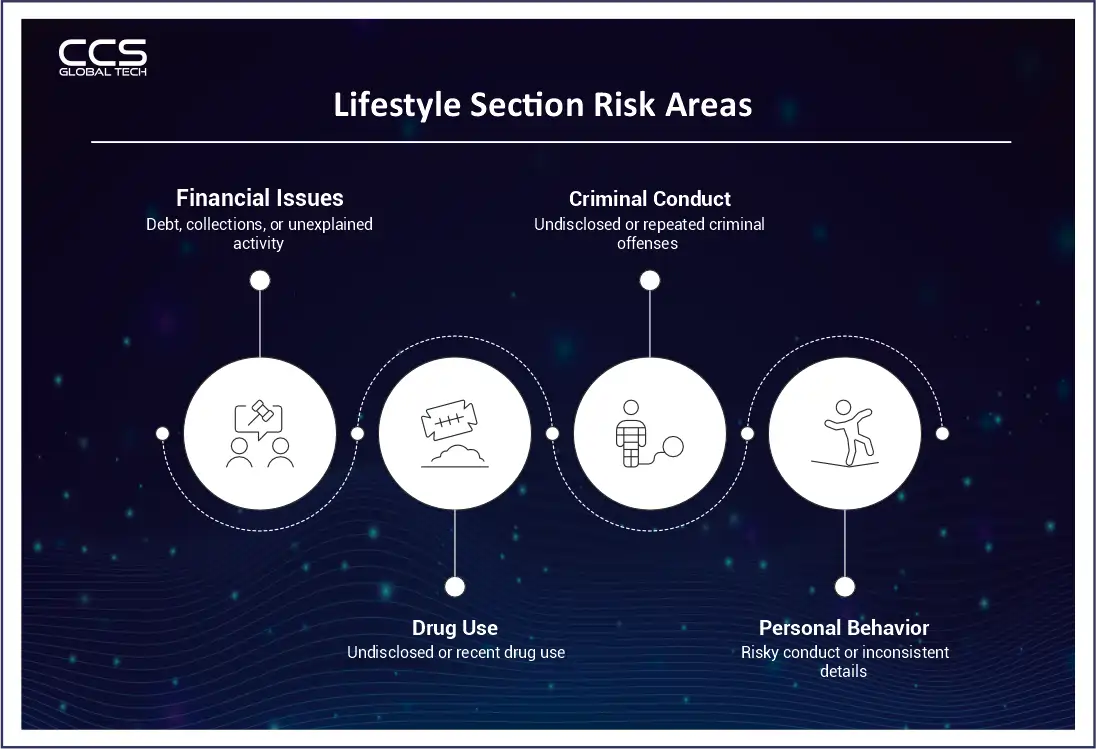
The Lifestyle component goes deeper into personal history. It covers topics such as undisclosed criminal behavior, financial dishonesty, drug use outside of what was reported on the SF-86, and conduct that could make an individual susceptible to blackmail or coercion.
A standard CI polygraph, by comparison, only covers the national security portion. The Full Scope exam does both and that distinction carries enormous weight in both the hiring process and in how agencies assess long-term trustworthiness.
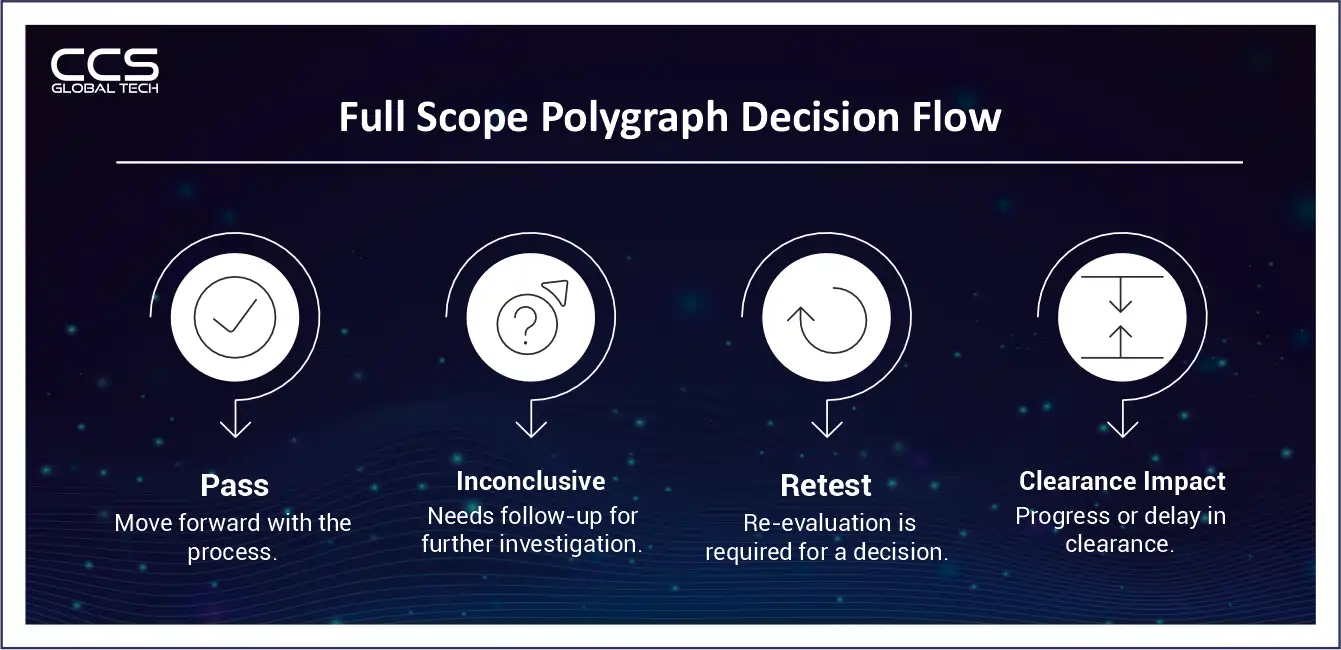
Full Scope Polygraph Decision Flow

Who Requires It?

The Full Scope Polygraph is primarily administered by agencies within the U.S. Intelligence Community. The NSA, CIA, DIA, NRO, and NGA are among the most prominent employers requiring FS Poly for a significant portion of their workforce particularly for roles involving Top Secret/SCI access.
Defense contractors supporting these agencies must also staff positions with FS Poly holders. At the CIA, all cybersecurity roles mandate Full Scope Polygraph clearance. The NSA similarly reserves its top-tier cyber operations positions for FS Poly holders, with GG-15 roles offering base salaries of up to $195,200.
It is also worth noting that some counterintelligence positions within the FBI, and certain special access programs across the DoD, require a full scope examination depending on the sensitivity of the program.

How It Works: The Process, Step by Step

The exam itself typically runs two to four hours, though some sessions extend longer depending on how the examination develops. Here is what candidates generally experience:
Pre-test interview: Before any physiological measurements are taken, the examiner conducts a detailed interview. This is when the examiner reviews the candidate’s SF-86 disclosures, explains what topics will be covered, and gives the candidate the opportunity to clarify or expand on anything in their background.
Experienced examiners describe this phase as the most informative part of the process not because of deception, but because voluntary disclosure during pre-test often removes the need for further questioning.
The examination itself: The examiner attaches sensors that measure respiratory activity, cardiovascular responses, and skin conductivity. A series of carefully structured questions – some relevant, some control, some irrelevant are asked in a standardized sequence. The candidate answers “yes” or “no” only.
Post-test review: After the charts are scored, the examiner may conduct additional questioning if any responses warrant further clarification. This is not necessarily a sign that anything went wrong. Examiners look for consistency and completeness, not just absence of response.
The outcome: The most favorable result is “No Deception Indicated” (NDI). NDI means you passed and that usually results in the final official job offer from the agency or department. Candidates can also pass if they fall within an acceptable range of the NDI threshold.

Key Statistics That Define the Current Landscape

The numbers around polygraph-cleared talent tell a story that federal agencies and contractors cannot afford to ignore.
The talent gap is real and growing- Over 70,000 Full Scope Polygraph positions remain unfilled across the intelligence community, with hotspots like Fort Meade alone accounting for more than 650 open roles.
Compensation reflects the scarcity– Professionals with FS Polygraph clearance earn an average salary of $148,314 in 2025 – a 58.2% premium over positions requiring only Secret clearance.
Salary data from the broader cleared market confirms the trend– Professionals with Full Scope Polygraphs earn an average of $141,299, nearly $30,000 more than cleared professionals without polygraph access.
The demand trajectory is steep– Through 2025 and beyond, demand for cleared specialists is anticipated to rise by 7–10% each year, with government, defense, and cybersecurity jobs especially affected.
Investigation timelines add pressure– As of 2025, the average end-to-end processing time for background investigations stands at approximately 243 days – including 19 days to initiate, 215 days to investigate, and 9 days to adjudicate.
The federal government administers a significant volume of exams annually– The federal government conducts approximately 70,000 polygraph tests per year across its various agencies and programs.
These numbers add up to one clear conclusion: the supply of qualified, polygraph-cleared candidates is not keeping pace with the demand.

CI Polygraph vs. Full Scope: The Practical Difference

A question we hear often from program managers and hiring officials is: “Our role only requires CI Poly. Is that enough?”
The answer depends entirely on the program and the agency. But here is the practical distinction.
A CI Polygraph focuses only on foreign intelligence contacts, espionage, sabotage, and unauthorized disclosure of classified information. It does not explore personal lifestyle choices, financial conduct, or undisclosed criminal history.
A Full Scope Polygraph includes everything in the CI exam plus questions about drug use, financial exploitation, undisclosed criminal activity, and other personal vulnerabilities.
For positions in the Intelligence Community’s most sensitive compartments particularly those involving access to sources and methods, signals intelligence, or covert operations- the lifestyle component is not a formality. It is a fundamental part of the risk calculus.
The FS Poly is required when the government needs the highest possible confidence that an individual cannot be leveraged or coerced. It is not about distrust. It is about reducing the attack surface that adversaries look for when targeting cleared personnel.

A Real-World Example: When Speed Meets Complexity

Consider what a major DoD prime contractor faced when they needed to rapidly staff a classified intelligence program. A major DoD prime contractor was under pressure needing to fill multiple high-security roles requiring Full Scope Polygraph and CI Poly clearances fast.
In today’s competitive cleared talent market, FS Poly candidates are among the hardest to source, and delayed hiring was putting federal program milestones and contract performance at serious risk.
This is not a hypothetical. It is a pattern that plays out across the intelligence community and defense contracting ecosystem every quarter.
The challenge is not finding talented professionals, it is finding talented professionals who have already cleared the Full Scope examination, whose polygraph is current (typically valid for five years), and who are available and willing to take on a new assignment.
The time it takes to put a new candidate through a Full Scope examination even when they are otherwise fully qualified can stretch from several months to over a year depending on the agency’s capacity and the individual’s background complexity. That timeline creates significant operational risk for programs that cannot afford gaps in staffing.

What Causes a Polygraph to Be Inconclusive or Deferred?

One of the most important things to understand about the Full Scope Polygraph is that “not passing” is not always the same thing as “failing.” There are several outcomes:
  • No Deception Indicated (NDI): The candidate passes and can proceed.
  • Deception Indicated (DI): The examiner scored physiological responses as consistent with deception on relevant questions. This is the outcome most people think of as “failing.” It typically results in disqualification, though some agencies allow for additional testing or a period before reapplication. 
  • No Opinion (NO): The examiner was unable to render a decision due to data quality, medical factors, or response patterns that were not clear enough to score definitively. This is not a failure, but it does require additional testing.
  • Significant Response (SR): Sometimes the examiner identifies a response requiring follow-up or further investigation before a determination can be made. This may lead to additional questioning or a deferred outcome while the security review continues.
Common reasons candidates struggle with the Full Scope examination include undisclosed history that should have been on the SF-86, anxiety or medical conditions affecting physiological baselines, and importantly issues that come up in the lifestyle portion that were not thoroughly disclosed upfront.

The single most consistent piece of guidance from experienced security professionals: disclose everything on the SF-86 that is asked for, accurately and completely. Attempting to manage what the examiner discovers almost always makes outcomes worse.
The NSA Talent Shortage: A Case Study in Structural Demand

Nowhere is the Full Scope Polygraph talent shortage more acute than at and around the National Security Agency. NSA contracts demand TS/SCI-cleared candidates, often with Full Scope Polygraph and deep technical expertise in signals intelligence, cybersecurity, or cryptography. The talent shortage in this space is real, structural, and not improving.
The reasons are layered. The Full Scope Polygraph requirement eliminates candidates who might otherwise qualify technically, and many cleared professionals prefer DoD prime contracts or commercial work with higher compensation ceilings. Attrition from established programs is accelerating as cleared technologists explore cybersecurity opportunities in the private sector.
For contractors and agencies working in this space, the implication is straightforward: you cannot afford to treat FS Poly talent as interchangeable with the broader cleared workforce. These candidates require a different recruiting strategy, longer pipeline development, and relationships built well before any specific opening exists.

Continuous Vetting and What It Means for Polygraph Holders?

The security clearance ecosystem is not static. The Trusted Workforce 2.0 initiative has introduced continuous vetting as a supplement and increasingly a replacement for periodic reinvestigation cycles. The full national security sensitive population is now enrolled in continuous vetting, with priorities for 2025 including expanding continuous vetting to the non-sensitive public trust population as well.
For FS Poly holders, this means that while the polygraph itself remains a discrete, scheduled event (typically valid for approximately five years), other aspects of their security status are being monitored on an ongoing basis.
Automated records checks for financial flags, criminal records, and certain behavioral indicators now run continuously in the background.
The practical implication for employers: holding an active FS Poly is necessary, but not sufficient. Candidates and current employees must maintain the same standard of conduct and disclosure that earned them their clearance in the first place.

The Hiring Reality for Federal Contractors in 2025-2026

The combination of sustained demand, long processing timelines, and a limited pool of cleared candidates has created a market where full scope polygraph holders with practical skills are hard to find, and employers know it- salaries reflect that reality.
For program managers and HR leaders at federal contractors, the lesson is that passive recruiting does not work in this market. You cannot post a job and wait. Sourcing FS Poly candidates requires active engagement with a pre-existing network of cleared professionals, relationships with former service members who may have carried these clearances from their military careers, and a staffing partner who understands the nuances of clearance adjacency, reciprocity, and reinvestigation timelines.
The growing need for polygraph-cleared expertise means recruiting will not get easier anytime soon. For agencies and government contractors, extended timelines can be a bottleneck each vacant position places pressure on project timetables, security operations, and mission effectiveness.
Getting ahead of this challenge means building pipelines now, not when a contract award forces urgency.

How CCS Global Tech Supports FS Poly Hiring?

At CCS Global Tech, federal staffing is not a side service, it is the foundation of what we do. With over 25 years of experience, CCS Global Tech is a trusted partner in federal staffing, veteran staffing, and providing top-tier cleared talent. We collaborate with professionals across all clearance levels, from Public Trust to TS/SCI with Full Scope Polygraph.
Our network includes active FS Poly holders across disciplines – cybersecurity, intelligence analysis, systems engineering, signals intelligence, program management, and more. We do not just find candidates; we qualify them, confirm their clearance status and polygraph currency, and match them to the specific scope and mission requirements of your program.
We understand the clearance adjacency rules, the reciprocity frameworks between agencies, and the nuances of how different IC organizations handle polygraph timelines. That knowledge saves our clients time, reduces risk, and ensures that candidates presented are genuinely ready to onboard not still months away from completing their investigation.
Whether you are a DoD prime contractor filling urgent FS Poly roles, a federal agency managing a surge in workload, or a program manager trying to build a cleared bench before your next contract award, we have the network, the process, and the mission-first mindset to help you move fast without cutting corners.
So, if you are navigating FS Poly hiring challenges or preparing for a future program that will require it, we are here for you.

FAQs

Q1. What questions are asked during a Full Scope Polygraph test?

A. Questions cover national security risks, foreign contacts, financial issues, drug use, criminal activity, and personal conduct. The focus is on honesty and consistency. 

A. A Full Scope Polygraph includes both counterintelligence and lifestyle questions, while a CI Polygraph focuses only on espionage, sabotage, and foreign threats.

A. Inconsistent answers, undisclosed information, or reactions linked to security concerns can lead to an inconclusive or unfavorable result.

A. Yes. Outcomes depend on full disclosure, consistency, and how well you explain past behavior. Undisclosed issues create higher risk. 

A. Review your SF-86, ensure all details are accurate, be ready to explain past events clearly, and avoid withholding information.

A. It typically lasts 2 to 4 hours, including pre-test discussion, the exam, and post-test review.

A. You may be asked to return for additional testing or provide clarification on specific areas of concern.

A. No. Results are one part of the overall adjudication process, which also includes background investigation and the whole-person evaluation. 

A. Normal nervousness is expected. Examiners focus on patterns and responses tied to specific questions, not general stress. 

A. Do not hide information, guess answers, or change your statements. Inconsistency is a major risk factor.