

Secret Security Clearance Renewal: Process, Timeline, and What to Expect

If you hold a Secret clearance, the renewal process probably isn’t something you think about every day, until your Facility Security Officer (FSO) sends a notification and suddenly it’s front of mind. The truth is, understanding how the renewal cycle works before you’re in the middle of it makes a significant difference in how smoothly the process goes.
The requirements have changed meaningfully over the past few years. Trusted Workforce 2.0 has replaced much of the old periodic reinvestigation model with continuous vetting. A new questionnaire form is replacing the SF-86.
Processing times have fluctuated as DCSA works through a growing case backlog. And for anyone who hasn’t been through a renewal recently, the experience today looks noticeably different from what it looked like five years ago.
This guide walks through every stage of the Secret clearance renewal process, what triggers it, what you’re required to submit, how long it realistically takes, and what to watch out for. We’ve pulled in the most current data available so you’re not working from outdated assumptions.yc

What "Renewal" Actually Means Now?
The term “renewal” is a bit of a holdover from an older model. Under the traditional system, cleared personnel underwent a formal Periodic Reinvestigation (PR) at set intervals – every ten years for Secret, every five for Top Secret. That model has been largely replaced under Trusted Workforce 2.0 (TW 2.0), the federal government’s sweeping overhaul of personnel vetting that has been rolling out since 2018.
Under TW 2.0, most cleared personnel are enrolled in Continuous Vetting (CV) – an automated monitoring program that runs regular checks against financial records, criminal databases, and other data sources in near real-time.
According to the National Security Law Firm’s 2025 clearance guide, as of 2021, all DoD clearance holders – approximately 3.6 million people, were enrolled in continuous vetting, with other agencies following suit.
What does this mean in practice? It means that rather than a single, comprehensive reinvestigation every decade, your clearance is being monitored on an ongoing basis. An alert that surfaces in a DCSA automated check, a new delinquent debt, an arrest record, a watchlist hit, can trigger a review at any point, not just at a scheduled interval.
Important Distinction
Continuous Vetting does not eliminate the need to submit updated SF-86 documentation. Under TW 2.0, cleared personnel are still required to submit a new SF-86 (and signed release pages) every five years.
The submission date is tied to either the closing date of your most recent investigation or the date your last SF-86 was submitted. This is a standing requirement for all cleared personnel regardless of CV enrollment.
For practical purposes, what most cleared professionals experience as a “renewal” is the combination of that five-year SF-86 update and any resulting investigation activity. Some cases resolve quickly with no additional action required. Others, particularly those with complex financial histories, foreign contacts, or significant life changes since the last investigation may require a deeper review.
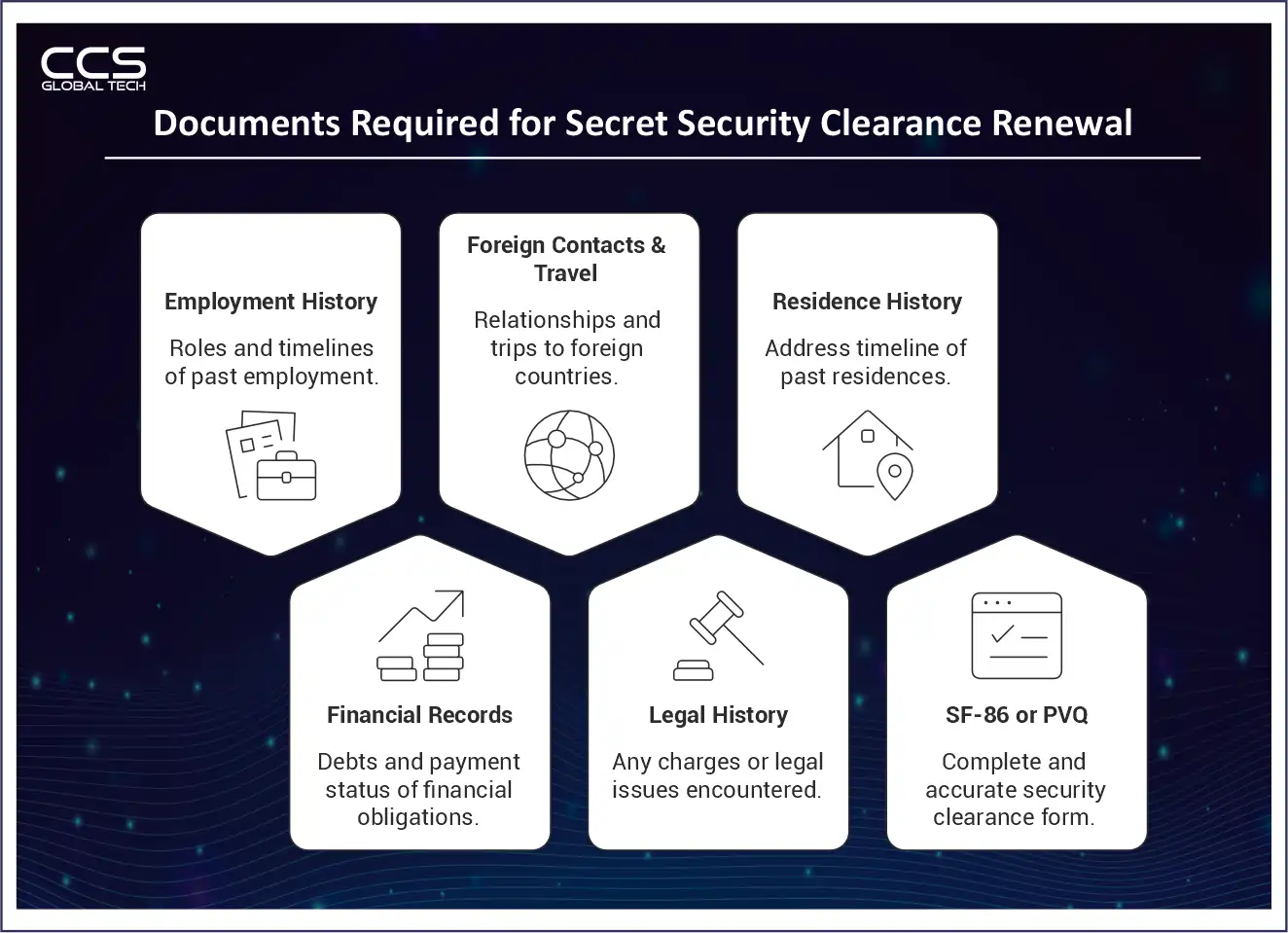
Documents Required for Secret Security Clearance Renewal

The Renewal Process: Stage by Stage

The specific mechanics vary depending on whether you’re a DoD contractor, a federal employee, or a member of the military. But the broad outline of the process follows the same structure across most cases. Here’s what that looks like from initiation through adjudication.

1- Notification from your FSO

Your Facility Security Officer (FSO) initiates the renewal process and notifies you when your SF-86 update is due.
In most cases, they will access your record through the Defense Information System for Security (DISS) and send you a link to complete your updated questionnaire via e-QIP (Electronic Questionnaires for Investigations Processing) or, increasingly, through DCSA’s newer systems as the migration progresses.
Initiated by FSO

2- Complete and submit the SF-86 (or PVQ)

As of FY2026 Q2, the government has begun the phased transition to the new Personnel Vetting Questionnaire (PVQ) – the long-awaited SF-86 successor approved by OMB in 2024.
Per ClearanceJobs (March 2026), early PVQ submissions were collected in FY26 Q2, with adoption expected to accelerate as supporting technology comes online. Disclosure is complete and accurate, omissions discovered later create far more serious concerns than the underlying issue itself.
ime required: Days to 2–3 weeks depending on preparation

You complete the updated Standard Form 86 covering your personal history, employment, residences, foreign contacts, finances, and other required areas.

3- Electronic fingerprint submission

DCSA requires electronic fingerprint transmission for all clearance applications. This must typically be completed within 14 days of the investigation request being submitted. Your FSO will coordinate the specifics – in most cleared facilities, fingerprinting is handled on-site or through a designated enrollment center.
Deadline: Within 14 days of investigation request

4- Background investigation (Tier 3)

Secret-level investigations are classified as Tier 3 (T3) investigations. DCSA assigns the case for investigation, which includes automated record checks at law enforcement databases, credit repositories, court records, and employment verification.
Complex cases may involve field interviews with references, neighbors, or former employers. The depth of investigation depends entirely on what the automated checks surface and how much investigative development your case requires.
Current average: 73 days for T3 investigation component (FY2025)

5- Adjudication

Once the investigation is complete, the case moves to adjudication – where a trained adjudicator reviews all findings against the 13 National Security Adjudicative Guidelines.
For Tier 3 cases, Federal News Network reports that adjudication averages 47 days as of Q3 FY2025. If the adjudicator identifies concerns, a Statement of Reasons (SOR) is issued and the applicant has the opportunity to respond. If no concerns arise, the clearance is continued without further action required from the clearance holder.
Current average: 47 days for T3 adjudication (Q3 FY2025)

Realistic Timeline: What to Actually Plan For

Timeline expectations matter – particularly for contractors and program managers who need to plan around personnel availability and access requirements. The table below reflects current DCSA data as of the most recent reporting periods.

Stage 

Current Average 

Notes 

Case initiation 

18–19 days 

Time from submission to case being formally opened. 

Tier 3 investigation 

73 days (goal: 40 days) 

DCSA goal of 40 days remains unmet; active improvement efforts ongoing. 

Adjudication 

47 days 

For straightforward T3 cases with no significant concerns surfaced. 

Total end-to-end (T3) 

~138 days (FY2024 avg.) 

Full-year 2024 average across fastest 90% of Secret cases. 

Complex cases 

6–12+ months 

Cases with foreign contacts, financial concerns, or record discrepancies may extend significantly. 

Backlog Context
DCSA’s pending investigation inventory climbed to just under 300,000 cases by the end of FY2024 – the highest since FY2019 Q4. The agency deployed a dedicated tiger team and, as of Q3 FY2025, had reduced the inventory by 24% to approximately 222,700 cases.
Additionally, a new FBI prioritization tool cut the name-check backlog from 42,000 to 20,000 cases – a 48% reduction. These improvements are gradually working through the system, and further timeline reductions are expected as inventory continues to decline. Source: Federal News Network, May 2025.

The Real-World Impact of Delays

A 138-day average sounds manageable in isolation. But in practice, timing matters enormously, especially when a contractor’s access is tied directly to their ability to perform on a program. Consider what happens when a renewal gets caught in a backlog: access may be extended provisionally while the investigation is pending, but this isn’t always guaranteed, and it depends on the specific agency and contract requirements.
Real-World Context
A cleared professional supporting a multi-year defense IT program had their renewal SF-86 submitted on schedule, nine months before their prior investigation’s anniversary date. That buffer proved essential. The automated checks surfaced a credit inquiry that required field follow-up, not a disqualifying issue, but one that added roughly six weeks to the investigation timeline.
Because the submission was proactive rather than last-minute, the case resolved before any access interruption occurred. The key variable wasn’t the complexity of the issue, it was how early the process started.
This is precisely why FSOs and security managers consistently recommend initiating the renewal process well ahead of the formal due date. The submission window you control; the investigation timeline you don’t.

What the SF-86 Update Requires - and Where People Get Into Trouble

The SF-86 update covers a substantial range of personal history. For most renewals, you’re documenting changes since your last submission – new employers, new addresses, foreign travel, financial changes, and any reportable life events. But that summary underestimates the places where issues arise.
The most common problems in renewal submissions aren’t dramatic security concerns. They’re documentation gaps, omissions of technically required disclosures, and the tendency to underreport changes that the applicant views as minor.
Every significant life event since your last SF-86 submission is potentially reportable, and the standard for disclosure is broader than most people initially assume.

Items Commonly Omitted or Underreported

Foreign travel– Every trip outside the U.S., including personal travel, must be documented. Country, dates, and purpose are all required.
Foreign contacts– Ongoing relationships with foreign nationals involving “bonds of affection or obligation” must be disclosed, including personal friendships that have developed since the prior submission.
Financial changes– Debts delinquent more than 120 days, bankruptcies, wage garnishments, and new significant debt obligations all require disclosure. This includes medical collections that the applicant considers a billing dispute.
Legal issues– Any arrest, citation, or criminal matter including minor civil infractions for controlled substances must be reported, regardless of final disposition.
Employment gaps or changes– All employment must be accounted for continuously. Gaps, freelance work, and short-term positions are all reportable.
Critical Point
An omission discovered during the investigation is treated as a personal conduct concern independent of whatever the underlying issue was. A debt that might have been mitigable on its own becomes significantly harder to address once the adjudicator is also evaluating why it wasn’t disclosed.
Complete and accurate disclosure even of unfavorable information is consistently better for the applicant than an incomplete submission.

Continuous Vetting: What It Monitors and What It Means for You

As mentioned earlier, enrollment in Continuous Vetting means your clearance is being monitored between the formal five-year SF-86 submissions. Understanding what CV actually checks helps cleared professionals avoid surprises.
The automated CV program runs regular checks against financial data, criminal record repositories, watchlists, and certain open-source information. An “alert” or “hit” – a new delinquent account, an arrest, a name appearing in a relevant database triggers notification to the relevant security official, who then determines whether additional investigation is warranted.

What Continuous Vetting Monitors?

  • Credit and financial record changes (new delinquencies, bankruptcies, wage garnishments, significant new debt).
  • Criminal record additions (arrests, charges, civil citations). 
  • Watchlist and law enforcement database checks. 
  • Certain social media indicators (in specific programs and at certain clearance levels). 
  • Personnel records changes that may affect eligibility.  
The practical implication: issues that arise between formal renewal cycles don’t sit undetected until your next scheduled investigation.
They can surface in near real-time. This actually serves cleared professionals who handle issues proactively resolving a delinquent account before it becomes a formal concern is vastly preferable to having it surface in a CV alert mid-program. Self-reporting to your FSO when a reportable event occurs remains the most important protective step a clearance holder can take.

The PVQ: What's Changing in the Application Process

For anyone who will be completing a clearance renewal in the next one to two years, the transition from the SF-86 to the Personnel Vetting Questionnaire (PVQ) is worth understanding. The PVQ was approved by the Office of Management and Budget in 2024 and received its first submissions in FY26 Q2, according to ClearanceJobs (March 2026).
The PVQ updates and consolidates several of the older forms, and it includes revised language in a few notable areas. It addresses prior marijuana use more specifically, clarifying that the government treats historical cannabis use differently from other drug history.
It also updates the mental health history sections to reduce the perception long held by many applicants that seeking counseling or mental health treatment automatically damages clearance eligibility. For renewals, the transition will be phased, with adoption expected to accelerate as the underlying NBIS technology platform comes online.
Key Update: Outdated SF-86 Forms
Outdated versions of the SF-86 are no longer accepted for new investigations or reciprocity requests as of August 1, 2025, per updated DCSA guidance. If you are approaching a renewal, confirm with your FSO that you are using the current version of the form or ask about the PVQ transition timeline for your specific case type. Using an outdated form delays the process before it even starts.

Maintaining Access During the Renewal Period

One of the most practically important questions for cleared professionals during a renewal is: will your access be interrupted while the investigation is pending? The short answer is: usually not, but it depends on the agency and the specifics of your situation.
For most DoD contractors, access continues under the existing clearance while the renewal investigation is in progress. The key is that the SF-86 must be submitted on time. If a renewal is overdue because the SF-86 wasn’t submitted when required, access can be suspended and that’s a far more disruptive outcome than the investigation itself.
The 24-month rule is also relevant here. If a cleared professional leaves a cleared employer, their clearance can be reactivated without a new full investigation for up to 24 months provided the clearance hasn’t lapsed. This window gives cleared professionals flexibility during career transitions, but it requires proactive management. Once that window closes, reactivation requires a full reinvestigation.

Five Things That Make Renewals Go Smoothly
Years of working with cleared professionals and their sponsors across the federal and defense contracting space have given us a clear picture of what separates smooth renewal processes from difficult ones. These five factors come up consistently.
1- Start early
Submit your SF-86 update well before the formal due date ideally six to nine months ahead. Investigation timelines are not within your control; submission timing is.
2- Keep organized records between renewals
Dates of all foreign travel, names and nationalities of foreign contacts, employment history with exact dates, and any reportable life events are all significantly easier to document when they’re recorded contemporaneously rather than reconstructed years later.
3- Self-report promptly
When a reportable event occurs – a new delinquency, an arrest, a foreign contact, a significant financial change notify your FSO. Self-reporting demonstrates the honesty and judgment that adjudicators are specifically evaluating. An issue that is self-reported looks very different in an adjudication file than one that was discovered during investigation.
4- Don’t leave gaps in your employment history
Every period since your last SF-86 must be accounted for. If you had a career transition, a period of contract work, or any gap in employment, document it specifically. Unexplained gaps create questions that have to be resolved during investigation.
5- Be complete, not strategic
The temptation to omit something because it seems minor is the single most common self-inflicted problem in clearance renewals. Adjudicators evaluate the whole person – an isolated unfavorable item with full disclosure and context is far more manageable than one that appears to have been concealed.
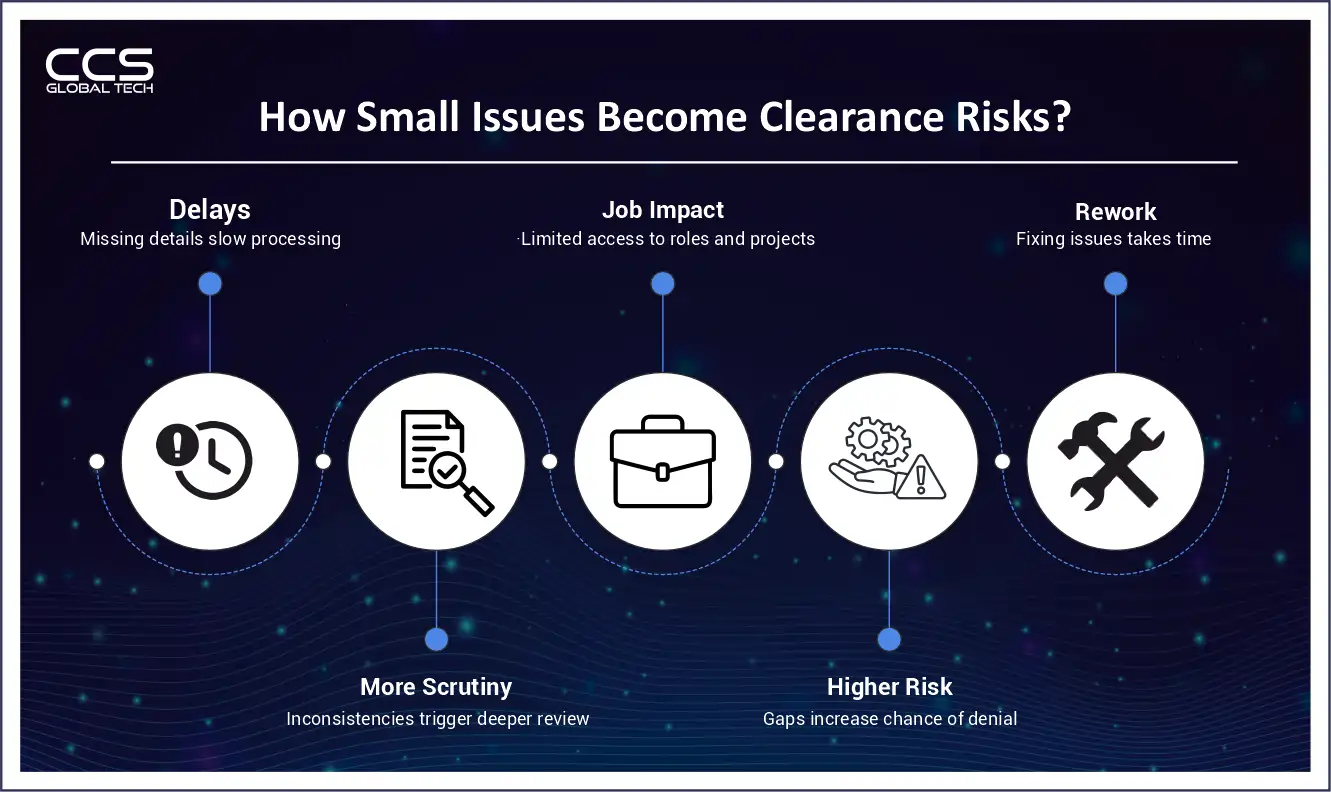
How Small Issues Become Clearnce Risks

CCS Global Tech Federal Services: Your Partner Through Every Stage of the Clearance Process

Whether you’re a contractor employer managing renewals across a cleared workforce, a program manager planning around access requirements, or an individual professional navigating the process for the first time, our Federal Services team has deep experience in every aspect of the clearance lifecycle.
We work with clients to reduce delays, avoid common documentation pitfalls, and maintain the workforce readiness their contracts require.

FAQs

Q1: How early should I start the secret security clearance renewal process?

A: Start 6 to 12 months before expirationEarly action reduces delays and prevents gaps in eligibility. 

A: Reviews are triggered by periodic timelines or continuous vetting alerts. Role or contract changes can also initiate renewal. 

A: Most renewals take 3 to 9 months. Timelines vary based on background complexity and investigation workload. 

A: You must update SF-86 or PVQ with employment, finances, and contacts. Accuracy across all disclosures is critical. 

A: Financial concerns, undisclosed information, and inconsistencies are common issues. These raise risk during evaluation. 

A: Most individuals continue working under active clearance status. This depends on employer and contract requirements. 

A: Delays can affect project access and job eligibility. Some roles require active clearance at all times. 

A: Continuous vetting flags issues in real time. This can either speed up or complicate the renewal process. 

A: Yes, unresolved debt and financial instability are major risk factors. Resolving them improves your chances. 

A: Disclose and correct them during renewal. Transparency and consistency improve credibility with investigators.