

5 Security Clearance Tips Every Cleared Candidate Must Know

Security Clearance Tips Every Cleared Candidate Must Know
Getting a security clearance is not a checkbox. It is a process that can take months, surface aspects of your personal history you forgot about, and hinge on decisions that feel completely out of your control. For many candidates, the uncertainty alone is overwhelming and the consequences of a stumble are significant, both for their careers and for the organizations counting on them.
We have been operating inside the federal cleared talent ecosystem for over 25 years. We have watched thousands of candidates go through this process, many of them smoothly, some of them not. And the difference, more often than not, comes down to preparation and awareness.
This is not a surface-level overview. These are five things cleared candidates actually need to understand going into 2025 and beyond backed by current data and grounded in what we see happening in the field.
DCSA’s background investigation backlog peaked at approximately 291,200 pending cases in September 2024, the highest level since FY2019. By January 2026, it had dropped to roughly 100,000 cases, a 65% reduction but processing times still vary widely depending on clearance level and case complexity.
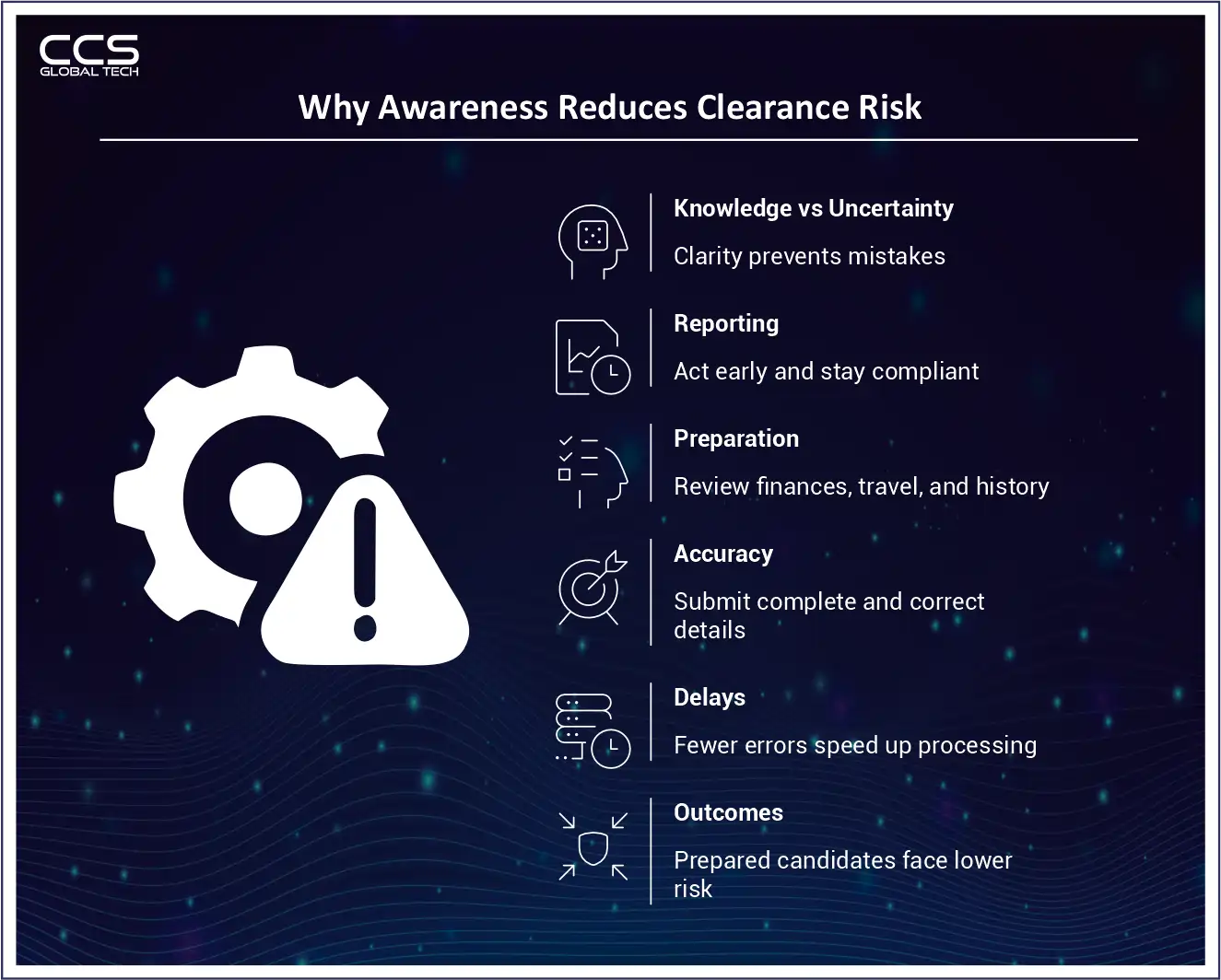
Why Awareness Reduces Clearance Risk

Best Security Clearance Tips to be considered

Let’s get started..

Tip #1: Honesty Is Not Optional - It Is the Foundation

This may sound obvious, but it’s not. Every year, candidates lose clearances or fail to get them not because of the issue itself, but because they tried to hide it. Adjudicators are trained to identify omission.
They compare your SF-86 against law enforcement records, credit reports, court filings, and interviews with people who know you. If the record contradicts your application, you now have two problems instead of one.
The adjudicative framework used by DCSA is built on what is called the “whole person concept.” This means no single issue automatically disqualifies a candidate.
A past financial hardship, an old arrest, a prior drug use disclosure, these are evaluated in context, weighed against mitigating factors like time elapsed, demonstrated rehabilitation, and, critically, whether the candidate was forthcoming about it.
According to adjudication data from the Defense Office of Hearing and Appeals (DOHA), financial issues account for the largest share of clearance denials nearly 30% and dishonesty on the SF-86 is among the top reasons those denials are upheld on appeal rather than reversed.

What this means in practice?

When you fill out your SF-86, disclose what is required. If you are unsure whether something needs to be reported, err toward disclosure.

When you fill out your SF-86, disclose what is required. If you are unsure whether something needs to be reported, err toward disclosure.

A minor issue that is voluntarily reported is almost always viewed more favorably than the same issue that surfaces through investigation. Adjudicators are instructed to consider honesty as a mitigating factor and dishonesty as a disqualifying one.

Tip #2: Your Financial Picture Matters More Than You Think

Of all the categories evaluated during a background investigation, financial considerations trip up more candidates than any other and it is the one most people underestimate. The concern is not that you have had financial difficulty.
Life happens medical emergencies, divorces, job losses. What adjudicators are evaluating is whether your financial situation creates a vulnerability to coercion or compromise, and whether you have taken responsible steps to address it.
Unresolved debt, ignored collections, tax liens, and bankruptcies that were never addressed these are the patterns that raise flags. Not because they represent moral failure, but because they represent unresolved risk in the eyes of a security professional.
DCSA has consistently reported that financial considerations under Adjudicative Guideline F represent the leading category of clearance denials year over year making up nearly 30% of all adverse decisions. Proactive mitigation, including documented repayment plans, consistently improves adjudicative outcomes.

What this means in practice?

Before you submit your application, pull your credit report. Know what is on it. If there are outstanding collections or unresolved debts, take steps to address them, enroll in a repayment plan, settle what you can, and document your efforts.
Even partial progress matters. Adjudicators are far more concerned about candidates who know about a problem and ignore it than candidates who know about a problem and are actively working through it.
Real-World Scenario
A cybersecurity professional applied for a Top Secret clearance and was well-qualified on paper. His credit report showed a medical collection from three years prior that he had been meaning to address but kept putting off. The collection was flagged during investigation, and the delay in adjudication pushed the project start date back by four months.
Had he cleared the balance or at minimum enrolled in a payment arrangement before submission, the issue would have been mitigated before it became a timeline problem. The clearance was eventually granted, but the delay cost both him and his sponsor organization significantly.

Tip #3: Continuous Vetting Is Now the Standard - Your Clearance Does Not End at Approval

This is the piece most cleared candidates do not fully internalize until it affects them. Getting your clearance approved is not the finish line. Under the Trusted Workforce 2.0 initiative, the traditional model of periodic reinvestigations every 5 to 10 years has been replaced and is being replaced by continuous vetting.
Continuous vetting runs automated background checks against public records, government databases, financial data, and other sources on an ongoing basis. When the system flags something a new arrest, a suspicious financial transaction, foreign travel, it generates an alert that prompts further review. You may not even know it is happening. And the expectation that you will report certain life events proactively has never been more actively enforced.
Under Trusted Workforce 2.0, continuous vetting has replaced periodic reinvestigations for cleared personnel across the DoD. DCSA now conducts approximately 2.7 million background investigations each year about 10,000 per business day. The agency also receives roughly 30,000 reports of suspicious contact annually.

What this means in practice?

Know your self-reporting obligations under SEAD-3 (Security Executive Agent Directive 3). These are not optional. Changes in your financial situation, foreign travel, new foreign contacts, arrests, and certain relationship changes must be reported to your security officer in a timely manner.
What was once easy to forget in the old periodic-reinvestigation model is now surfaced automatically through continuous monitoring. The candidates who get into trouble are almost always the ones who forgot or assumed that something did not need to be reported.

Tip #4: Understand the Timeline and Plan Around It, Not Against It

One of the most consistent sources of frustration and avoidable delays, we see is candidates and organizations treating clearance timelines as an afterthought. They submit an application and expect a decision in a few weeks. When months pass, panic sets in. Decisions get made under pressure. Projects get jeopardized.
The reality is that clearance timelines are long, and they vary. They depend on clearance level, case complexity, how complete your SF-86 is at submission, how quickly references respond, and whether there are any issues that require additional investigation. No single factor controls the outcome, all of them together do.
As of Q3 FY2025, the average end-to-end processing time for a Top Secret clearance was 243 days, including 215 days for the investigation itself. Secret-level cases averaged 73 days for investigation and 47 days for adjudication.
These numbers are improving as DCSA works through its backlog, but they remain the operational reality candidates and sponsors must plan around.

What this means in practice?

Start early. If you are entering a field that requires a clearance, take every step possible to be prepared before you even have a sponsor. That means knowing what is in your background, having your employment and residential history documented for at least the past 10 years, and identifying any issues that will need to be disclosed so you can address them proactively.
The candidates who move through the process fastest are those whose applications are complete, accurate, and free of preventable surprises.
For candidates already in the process: understand that silence from DCSA during the investigation phase is normal. The process takes time. Submitting duplicate documents, repeatedly contacting your security officer, or introducing new information mid-investigation can create additional delays rather than resolve them.

Tip #5: Know Your Adjudicative Guidelines - All 13 of Them

Most candidates walk into the clearance process knowing about two or three things that might affect them. They know about financial issues. They know about criminal history. They may know about drug use. What they often do not know is that DCSA evaluates candidates across 13 adjudicative guidelines and that some of the less-discussed ones are increasingly in play.
The 13 guidelines cover: Allegiance to the United States, Foreign Influence, Foreign Preference, Sexual Behavior, Personal Conduct, Financial Considerations, Alcohol Consumption, Drug Involvement, Psychological Conditions, Criminal Conduct, Security Violations, Outside Activities, and Use of Information Technology Systems.
Drug involvement, in particular, has become a more active category. The widespread legalization of cannabis at the state level has created a dangerous misconception: that federal agencies treat state law and federal law the same way.
They do not. Cannabis remains a Schedule I substance under federal law, and use especially recent use or stated intent to continue use remains a clearance concern regardless of where you live.
DOHA cases tied to drug use, primarily cannabis, rose steadily through 2023 and 2024. Denials in this category are almost never about the use itself, they are about non-disclosure on the SF-86, or the candidate’s stated intention to continue use because it is legal at the state level. Both raise serious concerns about compliance and judgment.

What this means in practice?

Read the National Security Adjudicative Guidelines. Know which ones are relevant to your specific history. The “whole person concept” cuts both ways, it means isolated past issues are not automatically disqualifying, but it also means the full picture of your character and judgment is being evaluated.
Candidates who understand what adjudicators are actually looking for are in a far stronger position than those who guess.
Foreign contacts and foreign travel are worth particular attention in today’s environment. Having family abroad, working with international colleagues, or traveling internationally for personal reasons is not disqualifying but failing to disclose foreign contacts, or maintaining financial relationships with foreign nationals without reporting them, is a significant flag under Guideline B (Foreign Influence) and Guideline C (Foreign Preference).
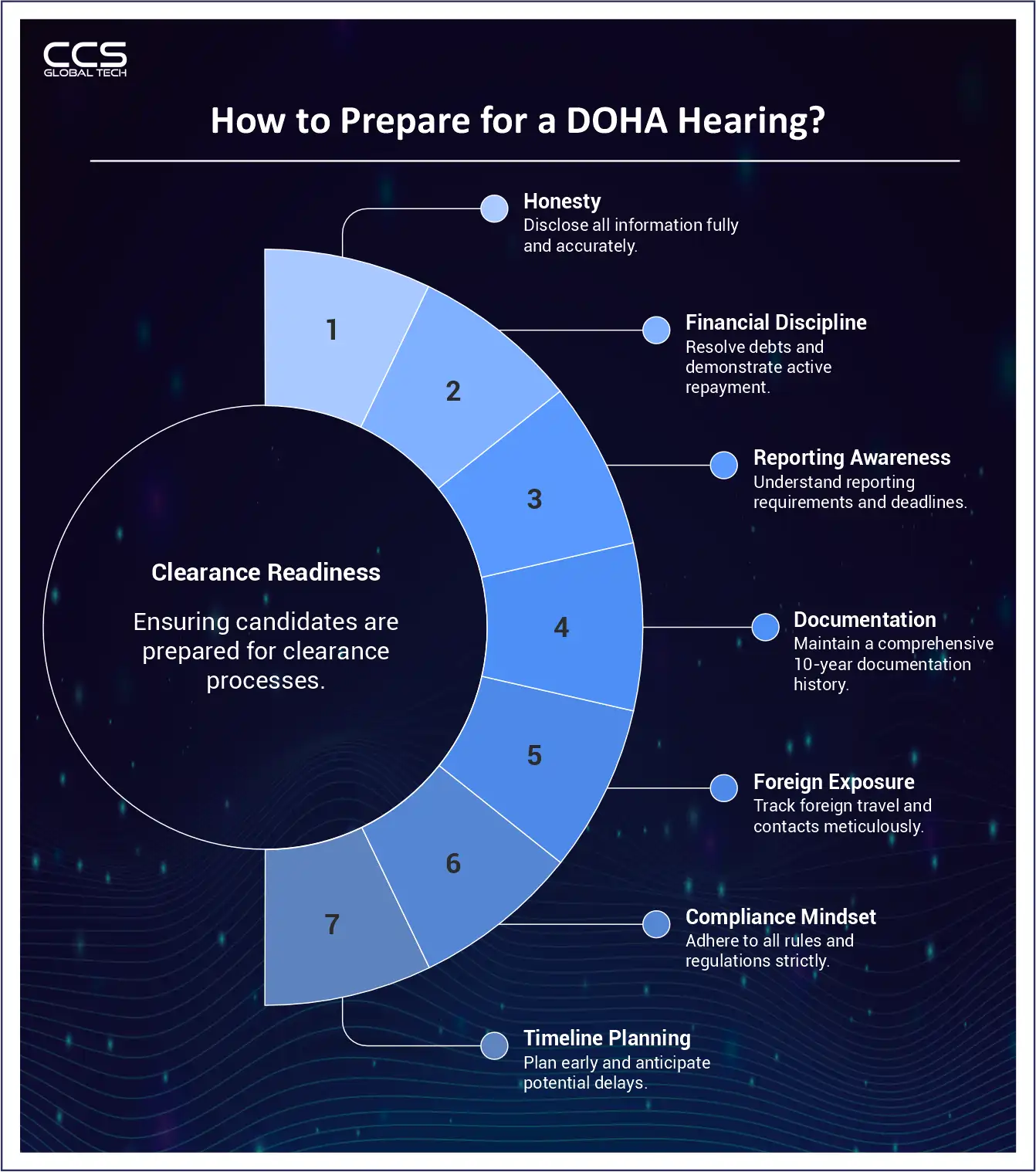
How to Prepare for a DOHA Clearing

The One Thing All Five Tips Have in Common

Every single piece of advice above points to the same root: candidates who prepare, who understand the process before they enter it, and who treat their clearance as an ongoing responsibility rather than a one-time application, these are the candidates who come through cleanly.
The clearance process is not designed to catch people in gotcha moments. It is designed to build a credible, documented picture of who you are, how you handle responsibility, and whether you can be trusted with classified information. Candidates who approach it that way almost always fare better than those who approach it as an obstacle to get around.
And for those who have complex histories – financial difficulties, prior drug use, foreign connections, past legal issues- there is almost always a path forward. It requires honest disclosure, documented mitigation, and in many cases, guidance from people who know the process well enough to help you present your situation accurately and compellingly.

Your Clearance Journey Deserves a Trusted Partner

Navigating the security clearance process is not something you should have to figure out alone especially when the rules keep changing, the timelines keep shifting, and the stakes are this high.
At CCS Global Tech, we have spent over 25 years working at the intersection of federal contracting, cleared talent acquisition, and compliance. We have seen candidates clear easily with the right preparation, and we have seen strong candidates stumble because nobody walked them through what to expect.
We work with cleared candidates from Public Trust through Top Secret/SCI and with the federal agencies and defense contractors that hire them. That means we understand the process from both sides, and we can help you navigate it with confidence.
How we support cleared professionals?
Access to 100+ hiring agencies, career-matched roles, and veteran-focused pathways through 200+ partnerships.
Pre-submission SF-86 guidance plus training and certifications aligned with DoD 8570 and 8140 through CCS Learning Academy.
Whether you are entering the clearance process for the first time, navigating a challenge mid-investigation, or looking for your next cleared role, our team is here to help. We do not deal in generic career advice. We deal in the specifics: the forms, the timelines, the roles, and the relationships that get cleared professionals placed.
One conversation can change the trajectory of your cleared career. Let’s have it.

FAQs

Q1- What are the most important habits to maintain a security clearance?

A- You should report changes early, keep financial records clean, track foreign travel and contacts, and follow all disclosure requirements consistently.

A- Start early, submit complete and accurate information on your SF-86, and resolve any financial or legal issues before submission.

A- Yes. Late payments, high debt, or unresolved collections can raise concerns about reliability and potential risk. 

A- You should report foreign travel, new foreign contacts, legal issues, significant financial changes, and any behavior that could affect your reliability. 

A- Accuracy is critical. Even small omissions or inconsistencies can delay processing or lead to denial.

A- Yes. Improper transfer or long gaps between cleared roles can move your clearance to inactive status and require re-investigation.

A- Track and report any meaningful or repeated interactions with foreign nationals, especially if the relationship continues over time. 

A- Report it immediately to your security officer with complete details. Early disclosure reduces risk. 

A- Yes. Avoid sharing sensitive information or content that could raise questions about judgment or associations. 

A- Maintain consistent records, follow reporting timelines, and avoid gaps in compliance across travel, finances, and personal conduct.