



5 Automatic Security Clearance Disqualifiers
1. Unresolved Financial Debt (Guideline F - Financial Considerations)
- Delinquent debt exceeding $7,500 (particularly over 90 days past due).
- Debt-to-income ratios above 40%.
- Chapter 7 bankruptcy within 10 years or Chapter 13 within 7 years.
- Patterns of financial irresponsibility (payday loans, gambling markers, chronic late payments).
Case Example: Systems administrator with $42,000 in delinquent accounts across credit cards and medical bills. Despite consistent payments, the debt-to-income ratio triggered Guideline F denial.
Mitigation Requirements:
- Obtain credit reports from all three bureaus (AnnualCreditReport.com).
- Establish documented repayment plans for debts over $2,000.
- Maintain 6-12 months of bank statements demonstrating responsible cash flow.
- Complete financial counseling (NFCC-certified providers preferred).
2. Recent Illegal Drug Use (Guideline H - Drug Involvement and Substance Misuse)
- Marijuana: Any use within 12-24 months.
- Schedule I/II controlled substances: Any use within 5 years.
- Multiple incidents: Even years apart indicates pattern.
- Non-disclosure: Triggers Guideline E (Personal Conduct) violation.
Required Mitigation Evidence:
- Full candor on Section 23 of SF-86 (all use, all dates).
- 5+ years time elapsed since last use (dramatically improves outcomes).
- Negative drug testing results (past 12 months).
- Professional counseling records (if applicable).

3. Foreign Influence and Close Relationships (Guideline B - Foreign Influence)
- Immediate family members residing in countries of concern (China, Russia, Iran, North Korea, Cuba).
- Dual citizenship or foreign passports (active or expired).
- Marriage, engagement, or cohabitation with foreign nationals.
- Financial dependencies on foreign nationals or entities.
- Frequent, undocumented foreign travel.
- Surrender all foreign passports to U.S. State Department.
- Document financial independence from foreign relatives (12 months bank records).
- Limit non-essential foreign travel during investigation.
- Prepare relationship affidavits from spouse/domestic partner.
4. Criminal Conduct (Guideline J - Criminal Conduct)
Criminal‑history‑related suitability concerns account for roughly 1‑out‑of‑every‑7 (about 14–15%) of security‑clearance‑related eligibility reviews, with felony convictions treated as a permanent risk factor under U.S. DoD and intelligence‑community guidelines. Recent or patterned conduct triggers automatic scrutiny.
- Felony convictions (violent crime, fraud, weapons)– lifetime adjudication.
- Misdemeanors within 7 years (DUI, domestic violence, theft).
- Multiple arrests (even dismissed charges create pattern).
- Domestic violence–automatic SCI disqualification.
- Non-disclosure –compounds Guideline E violation.
Case Example: Systems engineer disclosed 2018 misdemeanor DUI but omitted 2023 disorderly conduct charge “handled privately.” Omission triggered dual Guideline E/J denial.
- Complete court disposition documents (all charges).
- 10+ years’ time elapsed since last offense.
- Character reference letters from supervisors.
- Evidence of rehabilitation (community service, counseling).
- Full SF-86 candor across all sections.
5. Pattern of Security Violations or Dishonesty (Guideline E - Personal Conduct)
- SF-86 omissions (employment, residences, relationships, foreign contacts).
- Previous security violations (Level I, II, or III incidents).
- Unreported foreign travel (even personal trips).
- Inconsistent statements to investigators.
- Character contradictions (references vs documented behavior).
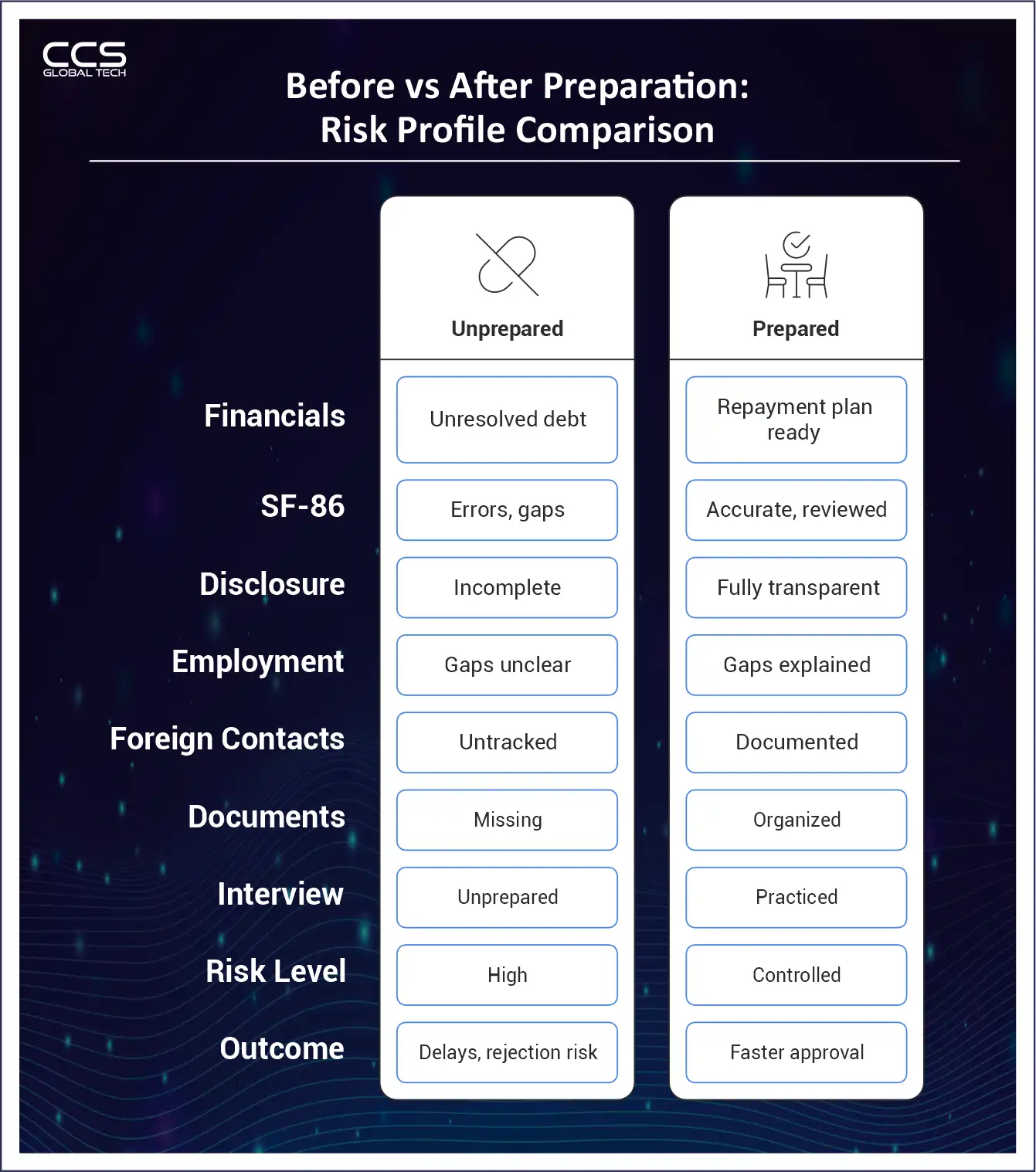
- Triple-check SF-86 using checklist (all sections, all time periods).
- Maintain security incident log (even minor counseling).
- Report foreign travel within 5 days via security manager.
- Spouse review of completed SF-86 (fresh eyes catch omissions).
Statistical Overview of Clearance Denial Trends
Disqualifier | % of Denials | Primary Guideline | Appeal Success Rate |
Financial Issues | 29.8% | F | 68% |
Drug Involvement | 22.4% | H | 42% |
Foreign Influence | 18.2% | B | 76% |
Criminal Conduct | 15.3% | J | 54% |
Personal Conduct | 12.7% | E | 61% |
Source: DCSA Annual Report to Congress, DOHA 2024 Case Summaries

The Preparation Imperative: Your 90-Day Action Plan
- Pull credit reports (Equifax, Experian, TransUnion)
- List all debts >$2,000 with repayment plans
- Begin financial counseling (NFCC-certified)
Weeks 3-4: Documentation Audit
- Compile criminal history (all dispositions)
- Map foreign relationships (family, financial, travel)
- Surrender foreign passports
Weeks 5-8: SF-86 Mastery
- Complete trial SF-86 (e-QIP practice version)
- Spouse and mentor review (minimum two reviews)
- Document all employment gaps >30 days
- Mock investigator interview (uncomfortable questions)
- Collect character references (supervisors only)
- 6 months bank statements (responsible cash flow)
Why CCS Global Tech Federal Services Delivers Results?
FAQs
Q1. What are the most common reasons a security clearance application gets denied?
A. Financial issues, foreign influence, criminal conduct, personal conduct, and drug involvement are the most common triggers. These raise concerns about reliability, judgment, and risk exposure.
Q2. How does debt impact security clearance eligibility?
A. Unresolved or delinquent debt signals financial instability. Investigators focus on patterns, repayment efforts, and whether the applicant has taken corrective action.
Q3. Can foreign relationships affect my security clearance approval?
A. Yes. Close relationships with foreign nationals, especially with financial or government ties, increase scrutiny due to potential coercion risks.
Q4. Do I need to report all foreign contacts on my clearance application?
A. Yes. You must disclose all relevant foreign contacts, including family, close associates, and recurring interactions. Missing details can trigger delays or denial.
Q5. Will past criminal charges automatically disqualify me from a clearance?
A. Not always. Decisions depend on severity, recency, and evidence of rehabilitation. Undisclosed offenses create higher risk than disclosed ones.
Q6. How does drug use affect security clearance decisions?
A. Recent or ongoing drug use raises concerns about judgment and reliability. Evidence of cessation and behavior change improves outcomes.
Q7. What happens if I forget to disclose information on the SF-86 form?
A. Incomplete or inconsistent disclosures are treated as personal conduct issues. This often leads to delays, deeper investigation, or denial.
Q8. Can I still get clearance if I have financial or legal issues?
A. Yes, if you show mitigation. Repayment plans, documentation, and consistent behavior help reduce risk.
Q9. How can I reduce the risk of my clearance application being delayed?
A. Ensure full disclosure, maintain consistent records, prepare documentation, and resolve major issues before applying.
Q10. Why do some applications get delayed instead of denied?
A. Missing information, unresolved risks, or unclear disclosures often lead to delays while investigators gather more details.