

How to Meet the Requirements for Public Trust Security Clearance?

Public Trust Security Clearance Requirements Complete Guide
Public Trust clearance sits at the center of federal hiring. It is not a clearance in the traditional classified sense, but it carries the same weight when it comes to access, responsibility, and trust.
For many professionals entering federal or contractor roles, this is where the process becomes unclear. Requirements are not always communicated in plain terms. Expectations vary by role. Small mistakes create delays that could have been avoided.
At CCS Global Tech Federal Services, we work with candidates and contractors navigating this process every day. The pattern is consistent. Most issues are not about eligibility. They are about preparation.
This guide breaks down what Public Trust clearance requires, where candidates face friction, and how to position yourself for a smooth outcome.

What Public Trust Clearance Actually Means?

Public Trust positions are designated for roles that involve access to sensitive government systems or data. These roles are common across:
  • Federal IT programs  
  • Data analytics and reporting systems  
  • Healthcare and financial systems  
  • Program management and operations
The evaluation focuses on suitability and reliability, not classified access. That distinction matters. The process is less about secrets and more about whether you can be trusted to handle systems, data, and responsibilities without risk.
The investigation is conducted using forms such as SF-85 or SF-85P, depending on the risk level.

Why This Process Matters More Than Candidates Expect?

Federal hiring is expanding in areas like cybersecurity, data, and digital transformation. At the same time, trust requirements are tightening.
According to the U.S. Bureau of Labor Statistics, employment in data-related roles such as data scientists is projected to grow 34% from 2022 to 2032, much faster than the average for all occupations.
That growth directly increases demand for Public Trust roles.
At the same time, workforce expectations are shifting. The World Economic Forum reports that 44% of workers’ core skills will change within five years, making continuous upskilling and role transitions more common.
More transitions mean more candidates entering federal roles for the first time. Many are qualified. Few are prepared for the clearance process.

Core Requirements for Public Trust Clearance

Public Trust clearance evaluates multiple areas at once. No single factor determines the outcome. The decision is based on overall risk.

1. Financial Responsibility

Financial stability is one of the first areas investigators review because it directly reflects judgment, reliability, and potential risk exposure. The goal is not to find perfect credit, but to understand how you manage obligations over time.
Investigators typically look for:
  • Delinquent or past-due accounts. 
  • Collections, charge-offs, or settlements.  
  • Patterns of missed or inconsistent payments.  
  • Sudden increases in debt without explanation.
A single issue does not create risk. A pattern without action does. What matters most is whether the candidate has taken responsibility and shown control over the situation.
For example, a candidate with $8,000 in credit card debt was initially flagged during review. The concern was not the amount. It was the lack of context. Once the candidate provided a structured repayment plan, along with three months of consistent payments and supporting statements, the concern was mitigated and the case moved forward.
Financial issues are common. Unaddressed issues are the problem. The expectation is simple. If there is a financial concern, it should be acknowledged, supported with documentation, and backed by a clear plan.

2. Employment and Background Consistency

Public Trust investigations rely heavily on consistency. Your employment, education, and residential history must align across all submitted information and external records.
Candidates are expected to provide:
  • Complete employment timelines with accurate dates.  
  • Verified education records.  
  • Full residential history without gaps.

Gaps in employment or residence are not unusual. Career transitions, relocations, or personal breaks happen. The issue arises when those gaps are not explained. 

Investigators cross-check your information against multiple sources, including employer verification, public records, and prior submissions. Even small discrepancies, such as overlapping dates or missing months, can trigger follow-up questions.
For instance, a candidate listed employment dates that differed slightly from employer records. The difference was only a few weeks, but it raised concerns about accuracy. The delay could have been avoided with a simple clarification upfront.
The expectation is not perfection. It is alignment. Every entry should be complete, consistent, and easy to verify.

3. Criminal and Legal History

Disclosure of legal history is a required part of the Public Trust process. This includes:
  • Arrests, even if charges were dropped.  
  • Criminal charges and outcomes.  
  • Civil or legal proceedings where applicable.  

The presence of a past issue does not automatically disqualify a candidate. Investigators look at context, recency, and resolution.
What matters most is transparency.
A resolved issue with proper documentation and clear explanation is often manageable. A failure to disclose the same issue creates a larger concern because it raises questions about honesty and reliability.
For example, a candidate with a minor past offense disclosed the incident, provided court documentation, and explained the circumstances. The case proceeded without issue. In contrast, candidates who omit similar information often face delays or escalations, even when the original issue is minor.
The process evaluates both the event and the response to it. Full disclosure, supported by documentation, is always the stronger position.

4. Foreign Contacts and Influence

Foreign relationships are common, especially in a global workforce. Public Trust clearance does not restrict these connections. It requires visibility into them.
Candidates must disclose:
Immediate and extended family members who are not U.S. citizens. Financial interests or obligations outside the U.S. Frequent or extended international travel. Close personal or professional relationships with foreign nationals.
The concern is not the existence of these connections. It is whether they create a potential risk of influence, coercion, or conflict of interest.
Clear and structured documentation reduces that risk.
For example, a candidate with family members abroad provided detailed information about the relationship, frequency of contact, and financial independence. This clarity removed ambiguity and allowed the case to proceed without escalation.
Lack of detail creates questions. Clear documentation answers them. The expectation is straightforward. If a relationship exists, it should be disclosed and explained with enough context to eliminate uncertainty.

5. Personal Conduct and Integrity

This is the area where most cases shift direction. Investigators place significant weight on behavior patterns, especially those related to honesty and consistency.
They evaluate:
Accuracy of all submitted information. Consistency across forms, interviews, and records. Willingness to disclose sensitive or uncomfortable details. Overall judgment and reliability.
A minor issue rarely causes a problem on its own. It becomes a concern when it is hidden, minimized, or presented inconsistently.
For example, a candidate who omitted a minor financial issue on the initial form later disclosed it during follow-up questioning. The inconsistency raised more concern than the issue itself. The focus shifted from the financial matter to credibility.
This pattern appears across multiple areas, including employment gaps, foreign contacts, and past conduct.
The evaluation is based on the full picture.
Integrity is not measured by the absence of issues. It is measured by how clearly and consistently those issues are handled.

Where Most Candidates Get Delayed?

Delays are far more common than denials. The process slows down when:
Financial issues are unresolved. Forms are incomplete or inconsistent. Supporting documentation is missing. Candidates are unprepared for follow-up questions.
Industry analysis shows that while formal denials remain relatively low, a large number of applications are delayed, suspended, or withdrawn during investigation due to preventable issues. This is where preparation creates a clear advantage.
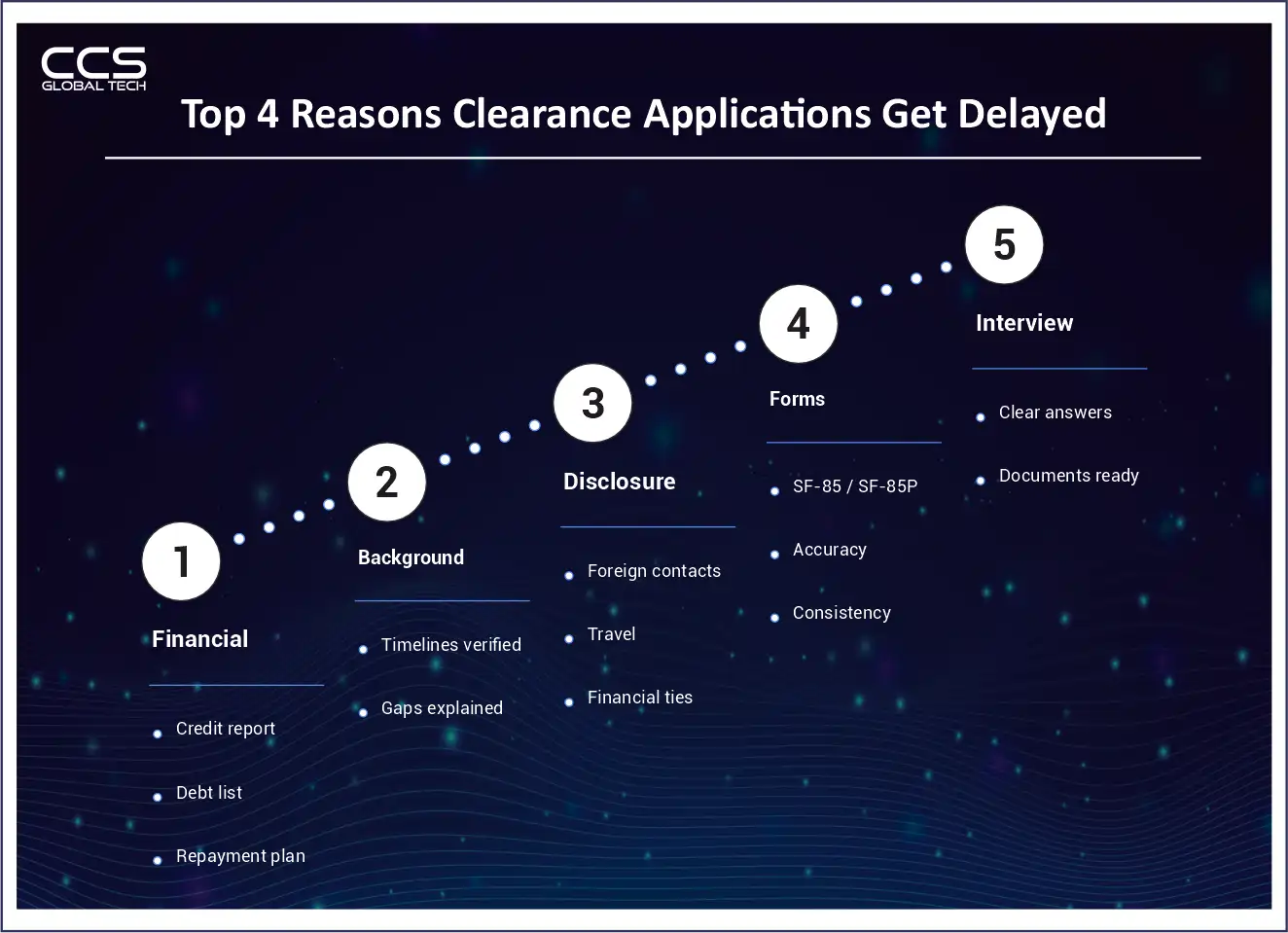
Reasons Why Clearance Applications Get Delayed

How Small Issues Escalate?

One of the most common patterns we see is escalation from a manageable issue to a clearance risk.
Example flow:
Minor debt → no action taken → not disclosed → mismatch found → flagged as conduct issue
At that point, the concern is no longer financial. It becomes a question of judgment and honesty. This pattern applies across:
  • Financial issues  
  • Employment gaps  
  • Foreign contacts  
The issue is rarely the problem. The handling is.

A Structured Approach to Meeting Requirements

Candidates who succeed in this process follow a structured approach.

Step 1: Build Financial Clarity

  • Pull credit reports  
  • Identify all outstanding obligations  
  • Create repayment plans  
Consistency matters more than perfection.

Step 2: Audit Your Background

  • Review employment timelines  
  • Document all gaps  
  • Gather legal and financial records  
Everything should align before submission.

Step 3: Prepare for Disclosure

  • List all foreign contacts  
  • Document travel history  
  • Be ready to explain context  
Clarity reduces follow-up.

Step 4: Validate Your Forms

  • Complete SF-85 or SF-85P carefully  
  • Review for accuracy  
  • Cross-check with supporting documents  
Most delays originate here.

Step 5: Prepare for the Interview

Investigators may ask:
  • Why was this not disclosed earlier  
  • What steps have you taken to resolve this issue  
  • Can you provide supporting documentation  
Prepared candidates answer with clarity. Unprepared candidates create uncertainty.

Real-World Scenario: What Preparation Changes

Two candidates applied for the same Public Trust role.
Candidate A:
  • Had minor financial issues  
  • Did not prepare documentation  
  • Provided incomplete disclosures  
Result: Investigation delayed for weeks with repeated follow-ups
Candidate B:
  • Had similar financial issues  
  • Provided repayment plan  
  • Documented all disclosures clearly  
Result: Smooth progression through investigation
The difference was not qualification. It was preparation.

The Business Impact of Getting This Right

For professionals, Public Trust clearance opens access to:
  • Federal contracts  
  • Long-term program roles  
  • Higher compensation opportunities  
For organizations, it impacts delivery timelines. Delays in clearance directly affect project execution.
At the same time, workforce stability is critical. According to LinkedIn, 94% of employees say they would stay longer at a company that invests in their development.
Retention, readiness, and clearance success are connected.

Why Preparation Is the Differentiator?

Public Trust clearance is not designed to eliminate candidates. It is designed to assess risk. Prepared candidates show:
  • Control over their financial and personal history. 
  • Consistency across all disclosures. 
  • Transparency in communication.  
Unprepared candidates create uncertainty. Adjudicators do not expect perfect records. They expect clear, documented, and honest ones.

How CCS Global Tech Federal Services Supports This Process?

CCS Global Tech Federal Services works with professionals and organizations navigating federal hiring requirements. Our approach focuses on preparation, not reaction.
We help candidates identify potential risks before submission, align their documentation with clearance requirements, prepare for investigator interactions with clarity and confidence, and reduce delays and uncertainty throughout the process.
Our experience across federal programs, cybersecurity roles, and data-driven projects gives us a practical understanding of how these decisions are made.

Your Next Step

If you are preparing for a Public Trust role, the question is not whether you qualify. The question is whether you are prepared.
  • Small gaps create delays. 
  • Unclear disclosures create risk. 
  • Structured preparation creates momentum. 
If you want a clear view of your readiness, feel free to connect with us. We will review your profile, identify potential risks, and outline a structured plan to strengthen your application. Always remember, preparation does not remove every issue. It ensures that those issues do not control the outcome.

FAQs

Q1: How far back does a Public Trust background check go?

A: Most investigations review 5 to 7 years of history based on role risk level. Higher-risk roles may require deeper checks across financial, employment, and personal records. 

A: Yes, debt is not an automatic disqualifier. Investigators look for repayment plans, consistent payments, and clear documentation showing financial control.

A: Gaps are acceptable if clearly explained. Unexplained or inconsistent gaps often lead to follow-ups and delays.

A: The review is detailed and cross-checked with multiple sources. Even small inconsistencies can trigger additional scrutiny.

A: Non-disclosure creates more risk than the issue itself. It should be corrected immediately with a clear explanation and supporting details. 

A: Timelines vary from a few weeks to several months depending on complexity, accuracy of the application, and verification requirements. 

A: No, foreign contacts are common. Full disclosure and clear context help eliminate concerns about influence or risk. 

A: They focus on financial issues, employment gaps, foreign contacts, and any inconsistencies. Supporting documentation is often requested. 

A: Yes, it will be reviewed, but it does not automatically disqualify you. You must disclose it and show what has changed since then. 

A: Submit accurate forms, provide complete documentation, resolve financial issues early, and prepare for investigator questions.