

Top Secret Clearance Expiration: How Long It Lasts and How to Reactivate

Top Secret Clearance Expiration
You earn Top Secret clearance after years of paperwork and investigation. Build your career around it. Then life intervenes- a private sector break, contract gap. Your clearance quietly expires. Reactivation? Now it’s a full reinvestigation.
This scenario plays out more often than most people in the cleared workforce realize. And it carries consequences that can reshape careers and put federal contractors in a difficult position either scrambling to catch up or losing bids they should have won.
At CCS Global Tech, we work closely with federal contractors, cleared professionals, and government agencies navigating exactly this challenge. What follows is a clear-eyed look at how Top Secret clearance timelines actually work and what it takes to get back in the game when eligibility has lapsed.

The Career Cost No One Warns You About
There is a gap in the way most people understand security clearances. They know the basics that Top Secret clearances exist, that they are hard to get, and that they require a thorough background investigation.
What many do not fully grasp until it becomes a problem is that a clearance is tied to a position, not to a person. The moment you leave a cleared role and do not move into another one quickly, your clearance does not remain active indefinitely. It becomes dormant and dormant clearances have a shelf life.
Approximately 5.1 million Americans currently hold active security clearances, with roughly 1.2 to 1.4 million of those at the Top Secret or TS/SCI level. These are the professionals staffing the Defense Industrial Base, intelligence community, and federal agencies where sensitive national security work gets done.
The demand for cleared talent consistently exceeds supply. And yet a significant number of professionals who once held clearances are not in a position to use them because they let eligibility lapse without understanding the implications.
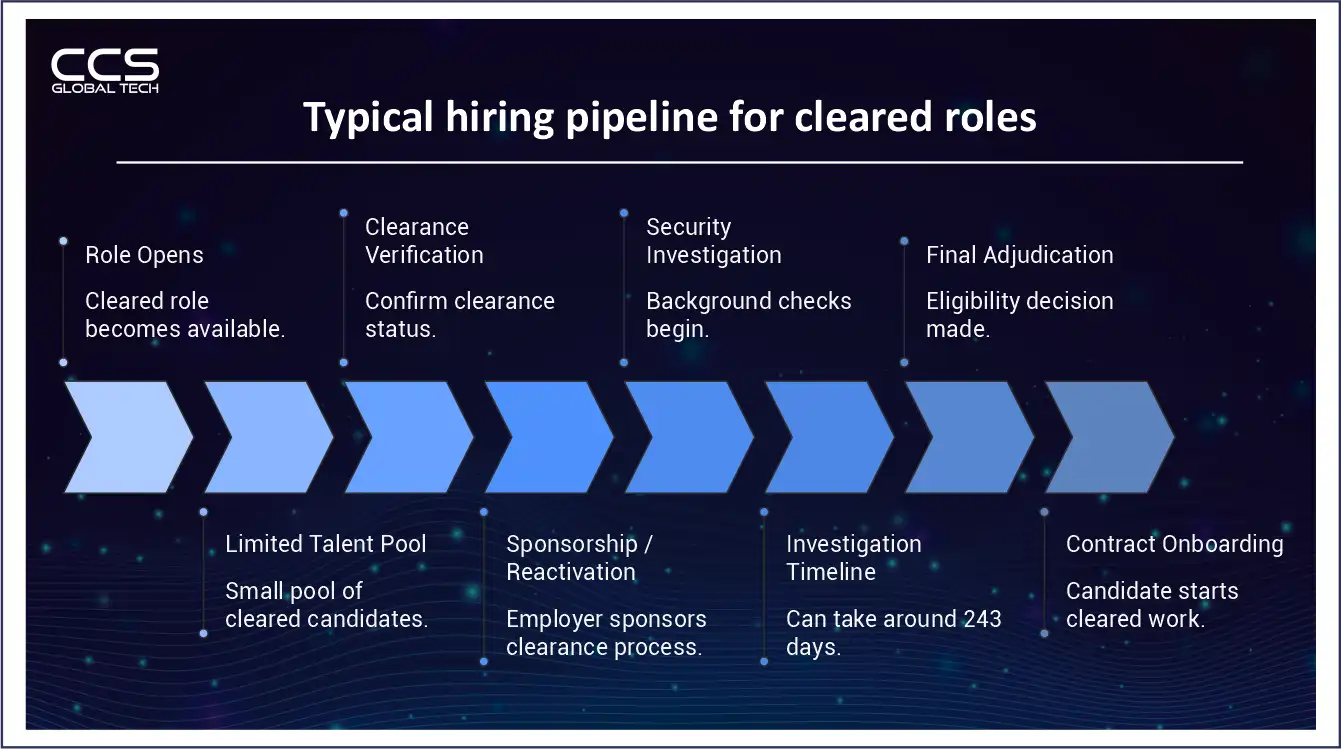
That 243-day average is not a bureaucratic footnote. For a defense contractor who has lost cleared personnel and needs to replace them, it means months of contract vulnerability. For a professional who let their eligibility expire and now needs a full reinvestigation, it means starting over from scratch losing the significant leverage that an existing clearance provides in any hiring or contracting conversation.
Typical hiring pipeline for cleared roles

How Long Does a Top-Secret Clearance Actually Last?

The short answer is five years but the reality is more layered than that, especially in today’s continuous vetting environment.
Under the traditional periodic reinvestigation model, Top Secret clearances required a full reinvestigation every five years to remain valid. Secret clearances had a ten-year cycle. Confidential clearances ran fifteen years. These timelines applied to individuals who remained in cleared positions and maintained continuous access.
Standard Clearance Expiration Timelines
Top Secret / TS-SCI | Reinvestigation required every 5 years (traditional PR model). Under continuous vetting, active monitoring replaces the fixed cycle.
Secret | Reinvestigation every 10 years. Under CV, same shift to continuous monitoring applies.
Confidential | Reinvestigation every 15 years. Largely being phased out as a standalone category.
If you leave a cleared position | Clearance becomes inactive and enters a 24-month window before it is considered expired. After 24 months without sponsorship, reactivation requires a new investigation.
Here is what changes the calculus significantly: the federal government’s shift to Trusted Workforce 2.0 and continuous vetting (CV). By September 2021, over four million national security-sensitive positions had been enrolled in an initial version of the continuous vetting system, eliminating the requirement for periodic reinvestigations for many cleared individuals.
Instead of a five-year checkpoint, the government now monitors cleared individuals on an ongoing basis checking credit activity, criminal records, public records, and other data points in something closer to real time.
In practice, this means that if you hold an active clearance and nothing adverse surfaces through continuous monitoring, you may not face a full reinvestigation at the old five-year mark. But if you leave a cleared position, continuous vetting stops. Your eligibility enters the 24-month window and the clock starts ticking.

The 24-Month Rule That Changes Everything

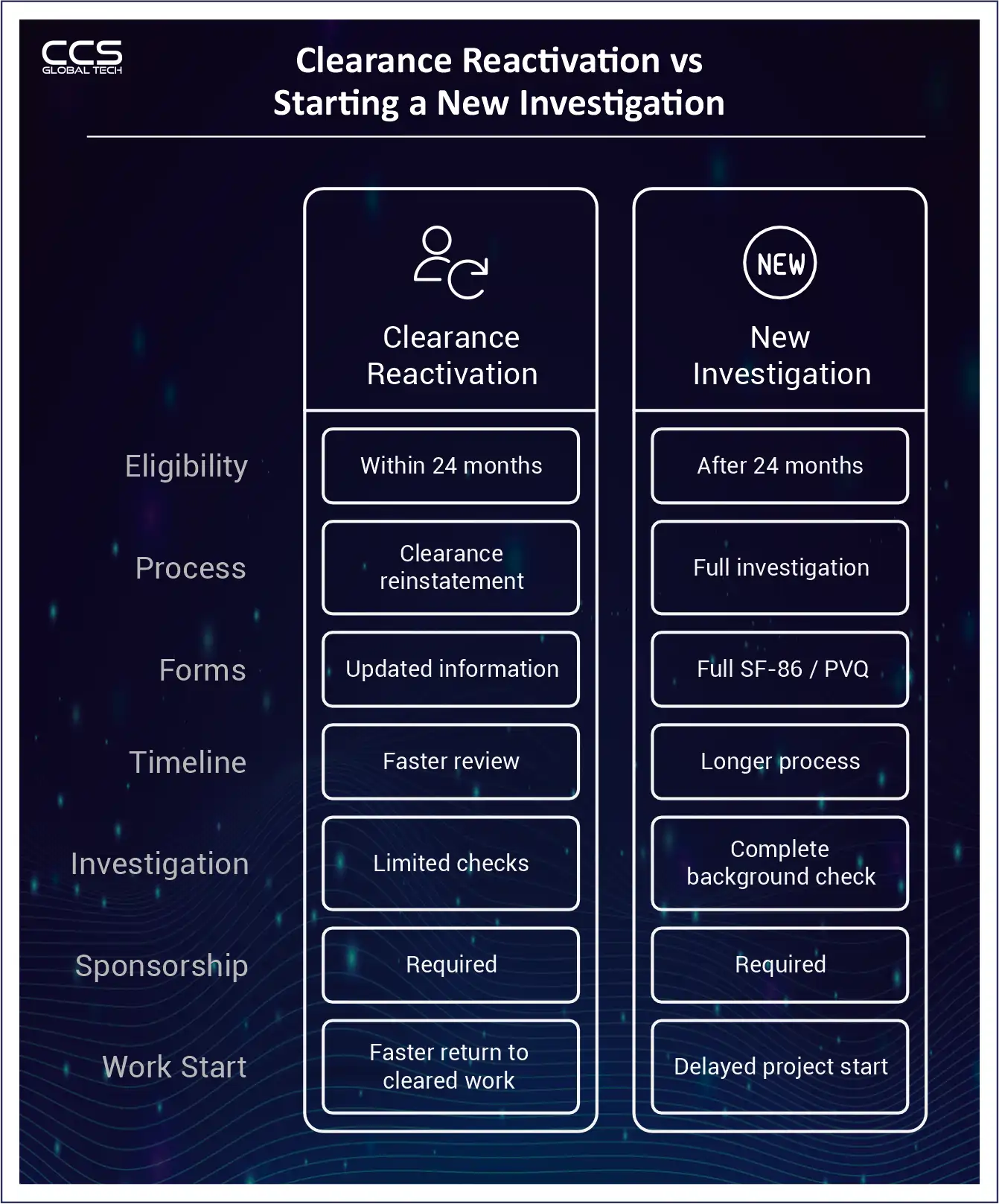
The 24-month rule is the single most important timeline for any professional transitioning out of a cleared role. Once you leave a position that requires your clearance and are not immediately picked up by a new sponsoring employer, you have a window generally up to 24 months during which your clearance can be reactivated without requiring a completely new investigation.
Beyond that 24-month mark, the eligibility is considered expired. A new full background investigation is required. That means a new SF-86 or the forthcoming Personnel Vetting Questionnaire (PVQ), a fresh round of field interviews, reference checks, and waiting through a process that currently averages over eight months for Top Secret-level work.
There is important legislative movement on this front. Pending legislation discussed under the Trusted Workforce 2.0 reform framework would extend this reactivation window from 24 months to 5 years – a significant change that would make it far easier for former cleared professionals to return to the workforce. As of early 2026, this proposal has not yet been enacted into law, but it reflects real momentum in Congress and among defense contractors lobbying for workforce flexibility.
The backlog matters because it is the context in which reactivation requests compete. When DCSA is working through roughly 300,000 pending cases, a lapsed clearance requiring a full new investigation is not at the front of the line. Professionals who stay within the 24-month window and whose sponsoring employer submits a timely reinstatement request move through the system significantly faster.

Two Stories That Illustrate the Stakes

Scenario A — The Contractor Who Waited Too Long

A program manager at a mid-size defense IT firm held a Top Secret clearance for eleven years. When her company lost a major DoD contract, she transitioned to a commercial cybersecurity firm – a role that did not require her clearance. The work was good. The pay was better. She kept meaning to find a cleared position “eventually.”

Twenty-seven months later, her original firm won a new contract and reached out about a senior role that would have been a natural fit. When the recruiter attempted to verify her clearance status, the eligibility had been inactive for over two years. The 24-month window had closed. What should have been a straightforward reinstatement became a full new investigation: a new SF-86, field interviews, and an estimated wait of six to nine months before she could work on the classified portion of the contract.

The firm needed the role filled faster than that. They hired someone else. She eventually regained her clearance but at the cost of a significant career opportunity and months of lost earning potential in the cleared market.

How to Reactivate a Top Secret Clearance - Step by Step

If your clearance has lapsed or gone inactive, reactivation is not impossible but it requires the right approach, a sponsoring employer, and realistic expectations about timelines. Here is how the process generally works.
  1. Determine your current eligibility status — Contact your most recent Facility Security Officer (FSO) or request verification through the DCSA portal to confirm whether your clearance is still within the 24-month reactivation window. This step is often skipped, and skipping it leads to expensive surprises.  
  2. Secure a cleared employer who will sponsor you — Reactivation cannot happen without sponsorship. A company must have a Facility Security Clearance, an open position requiring your level of clearance, and the willingness to submit a request for your reinstatement to DCSA on your behalf. 
  3. Complete the required forms accurately — Within the 24-month window, this is typically a streamlined reinstatement process. Beyond 24 months, you will need to submit a full new SF-86 (or the forthcoming PVQ). Either way, accuracy and completeness are non-negotiable — discrepancies are one of the leading causes of delay and denial. 
  4. Expect an updated investigation if significant time has passed — Even within the 24-month window, if your prior investigation is close to the five-year TS threshold or if adverse information has surfaced, DCSA may require a new field investigation before reinstating access. Budget time for this possibility.
  5. Prepare for continuous vetting enrollment — Once reinstated, your clearance will be enrolled in DCSA’s continuous vetting program — meaning ongoing monitoring of financial, criminal, and public records. Self-reporting obligations apply immediately. 
  6. Maintain documentation proactively — Keep copies of your prior SF-86, any mitigation documents, FSO correspondence, and records of self-reporting. This documentation becomes critical if adverse information surfaces during continuous vetting. 
Continuous Vetting: The New Reality for Cleared Professionals

One of the most significant shifts in the security clearance landscape over the past several years is the move from periodic reinvestigations to continuous vetting. Under the old model, a cleared individual might go five years between formal checkpoints. A lot can change in five years financially, personally, and in terms of foreign contacts. The traditional reinvestigation cycle was simply not designed for today’s threat environment.
Continuous vetting changes that. Under the Trusted Workforce 2.0 framework, cleared individuals are subject to automated checks across financial records, criminal databases, public records, and other data sources on an ongoing basis. Alerts are generated when something relevant surfaces – a delinquent debt, an arrest, a foreign contact disclosure — and those alerts are routed to security officers for review.
“The old model asked: were you trustworthy five years ago? The new model asks: are you trustworthy right now – and are you transparent enough to tell us when something changes?”
This has several practical implications for cleared professionals and the organizations that employ them. First, self-reporting is no longer optional in any meaningful sense. DCSA’s continuous vetting system will surface financial and criminal information whether you report it or not.
The clearance holders who come through this environment intact are the ones who get ahead of issues rather than hoping they go unnoticed. Second, workforce training on security obligations is not a one-time onboarding exercise. It is an ongoing responsibility that requires attention every time an employee’s life circumstances evolve.

Common Reasons Reactivation Gets Denied or Delayed

Not every reinstatement request succeeds. Understanding the most frequent stumbling blocks can help cleared professionals and their employers avoid them.
Financial issues remain the leading cause of clearance concern. Significant unresolved debt, bankruptcies, and patterns of financial irresponsibility are evaluated under Adjudicative Guideline F. The adjudicators’ job is not to penalize people for difficult circumstances – it is to assess whether financial pressure creates vulnerability to coercion or compromise. Proactive mitigation matters: a cleared professional who enters a repayment plan, documents their progress, and is transparent about the situation is in a far better position than someone who avoids the subject.
Gaps in foreign contact disclosure are increasingly significant, particularly for professionals who have worked internationally, have family connections abroad, or have traveled extensively. Any contact with foreign nationals that could be interpreted as a potential foreign influence requires disclosure. Omitting it even inadvertently can be treated as dishonesty, which triggers a separate and more serious concern in adjudication.
Incomplete or inaccurate forms remain a persistent source of delays. The SF-86 covers a decade of employment, residence, financial history, foreign contacts, and personal conduct. Rushing through it or failing to disclose items because they “seem minor” is a frequent and costly mistake. DCSA cross-references submitted information against automated record checks. Discrepancies surface. Explaining them after the fact is always more difficult than disclosing them upfront.
DCSA Clearance Denial — Most Frequent Adjudicative Concerns
Financial considerations | Unresolved debt, bankruptcies, patterns of financial irresponsibility — the most common single concern in denial decisions
Personal conduct / dishonesty | False statements on the SF-86 are federal crimes. Omissions are treated as dishonesty in adjudication.
Foreign influence | Undisclosed foreign contacts, dual citizenship issues, or foreign financial interests
Drug involvement | Recent or habitual use — cannabis remains a federal concern regardless of state law
Criminal conduct | Arrests, convictions, or patterns of behavior — not automatically disqualifying but requires full disclosure
DCSA uses a “whole person concept” in adjudication isolated incidents or past mistakes do not automatically disqualify an applicant. Context, time, and demonstrated rehabilitation all factor into the outcome. What consistently tips the balance against clearance holders is the combination of a substantive concern and a lack of transparency about it.
Working with cleared professionals since 1999, CCS Global Tech helps organizations and individuals navigate the security-cleared workforce landscape. We support federal contractors, cleared professionals, and organizations building cleared talent pipelines through workforce strategy, clearance readiness consulting, FSO advisory, cybersecurity certification training (Security+, CISSP, CCSP, CEH), Recruit-Train-Place programs for defense contractors, veteran transition support, and continuous vetting compliance training. Want to know how we can support your cleared workforce needs?

FAQs

Q1. How long does a Top Secret clearance remain valid after leaving a cleared job?

A – Top Secret clearance can typically remain eligible for reactivation for up to two years after leaving a cleared position. During this time, the clearance is inactive but may be reinstated by a sponsoring employer.

A: Yes. If the clearance has been inactive for less than two years, a federal agency or government contractor can often reactivate it without starting the full investigation process again.

A: If more than two years pass without holding a cleared position, the clearance usually expires and the individual may need to go through a new investigation and adjudication process. 

A: Only a federal agency or an authorized government contractor can sponsor the reactivation of a Top Secret clearance. Individuals cannot reactivate their clearance independently.

A: If the clearance is within the reinstatement window, reactivation may take a few weeks to a few months depending on the agency, background checks, and documentation requirements. 

A: Reactivation typically requires updating the SF-86 security clearance form and confirming personal, employment, and financial history for review by the sponsoring organization. 

A: Yes. Many cleared professionals return to cleared roles after a career break if they are still within the two-year reinstatement window and meet eligibility requirements.

A: Delays may occur due to incomplete forms, unresolved financial issues, foreign contacts requiring review, employment history gaps, or additional adjudication checks. 

A: Yes. Under the federal government’s continuous vetting program, cleared individuals are monitored through automated checks that help agencies assess eligibility and support faster reinstatement. 

 A: Changing employers does not cancel the clearance. The new employer simply needs to sponsor the transfer or reinstatement of the clearance within the allowed timeframe.