


Most contractors start looking for cleared staff after the award letter arrives. By then, the clock is already working against them. DCSA’s latest industry figures, reported in September 2026, put an initial Top-Secret clearance at about 243 days from start to finish. Your contract start date will not wait that long.
Here is a step-by-step plan that will help you create a pipeline prior to the award. It provides you with everything from activities that have to be performed, their duration, and documentation that is required. This process is based on the real-life experience of our Federal & Cleared Talent team.
Know the Clearance Timelines Before You Plan
The clearance process is broken down into three stages: initiation, investigation, and adjudication. These most recent statistics are from the Q3 FY2026 update from ClearanceJobs, based on DCSA numbers for industry candidates:
- Initial TS: 243 days total (20 days for initiation, 97 for investigation, 126 for adjudication)
- Initial S: 197 days total (21 days for initiation, 59 for investigation, 117 for adjudication)
Make your plan based on these numbers. Some candidates will be done sooner. Some will have issues during investigation and polygraph scheduling.
Also, the Performance.gov site provides quarterly personnel vetting statistics that you can use as background information only.
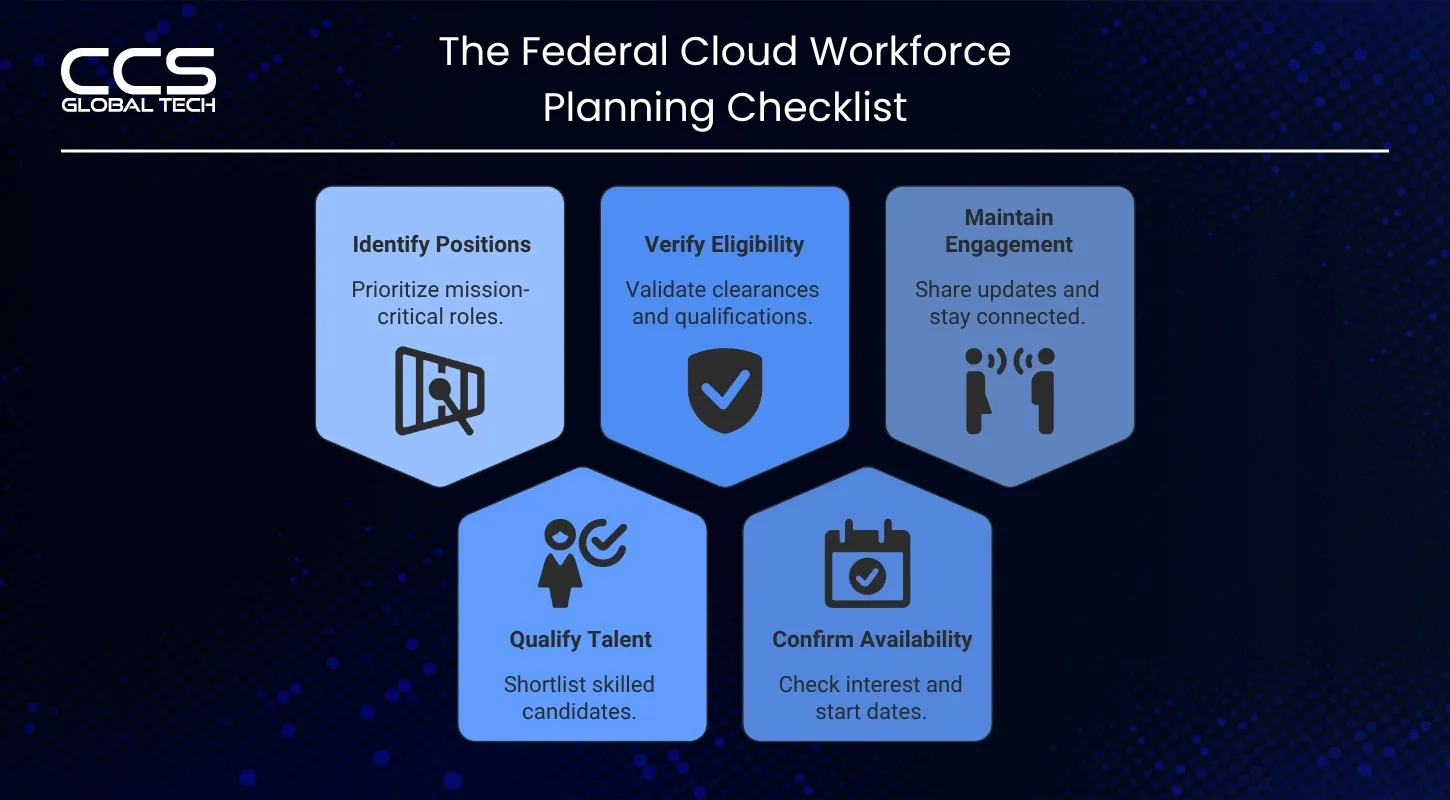
How to Build Your Cleared Talent Pipeline: 7 Steps
Step 1: Enumerate Your Roles and Begin Date
Time required: One day
Enumerate all your roles that you will play in the following contract. Include the following information:
- The job title or labor category
- The contract start date
- The number of people required
- Whether the position is new or replacing one
Should there be no existing contract at the moment, feel free to estimate the commencement date. It is always more prudent to base plans on estimates than on certainties.
Step 2: Set a Clearance Deadline for Each Role
Time needed: One hour
Subtract the time for clearance from each start date. Add two weeks to allow for onboarding.
Here is a worked example. Suppose a contract starts July 1, 2027.
- Top Secret roles: Candidate work must begin by October 30, 2026 (243 days before July 1).
- Secret roles: Candidate work must begin by December 16, 2026 (197 days before July 1).
The Top-Secret deadline is only around two weeks away from now. In case there are no candidates in line for these positions, you should put them at the top of your list right away.
Where the individual already has his/her clearance, then he/she will transfer through reciprocity, thereby saving time. Just remember to flag these positions for future reference.
Step 3: Map Each Role to the Contract Vehicle
Time needed: Two hours
Determine what types of labor categories are present within the contract vehicle that you have, for example, GSA IT Schedule 70, Navy Seaport-E, OASIS+, CIO-SP3, and IDIQ Task Orders. Once done, assign labor categories and clearance levels to each job position.
Next, count headcount on a quarterly basis. Assume the following task order requires eight cleared systems engineers in Q1 and four more in Q2. You will need eight candidates in process at the moment and four more in the future.

Step 4: Write Postings That Filter Well
Time needed: Two hours per role
Each posting should answer four questions for the applicant:
- What is the clearance level?
- Do they need to have active clearance, or do you sponsor it?
- Is polygraph mandatory for a position such as full scope or CI?
- What is the program/contract the position supports?
“Cleared preferred” leaves applicants guessing. Specific requirements bring in qualified people and cut your screening time.
Step 5: Source From Four Pools
Time required: Two to three weeks to create the initial list.
Aim for a total of three to five individuals per position. Look for individuals in the following four groups:
Individuals who have clearance and are currently between contracts. They are the fastest to place.
- Veterans who held clearances in service– Many know classified handling procedures.
- Career changers who complete targeted training– They can enter cleared roles after building the right skills.
- Your current employees– Some can move into cleared roles with sponsorship and training.
As shown on our Federal Staffing webpage, we have been collaborating with over 200 veteran groups and employing 1,000 plus trained veterans each year. You may always feel free to inquire about any of our staffing partners, including us, about the numbers.
Step 6: Screen and Record Clearance Details
Time required: Continuous, 30 minutes per individual
Per individual, determine and document the following:
- Level of clearance possessed and its current status (active, expired, or none)
- Possibility of reciprocity
- Polygraph history, if relevant
- Sponsorship eligibility
- Skills assessment result
- Availability and relocation willingness
Do this before you put anyone on a bench. A candidate whose clearance status is unclear will delay your deadline.
Step 7: Keep the Bench Active Every Month
Time needed: Two hours per month
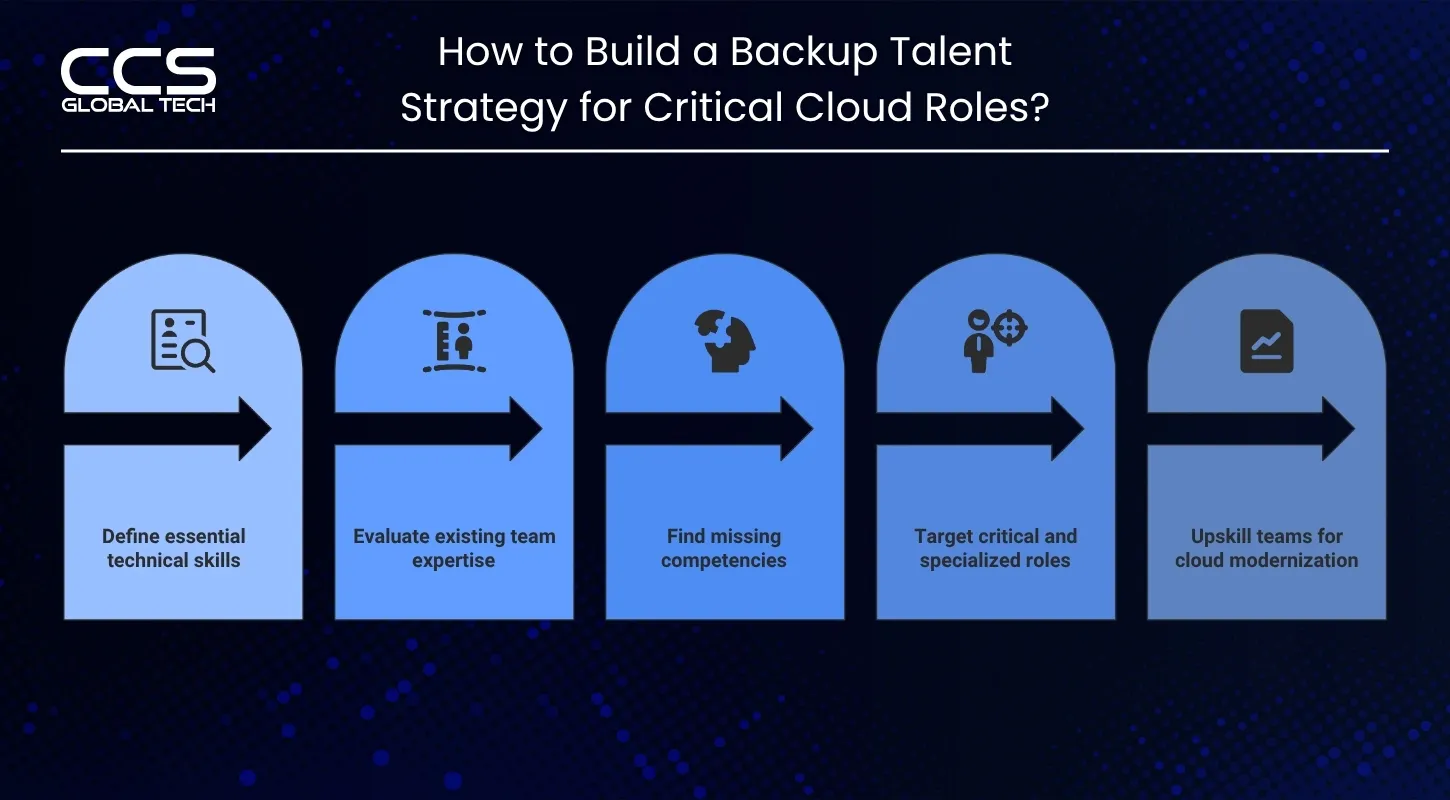
Form a bench of pre-qualified people for any critical positions that you might have. Make sure to stay in touch with your candidates by contacting them at least once a month to know if they’re still available for the position.
If the individual you are interested in is almost qualified, send him to a specialized training program. We offer a variety of training programs ranging from boot camps to certifications.
Track Your Pipeline Each Week
A spreadsheet works well for your first year. Use these columns:
Column | What to record |
Role | Labor category or position |
Clearance required | Secret, Top Secret, TS/SCI, or polygraph |
Current status | Active, none, or reciprocity in progress |
Sponsor status | Sponsored, pending, or not started |
Deadline | Latest date candidate work must begin |
Backup | Second candidate for the same role |
Check it every Monday. Identify all roles that do not have backups, and all Top-Secret roles whose candidate work has not commenced by their deadlines.
Mistakes That Slow Down Cleared Hiring
- Award receipt and the posting of positions– You give up the timeline benefit on the day you receive the award.
- Missing the polygraph requirement– Full scope and CI polygraphs will delay your hiring process, identify them in Step 2.
- Applying for a clearance that is too high for the position– Clearance should match need.
- Allowing your bench to go cold– Candidates that sit idle for months typically accept another offer.
- Omitting your Facility Security Officer– Inform your security office of available positions before delays occur.

Start This Week
Start with the steps above. Map your roles, set your deadlines, and build a shortlist for the three roles that carry the most risk.
If the Top-Secret deadline is close, begin this week. When you want help with the pipeline, our federal staffing team will review your contract vehicle and roles with you.
Frequently Asked Questions
Q1. How early should federal contractors start recruiting cleared professionals before a contract award?
A- Federal contractors should begin identifying cleared candidates during the opportunity identification or capture planning stage. Early engagement helps assess talent availability, clearance requirements, salary expectations, and potential hiring challenges before proposal submission. The recruiting timeline should align with the anticipated award date and staffing requirements.
Q2. How do government contractors build a cleared talent pipeline without confirmed contract funding?
A- Contractors should focus on building relationships with qualified candidates rather than hiring them immediately. They should maintain a database of interested professionals, conduct preliminary screening, discuss potential opportunities, and track availability. Contingent offers and candidate commitment letters also support pre-award recruitment when used appropriately.
Q3. Which cleared positions should federal contractors prioritize during pre-award recruitment?
A- Contractors should prioritize key personnel identified in the solicitation, followed by positions requiring specialized technical skills or higher security clearances. Common priorities include program managers, cybersecurity engineers, cloud architects, intelligence analysts, and systems engineers. Roles with limited candidate availability deserve earlier recruiting attention.
Q4. How do federal contractors verify security clearances before submitting a proposal?
A- Contractors should coordinate clearance verification through their authorized security personnel using approved government systems. Recruiters should initially collect candidate-reported clearance details and obtain confirmation through appropriate security channels. A candidate’s previous clearance does not automatically establish current eligibility or access authorization.
Q5. What is the difference between a cleared talent pipeline and a traditional recruiting pipeline?
A- A cleared talent pipeline tracks additional requirements beyond technical skills and experience. These include security clearance eligibility, required access levels, polygraph qualifications, geographic restrictions, contract-specific requirements, and deployment readiness. Traditional recruiting generally focuses more on qualifications, compensation, availability, and cultural fit.
Q6. Should federal contractors recruit incumbent employees before winning a recompete contract?
A- Incumbent employees are valuable candidates because they often possess relevant clearances, agency knowledge, and familiarity with contract requirements. Contractors should engage interested incumbents through lawful recruiting practices while respecting confidentiality, employment restrictions, solicitation requirements, and any applicable successor-contractor obligations.
Q7. How should contractors approach cleared candidates when the federal contract has not yet been awarded?
A- Recruiters should explain the anticipated position, required clearance, expected location, compensation range, and award-dependent timeline. They should clearly communicate that employment depends on contract award and other stated conditions. Regular updates help maintain candidate interest without creating unrealistic expectations.
Q8. How do letters of commitment help federal contractors during proposal submission?
A- Letters of commitment document a candidate’s expressed willingness to support a proposed contract if awarded. They are especially useful when solicitations require identified key personnel. Contractors should ensure the letters accurately reflect candidate availability, qualifications, and intentions without promising guaranteed employment.
Q9. What information should contractors track in a pre-award cleared talent database?
A- Contractors should track technical skills, relevant experience, candidate-reported clearance level, verification status, location preferences, salary expectations, availability, and contract interests. They should also record communication history and the candidate’s willingness to consider contingent opportunities. Sensitive clearance information should be handled through authorized processes.
Q10. How do security clearance requirements affect federal contract staffing timelines?
A- Clearance requirements affect how quickly candidates become eligible for contract assignments. Positions requiring Top Secret, SCI access, or polygraph examinations often involve additional verification or screening steps. Contractors should distinguish between existing eligibility and contract-specific access approval when estimating staffing readiness.