

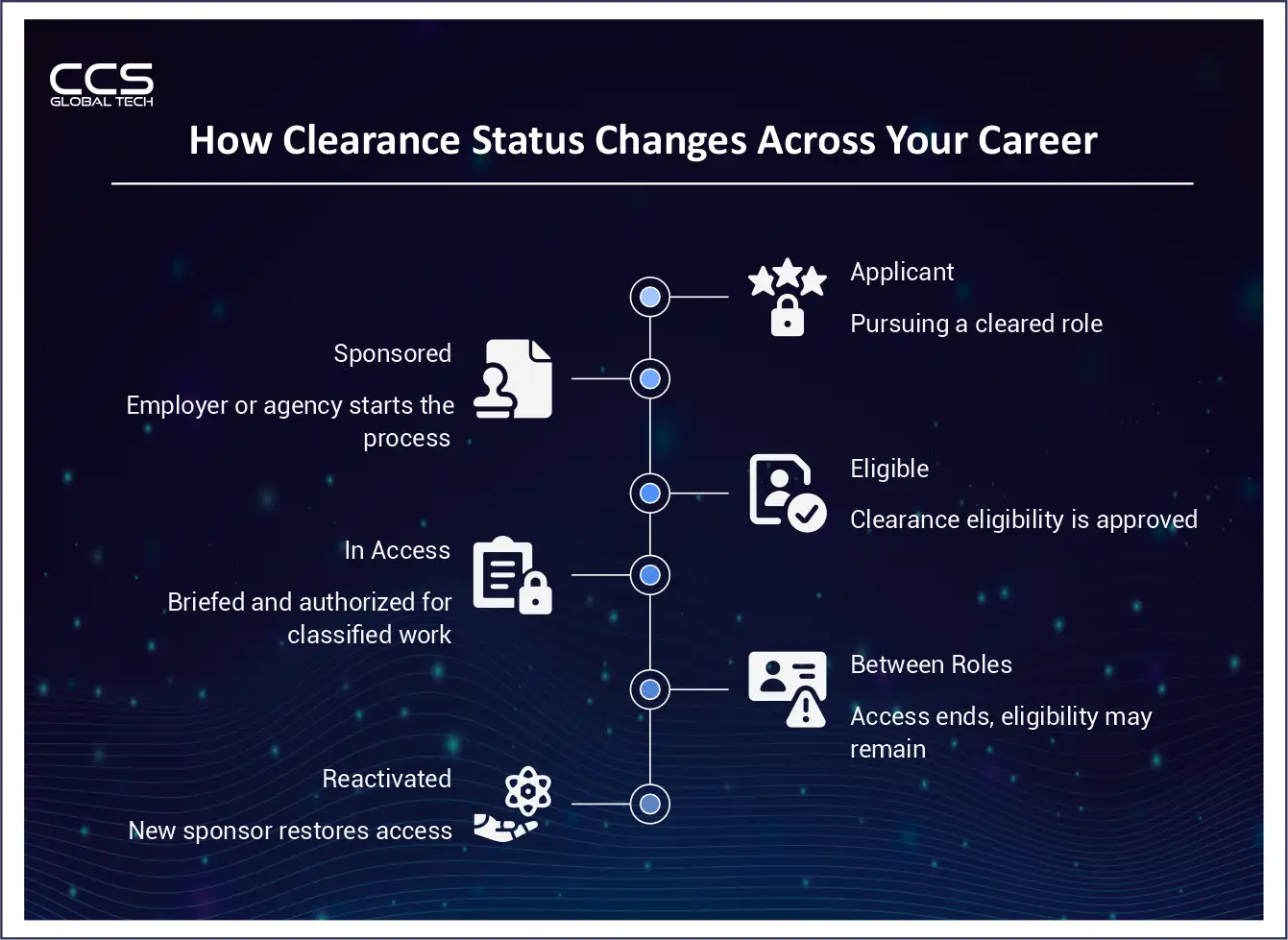
A candidate tells us she holds a TS/SCI. Her last cleared job ended fourteen months ago. She is not wrong, exactly, and she is not quite right either.
Active Clearance vs. Clearance Eligibility at a Glance
Status | What it means | Can you work on classified material? | What it takes to use |
Active | Eligible, sponsored, and currently in access for a position that requires it | Yes, within your need-to-know | Nothing further |
Current | Eligible, not in access, and inside the 24-month window since leaving access | No | A sponsor with a requirement who requests reinstatement |
Expired or inactive | More than 24 months out of access, or investigation outside scope | No | A new investigation, handled as an initial case |
Eligible (adjudicated, never in access) | Investigation favorably adjudicated, but access never granted | No | Sponsorship, need-to-know, briefing, and a signed SF-312 |
What Is an Active Security Clearance?
Definition of an Active Clearance
Requirements to Maintain an Active Clearance

What Is Security Clearance Eligibility?
Definition of Clearance Eligibility
How Security Clearance Eligibility Is Obtained?
Key Differences Between Active Clearance and Clearance Eligibility
Current Usage vs. Potential Access
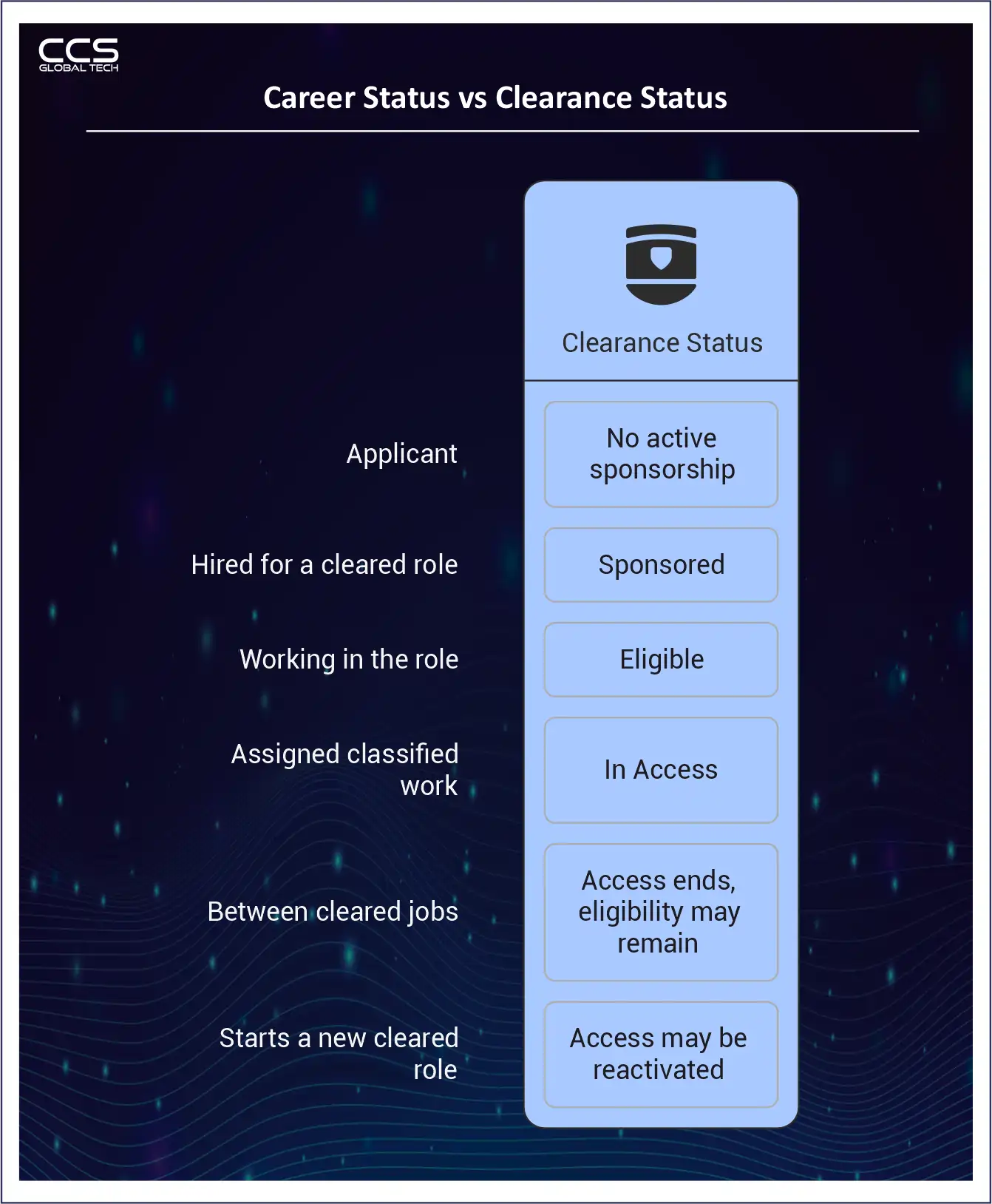
Employment Status and Clearance Status
How Long Clearance Eligibility Lasts After You Leave a Cleared Job?
Time since leaving access | Typical status | What reactivation involves |
0 to 45 days | Still enrolled in continuous vetting | DCSA’s 2026 grace period before CV unenrollment |
45 days to 24 months | Current eligibility, not in access | New sponsor requests reinstatement, usually no new investigation |
Beyond 24 months | Expired or inactive | Treated as an initial clearance case with a new investigation |
Turning Clearance Eligibility into an Active Clearance
Steps to Reactivate a Security Clearance
Common Clearance Reactivation Scenarios

Factors That Affect Your Security Clearance Status
Investigation Age and the 2027 Five-Year Questionnaire Rule
Employment Gaps and Security Clearance Status
Continuous Vetting and Clearance Maintenance
Common Misconceptions About Security Clearance Status
A candidate tells us she holds a TS/SCI. Her last cleared job ended fourteen months ago. She is not wrong, exactly, and she is not quite right either.
Active Clearance vs. Clearance Eligibility at a Glance
Status | What it means | Can you work on classified material? | What it takes to use |
Active | Eligible, sponsored, and currently in access for a position that requires it | Yes, within your need-to-know | Nothing further |
Current | Eligible, not in access, and inside the 24-month window since leaving access | No | A sponsor with a requirement who requests reinstatement |
Expired or inactive | More than 24 months out of access, or investigation outside scope | No | A new investigation, handled as an initial case |
Eligible (adjudicated, never in access) | Investigation favorably adjudicated, but access never granted | No | Sponsorship, need-to-know, briefing, and a signed SF-312 |
What Is an Active Security Clearance?
Definition of an Active Clearance
Requirements to Maintain an Active Clearance
What Is Security Clearance Eligibility?
Definition of Clearance Eligibility
How Security Clearance Eligibility Is Obtained?
Key Differences Between Active Clearance and Clearance Eligibility
Current Usage vs. Potential Access
Employment Status and Clearance Status
How Long Clearance Eligibility Lasts After You Leave a Cleared Job?
Time since leaving access | Typical status | What reactivation involves |
0 to 45 days | Still enrolled in continuous vetting | DCSA’s 2026 grace period before CV unenrollment |
45 days to 24 months | Current eligibility, not in access | New sponsor requests reinstatement, usually no new investigation |
Beyond 24 months | Expired or inactive | Treated as an initial clearance case with a new investigation |
Turning Clearance Eligibility into an Active Clearance
Steps to Reactivate a Security Clearance
Common Clearance Reactivation Scenarios
Factors That Affect Your Security Clearance Status
Investigation Age and the 2027 Five-Year Questionnaire Rule
Employment Gaps and Security Clearance Status
Continuous Vetting and Clearance Maintenance
Common Misconceptions About Security Clearance Status
"Current" vs. "Active": The Most Misused Clearance Terms
Can You Hold Clearance Eligibility Without a Job?
What the Distinction Means for Cleared Job Seekers?
How Active Clearances Affect Hiring Decisions?
Clearance Eligibility as a Competitive Advantage
How to Describe Your Clearance Status on a Resume?
Your situation | Write it like this |
In access today | Active TS/SCI with CI polygraph, in access through present |
Out of access, inside 24 months | Current TS/SCI eligibility, last in access March 2026 |
Out of access, beyond 24 months | Previously held TS/SCI, last in access 2023 |
Adjudicated but never briefed | Favorably adjudicated for Secret eligibility, not yet in access |
Protect Your Window
Frequently Asked Questions
Q1- What is the difference between an active clearance and clearance eligibility?
A- Eligibility is the adjudicative decision that you can be trusted with classified information at a given level. An active clearance means you hold that eligibility, have a sponsor with a requirement, and are currently in access after a briefing and a signed SF-312.
Q2- How long does security clearance eligibility last after leaving a cleared job?
A- Generally 24 months. DCSA also allows a 45-day grace period before continuous vetting unenrolls you. Beyond 24 months, DCSA treats a terminated industrial clearance as an initial case requiring a new investigation.
Q3- Can I reactivate my security clearance myself?
A- No. Only a government agency or a contractor with a facility clearance and a position requiring your level can request reinstatement. The Facility Security Officer manages the process and verifies your record in the system of record.
Q4- Do security clearances still require periodic reinvestigations in 2027?
A- Not for NISP contractor personnel. DCSA’s April and May 2026 guidance replaced legacy periodic reinvestigations with continuous vetting plus an updated Personnel Vetting Questionnaire every five years, regardless of eligibility level.
Q5- What does "current" mean for a security clearance?
A- Current means you hold eligibility but are not in access, and you are still inside the 24-month window since leaving access. A new sponsor can usually request reinstatement without a new investigation.
Q6- Does leaving the military revoke my security clearance?
A- No. Separation is an administrative termination, which SEAD 7 distinguishes from a revocation. It starts the 24-month window but carries no period of ineligibility, unlike a revocation.
Q7- What does "clearance eligible" mean in a job posting?
A- Usually that the employer will sponsor a candidate able to pass an investigation. It does not always mean you must already hold adjudicated eligibility. Ask the recruiter to confirm what the posting requires.
Q8- How can I check my security clearance status?
A- Ask a Facility Security Officer, current or former, to verify your record in DISS or the relevant system. You can also submit a Privacy Act request to DCSA for your investigation and adjudication records.
Q9- Does upgrading from Secret to Top Secret count as reactivation?
A- No. Moving to Top Secret requires a new Tier 5 investigation. Existing Secret eligibility helps the process but does not replace the higher-level investigation.
Q10- Should I put "active" on my resume if I recently left a cleared job?
A- No. Use “current” with the date you were last in access. Calling a clearance active when you are out of access creates a mismatch the FSO will find in the first records check, and it costs credibility.