

Before You Scroll Past, Think About This for a Moment
Why Data Foundation Matters for AI
- A unified view of data across the organization
- Reliable and consistent data for accurate results
- Clear visibility into data ownership and lineage
- Scalable systems that support growing data volumes
- Trusted data that teams can use with confidence
The Cost of Ignoring Data Readiness
- Models appear accurate in isolation but fail in real business scenarios
- Teams spend more time fixing data than building models
- New use cases start from scratch due to a lack of reusable data
- Stakeholders lose confidence as outputs cannot be clearly explained
- Pilots succeed, but scaling fails due to unstable pipelines and dependencies
A Practical Framework to Build Data Foundation
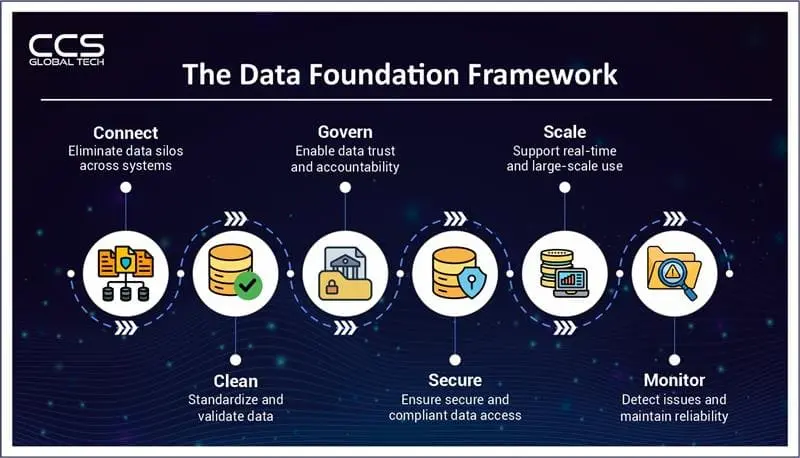
1. Connect: Break Down Data Silos
2. Clean: Establish Data Quality Standards
3. Govern: Build Trust and Accountability
As data becomes more integrated and widely used, governance becomes essential.
- Who owns the data
- How data flows across systems
- What policies control its usage
- How compliance requirements are enforced
Without governance, even high-quality data cannot be trusted at scale. AI outputs must be explainable, especially in business-critical scenarios. Governance ensures that data can be traced, audited, and validated.
4. Secure: Enable Safe and Responsible Access
- Role-based access controls to ensure the right people access the right data
- Data protection mechanisms such as encryption and masking
- Compliance with regulatory and organizational policies masking
5. Scale: Support Growing Data and Use Cases
- Handle large and growing data volumes
- Support both batch and real-time processing
- Enable multiple use cases simultaneously
6. Monitor: Maintain Long-Term Reliability
- Data pipelines are functioning correctly
- Data freshness is maintained
- Issues such as data drift or schema changes are detected early
Assessing Your Current Data Maturity
- Do all teams work on a consistent and unified view of data?
- Are there defined data quality rules and validation checks in place?
- Can you trace data back to its source and understand how it flows?
- Is data ownership clearly defined across teams or domains?
- Are access controls and security measures consistently enforced?
- Can your systems handle increasing data volume and real-time processing needs?
- Are datasets reusable across multiple use cases?
- Are data pipelines automated and actively monitored?
- Are data issues detected early before they impact outcomes?
Final Perspective
FAQs
1. Why do AI initiatives fail in organizations?
AI initiatives often fail due to poor data quality, disconnected systems, and weak data governance.
2: What are the key components of a strong data foundation?
A strong data foundation includes data integration, quality, governance, security, and scalability.
3: How do you know if your data is ready for AI?
AI-ready data is accurate, accessible, governed, secure, and connected across business systems.
4: What is the relationship between data governance and AI?
Data governance helps ensure AI uses trusted, compliant, and well-managed data for reliable outcomes.
5: Why do organizations need a data strategy for AI?
A data strategy helps ensure the right data, governance, and infrastructure are in place to support successful AI initiatives.