
Federal agencies and contractors often treat Public Trust determinations as a milestone that occurs once during hiring. In reality, Public Trust status is not permanent. It can be reviewed, suspended, or revoked if new information raises concerns about an employee’s suitability for a position of trust.
For HR leaders, security officers, and federal contractors, understanding how and why Public Trust status can be lost is essential. Staffing decisions, program delivery timelines, and compliance obligations are directly affected by how organizations manage this process.
This article explains the real-world causes that trigger reviews, how the process works, and what federal employers can do to reduce risk in their workforce.
Public Trust Status Is Not Permanent
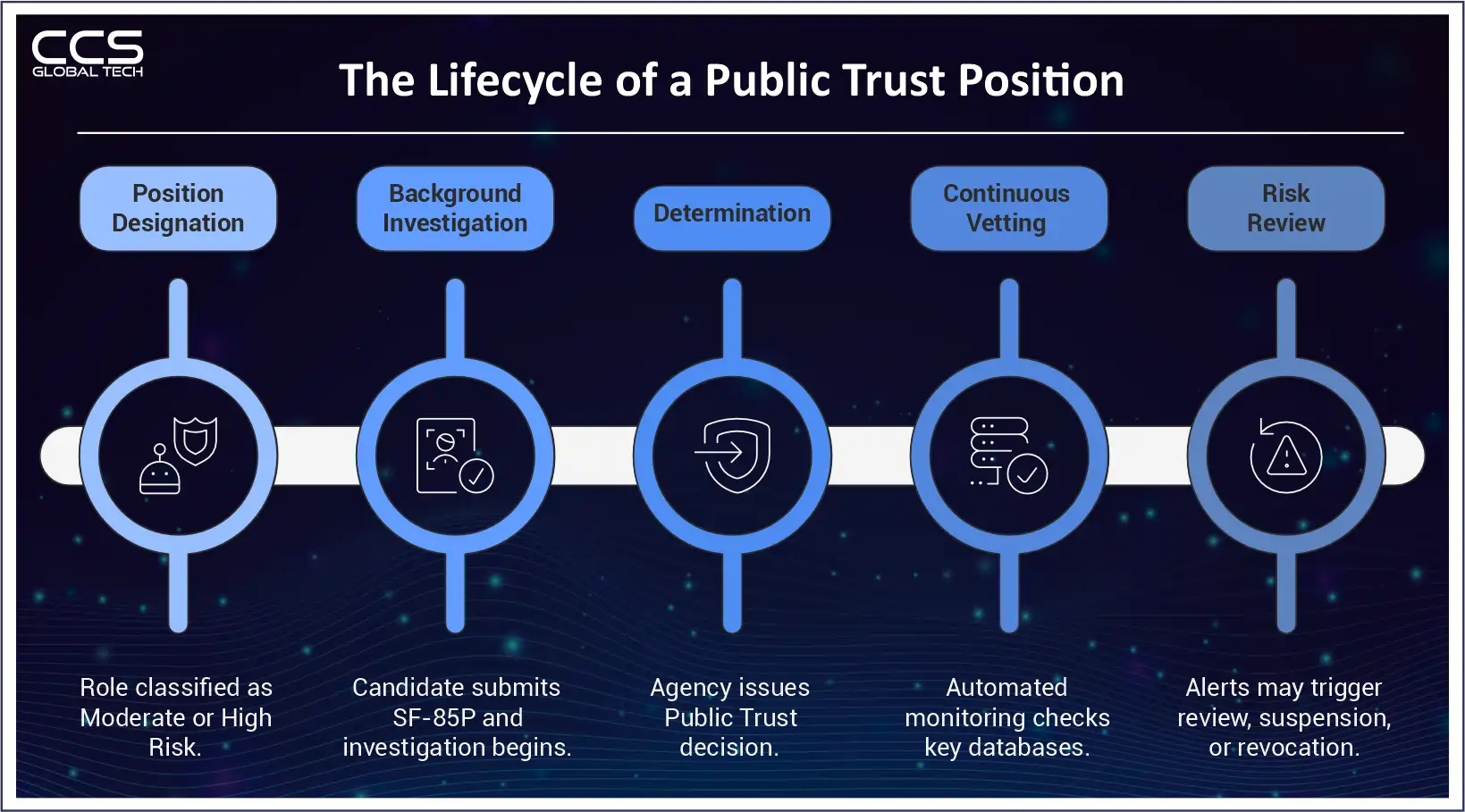
Unlike many private-sector background checks, a Public Trust determination is not a one-time verification. Employees in Moderate Risk and High Risk Public Trust roles remain subject to ongoing review.
This approach is part of the federal government’s broader Trusted Workforce 2.0 initiative, which replaced periodic reinvestigations with continuous vetting. Instead of reviewing employees every five years, federal systems now monitor certain data sources automatically.
Continuous vetting checks may include:
- Criminal records databases.
- Financial reporting indicators.
- Terrorist screening and watch lists.
- Foreign travel and foreign contact disclosures.
If an issue appears in these systems, the alert can trigger a targeted review of the employee’s eligibility to remain in a Public Trust position.
According to the Defense Counterintelligence and Security Agency (DCSA), federal personnel vetting systems process millions of automated record checks each year as part of continuous vetting operations. The scale of monitoring reflects how seriously the federal government treats workforce suitability.
For organizations supporting federal programs, this means the hiring decision is only the beginning of the compliance lifecycle.
The Legal Framework Behind Public Trust Reviews
Public Trust determinations fall under Title 5 Code of Federal Regulations Part 731, which governs suitability for federal employment and positions of trust. This regulation allows agencies to take action if new information indicates that an individual may not meet the standards required for their role.
The suitability factors considered during reviews include:
- Misconduct or negligence in employment
- Criminal or dishonest conduct
- Material misrepresentation on vetting forms
- Alcohol or drug misuse affecting reliability
- Financial irresponsibility
- Statutory or regulatory violations
When a potential issue appears, agencies assess the situation using a totality-of-circumstances approach. This means adjudicators consider the seriousness of the issue, when it occurred, whether it represents a pattern of behavior, and whether the individual has taken steps to resolve the problem.
This framework recognizes that people make mistakes. At the same time, it ensures the federal workforce remains trustworthy and reliable.
The Most Common Causes of Public Trust Revocation
While many issues can trigger a review, several patterns appear frequently in suitability cases.
Financial Problems
Financial history remains one of the most common factors examined in Public Trust reviews. Investigators look for indicators that financial stress could create vulnerability to coercion or influence. Examples include:
- Large unresolved debts
- Failure to pay federal taxes
- Multiple bankruptcies without clear resolution
- Wage garnishments or collections activity
Financial hardship itself does not automatically lead to revocation. What concerns adjudicators is a pattern of irresponsibility or unwillingness to address financial obligations.
The Federal Reserve has reported that nearly 37 percent of American adults would struggle to cover an unexpected $400 expense, illustrating how common financial strain can be. For federal employees in sensitive roles, however, unmanaged financial stress can raise security concerns.

Criminal Conduct
A criminal record does not automatically disqualify an employee from holding a Public Trust position. However, certain types of offenses carry greater weight.
These include:
- Fraud or financial crimes
- Theft or embezzlement
- Drug-related offenses
- Violent crimes
Investigators evaluate the nature of the offense, how long ago it occurred, and whether the individual has demonstrated rehabilitation. For example, a contractor employee convicted of financial fraud while working on a federal program could face immediate suitability review because the offense directly relates to trust and integrity.
Failure to Disclose Required Information
Across many suitability investigations, the issue that causes the most severe outcomes is dishonesty during the vetting process. Applicants and employees are legally required to provide accurate information on forms such as the SF-85P, which is used for Moderate Risk and High-Risk Public Trust positions.
Providing false information on federal vetting forms is a federal offense that can carry criminal penalties and result in immediate removal from the position. Investigators often view nondisclosure more seriously than the underlying issue itself.
For example, an employee who truthfully discloses past financial hardship may be cleared after demonstrating responsible repayment. However, an employee who hides the same issue and is later discovered during investigation may face an unfavorable determination.
Foreign Influence Concerns
Foreign contacts or overseas financial interests can also trigger review, particularly in High Risk Public Trust roles. This does not mean foreign ties automatically create a problem. The United States government employs thousands of individuals with international backgrounds.
Concerns arise when foreign relationships could create potential pressure, divided loyalty, or vulnerability to exploitation.
Examples that may prompt additional review include:
- Undisclosed foreign travel
- Financial investments in foreign entities
- Close relatives employed by foreign governments
- Business relationships with foreign companies
Transparency about foreign contacts is essential. Many suitability concerns arise when individuals fail to report relationships that investigators later discover.
A Real-World Example: Financial Disclosure Issues
Consider the case of a systems administrator supporting a federal healthcare agency.
During continuous vetting, automated checks detected several delinquent credit accounts that had recently entered collections. The employee had not disclosed the financial issue to their security office, despite internal policies requiring self-reporting of significant financial problems.
The agency initiated a suitability review. During the review, investigators discovered the employee had experienced a medical emergency that created the financial hardship. Because the employee had begun working with creditors and could document repayment plans, the issue was mitigated.
The employee retained Public Trust eligibility but received formal counseling about reporting requirements.
This example highlights an important point: the underlying issue is often less important than how the employee handles it.
Another Scenario: When Risk Designation Matters
A federal contractor once hired a project analyst for a role initially designated as Moderate Risk Public Trust. During the onboarding process, the contracting agency determined the position actually required High Risk designation because the role involved access to large volumes of personnel records.
The employee’s investigation had to restart under the Tier 4 process. During the expanded investigation, undisclosed foreign financial interests were discovered. The issue triggered an adjudicative review that ultimately resulted in an unfavorable suitability determination.
The contractor had to refill the role months later, delaying project delivery. This case demonstrates how accurate position designation and candidate preparation can prevent significant operational disruptions.
Continuous Vetting Has Changed the Risk Landscape
The shift to continuous vetting has dramatically changed how Public Trust eligibility is monitored.
Under the previous model, employees were typically reinvestigated every five years. Today, potential concerns may surface much faster because automated systems monitor records continuously.
According to federal personnel vetting data, millions of automated checks occur each year as part of continuous evaluation programs across the federal workforce.
For HR leaders, this means the suitability process is no longer limited to hiring events. It is an ongoing compliance responsibility. Employees must understand that:
- Significant legal issues must be reported promptly.
- Major financial problems may trigger review.
- Foreign contacts must be disclosed accurately.
Organizations that fail to educate employees about these responsibilities may face unexpected suitability cases later.
How Organizations Can Reduce Public Trust Risk?
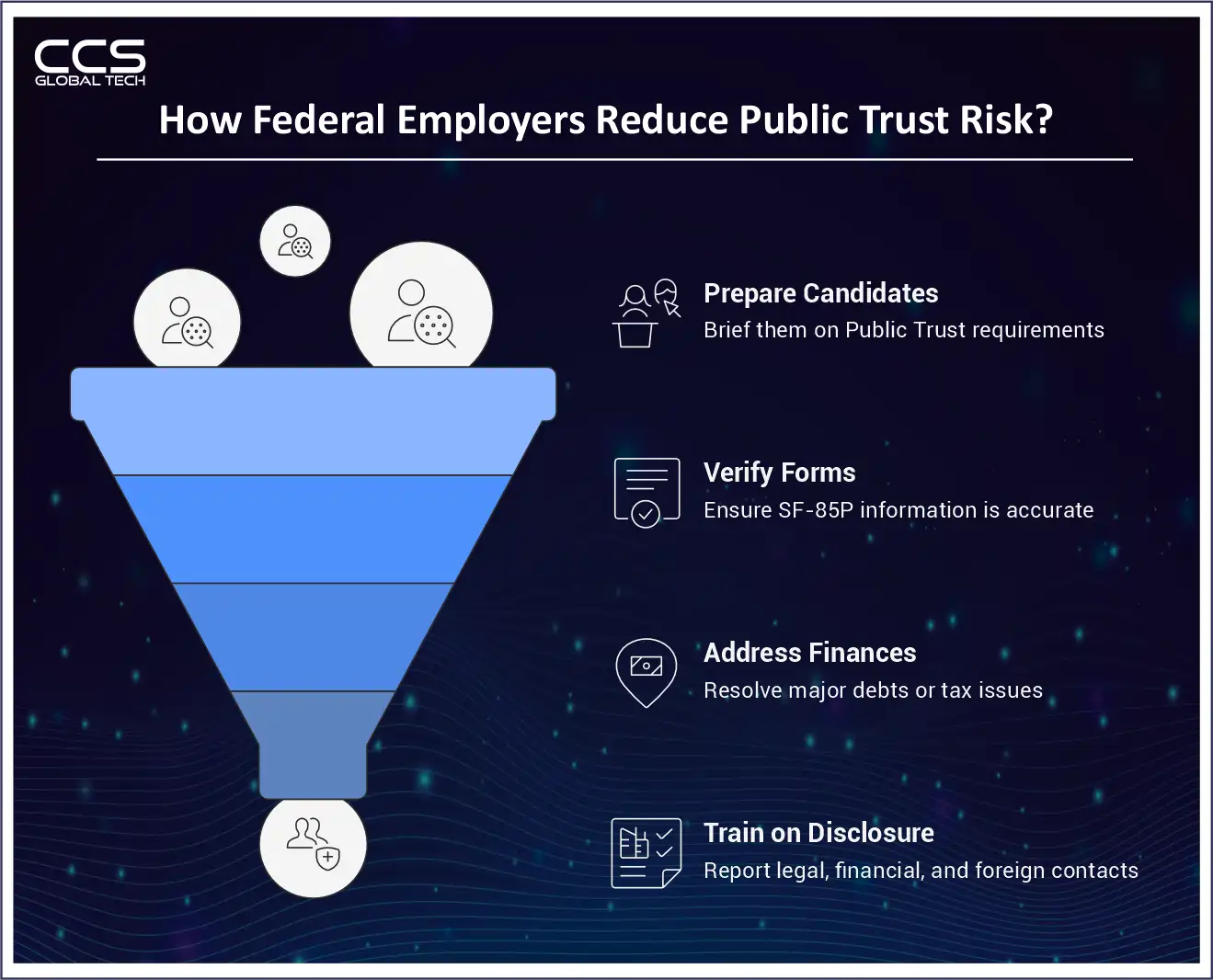
While suitability decisions ultimately rest with federal agencies, organizations can take practical steps to reduce risk.
Prepare candidates before forms are submitted
Candidates often make mistakes because they do not understand the level of detail required in federal vetting forms. Providing clear guidance before submission reduces errors and omissions.
Designate position risk levels accurately
Incorrect designation is a frequent cause of delays and investigation restarts. Risk levels should reflect the actual responsibilities of the role, including access to systems, financial resources, and sensitive information.
Educate employees about reporting obligations
Employees in Public Trust roles must understand self-reporting requirements under Security Executive Agent Directive 3 (SEAD-3). These obligations include reporting:
- Arrests
- Significant financial problems
- Foreign contacts
- Foreign travel in certain cases
Organizations that brief employees regularly experience fewer unexpected reviews.
Maintain strong communication between HR and security teams
Suitability reviews often involve coordination between HR departments, facility security officers, and agency adjudicators. Clear internal communication reduces confusion and speeds response to potential issues.

Public Trust Determinations Are About Trust and Responsibility
Public Trust eligibility reflects more than a background investigation. It represents the federal government’s expectation that individuals entrusted with sensitive responsibilities will maintain reliability and integrity throughout their employment.
For agencies and contractors alike, protecting that trust requires proactive workforce management. Organizations that prepare employees, monitor compliance, and address concerns early are far less likely to face disruptive suitability cases.
Supporting the Federal Workforce
For federal agencies and contractors, staffing the right talent is just as important as managing compliance. A CCS Global Tech supports federal programs through specialized hiring initiatives, including veteran-focused workforce programs.
Veterans bring mission experience, security awareness, and strong operational discipline to federal roles. Many already understand government compliance environments and can transition quickly into Public Trust or other sensitive positions.
Through its Veteran Staffing Program, CCS Global Tech helps organizations connect with skilled veterans ready to support federal missions.
If your organization is looking to strengthen its workforce with professionals who understand the demands of federal programs, our team is ready to help.