
Security Clearance Denial Rates in 2026: What Federal Candidates Should Know

Security Clearance Denial Rates in 2026 What Federal Candidates Should Know
There is a point in federal hiring few discuss openly. A background investigation flags an issue, and an adjudicator must decide if the risk outweighs the hire.
Most candidates pass without issue. Others face problems that shift the outcome. Common triggers include rising debt, past drug use, or undisclosed foreign contacts. These factors do not guarantee denial, but they influence the decision.
Denials are not random. They follow patterns tied to financial behavior, honesty, and risk exposure. Understanding these patterns helps candidates prepare before entering the process. It also helps them avoid mistakes that surface late, after months of waiting.
For employers, the impact is significant. A failed clearance after a 200+ day process delays projects and increases cost.
In 2026, clarity matters. Candidates need to know what is evaluated. Employers need candidates who are ready. The data shows where risks sit and how both sides can reduce them.

The Scale of the Process and Where Denials Actually Fit
Before getting into denial rates, it helps to understand the sheer scale of what DCSA manages. Approximately 5.1 million Americans hold active security clearances at any given time. Of those, roughly 1.3 million hold Top Secret or TS/SCI-level access. Every year, hundreds of thousands of new investigations, renewals, and reciprocity determinations flow through the system.
Against that backdrop, the headline denial rate is smaller than most people expect. According to data from the National Counterintelligence and Security Center, approximately 2% of security clearance applications are denied annually. In absolute numbers, that translates to tens of thousands of people, but as a share of the total volume processed, it is relatively modest.
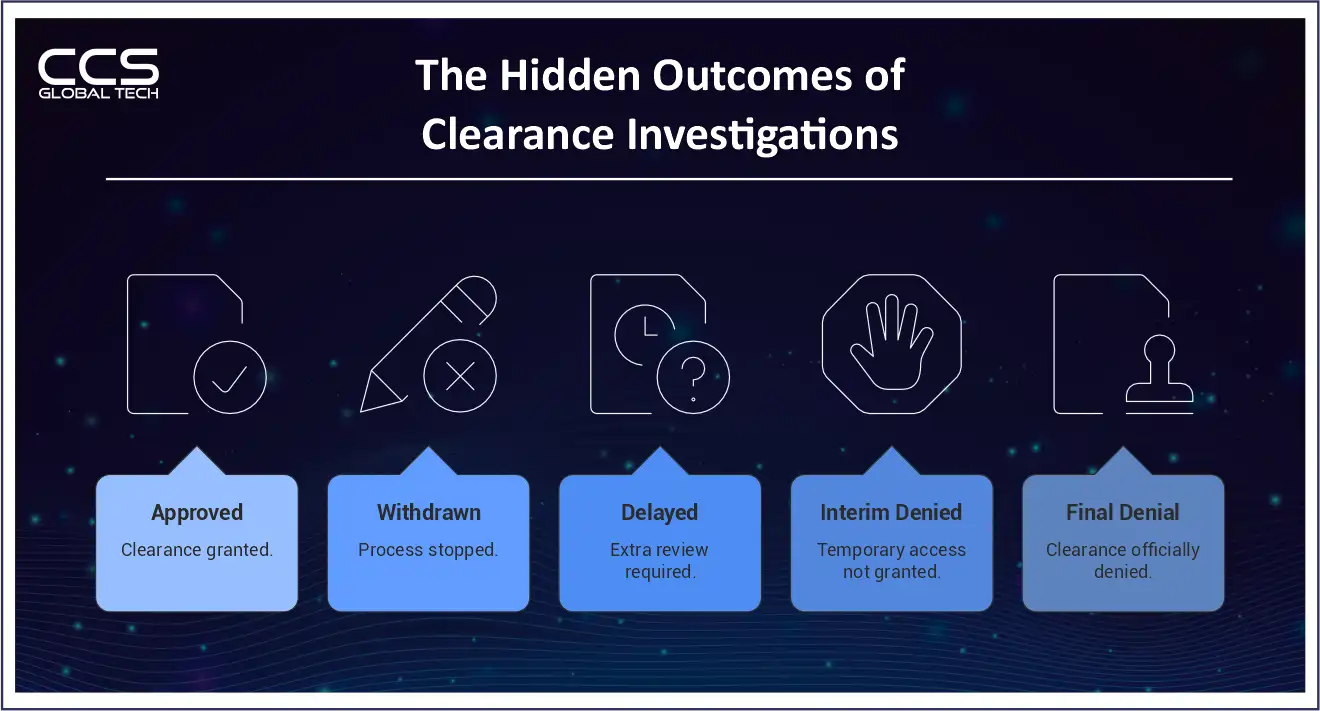
That number hides key differences. Denial rates vary by clearance level, applicant type, and issue severity. A single financial concern is treated differently than repeated concealment. The 2% figure also excludes withdrawn, delayed, or dropped cases, which affect far more candidates than final denials.
2024 DOHA data shows a clear pattern. Financial issues lead clearance denials, followed by drug involvement and personal conduct such as SF-86 dishonesty. These categories drive most denials and are largely preventable with proper preparation and transparency.
The Hidden Outcomes of Clearance Investigations

Why Financial Issues Dominate Denial Decisions?

The single most common reason a security clearance gets denied has nothing to do with loyalty to foreign governments, political beliefs, or criminal history. It is debt. Specifically, unresolved, unaddressed debt that creates a profile of financial irresponsibility and with it, a theoretical vulnerability to coercion.
This surprises many candidates. The intuitive assumption is that clearance adjudicators are primarily looking for spies or people with dangerous foreign connections. In reality, Adjudicative Guideline F – Financial Considerations is the leading disqualifier year after year. DCSA has reported that nearly 30% of denials involve financial concerns.
Proactive mitigation drives outcomes. Candidates who address financial issues with clear steps are viewed differently than those who ignore them. Adjudicators assess the full context, including how you respond to hardship.
Most denials occur when issues are undisclosed or unresolved. Incomplete or inaccurate SF-86 details can turn a financial concern into a credibility problem.
Read more: New Federal Contractors: Staffing Strategy Guide for First-Time Prime Winners

The Rising Problem of Drug Disclosures - Especially Cannabis

The second-fastest growing category in clearance denials over the past two years is drug involvement and the primary driver within that category is cannabis. This is one of the more nuanced areas of the current clearance environment, because state law and federal law are flatly in conflict, and candidates are regularly caught off guard by the gap.
Cannabis remains a Schedule I controlled substance under federal law, regardless of what individual states have legalized. For security clearance purposes, federal law governs. That means a candidate who has used cannabis regularly in a state where it is fully legal has still engaged in activity that DCSA adjudicators must take into account.
Denials here are driven by behavior, not use alone. The key issues are failure to disclose on the SF-86 and intent to continue use despite federal rules. Both raise concerns on honesty and compliance.
DOHA cases tied to drug use have risen through 2023 and 2024. State legalization has increased recent use, but it remains relevant in federal clearance decisions.

Two Candidates, Two Very Different Outcomes

SCENARIO A – FINANCIAL CONCERNS, HANDLED POORLY

A software engineer with strong technical credentials applied for a Secret clearance through a mid-size defense contractor. His financial history included a credit card default from three years prior and outstanding medical collections balance he had been ignoring. On the SF-86, he listed the credit card default but did not mention the medical collections, reasoning that it was a billing dispute and would probably resolve itself.

The investigation surfaced the collections balance. Because it had not been disclosed, the adjudicator now had two concerns: the financial conduct itself, and the omission on the form. What might have been adjudicated as a mitigable financial issue became a personal conduct concern as well. The interim clearance was denied. The final determination took an additional seven months and required extensive documentation and a personal appearance before ultimately resulting in a conditional grant.

The total cost to the contractor: a delayed project start, months of administrative burden, and a candidate who spent most of his first year under significant professional uncertainty. All of it could have been avoided with full disclosure on the front end.

What “Whole Person” Actually Means in Practice?

The phrase appears in every description of the security clearance adjudication process: DCSA evaluates candidates under a “whole person concept.” It is reassuring language, and it is genuinely accurate but it can also create a false impression that any issue can be mitigated with the right presentation.
Adjudicators assess the full context, not a checklist. An isolated issue from years ago carries less weight than repeated or recent behavior. Patterns and intent drive decisions.
“The whole-person concept is a framework for context, not an escape hatch. It works when a candidate gives it material to work with by being honest, taking responsibility, and demonstrating that the concerning behavior belongs to a defined period rather than an ongoing pattern.”
There are several categories where the whole-person framework tends to work in candidates’ favor. Mental health treatment is one of them. DCSA has been explicit: less than 1% of clearances are denied for psychological concerns alone. Seeking treatment is treated favorably in adjudication, not as evidence of instability. This distinction matters for veterans and military candidates especially, who sometimes avoid seeking care out of fear that it will affect clearance eligibility.
There are also categories where the whole-person framework offers less flexibility. Dishonesty on the SF-86 regardless of how minor the underlying issue is one of them. Foreign contacts and influence, particularly when undisclosed, is another. These are the areas where a single decision to omit information can transform an otherwise manageable application into a denial.

What the 2026 Clearance Environment Looks Like?

The clearance processing environment has shifted considerably over the past two years, and candidates entering the system in 2026 are navigating a different landscape than the one that existed even a few years ago.
DCSA has made meaningful progress on the investigation backlog. After the inventory peaked at nearly 291,200 pending cases in September 2024 — the highest level since FY2019 — a concerted effort by a dedicated tiger team brought the number down to approximately 222,700 cases by April 2025, a 24% reduction. The agency has targeted bringing the inventory below 200,000 cases by the end of fiscal year 2025.
Average end-to-end processing times remain lengthy at the Top-Secret level — 243 days as of Q3 FY2025, including 215 days for the investigation component itself. Secret-level cases move faster, averaging 73 days for investigation and 47 days for adjudication.
The FBI’s introduction of a new prioritization tool in late 2024 cut the name-check backlog from 42,000 to 20,000 cases a 48% reduction which should continue to flow through as processing time improvements in 2026.
Continuous vetting is now the norm rather than the exception for most cleared positions. The shift away from periodic reinvestigations means that cleared individuals are monitored on an ongoing basis which changes the risk calculation for both candidates and their sponsoring employers. A concern that surfaces through continuous monitoring requires the same transparency and proactive disclosure that the initial investigation requires. The difference is that in continuous vetting, there is no application submission date on the horizon the monitoring is constant.

What Candidates Should Do Differently in 2026?

The clearance process rewards preparation. Not the kind of preparation that involves deciding what to leave out the kind that involves knowing your own record thoroughly and understanding how the adjudicative framework will evaluate it.
  1. Pull your own credit report before the SF-86  Know what is there before the investigator does. Unresolved collections, erroneous accounts, or accounts you had forgotten about should be identified and addressed or at minimum disclosed and contextualized before the form is submitted. 
  2. Disclose everything and explain the context  The adjudication process uses a whole-person framework. Give it material to work with. A disclosed issue with a documented recovery narrative is categorically different from an undisclosed issue that surfaces through automated record checks. 
  3. Address financial concerns proactively  If you carry significant debt, establish a repayment plan and document your progress. A structured, sincere effort to resolve financial issues is one of the most effective mitigating factors available. Waiting for the investigation to find the problem is not a strategy. 
  4. Understand where cannabis use stands  If you have used cannabis recently, disclose it accurately. Do not state an intention to continue use in a cleared role. If recent and ongoing use is a factor, be realistic about the timing and candidacy considerations before sponsoring or accepting sponsorship for a clearance. 
  5. Treat foreign contacts as disclosure obligations, not judgment calls  Any contact with a foreign national that could reasonably be interpreted as a foreign influence issue  family abroad, business travel, foreign coworkers should be disclosed. Omission is the problem, not the contact itself. 
  6. Ask your FSO the hard questions before submitting  A good Facility Security Officer will not help you hide things, but they will help you understand how to contextualize them accurately. That conversation, before the form goes in, is worth more than any correction you can make afterward. 
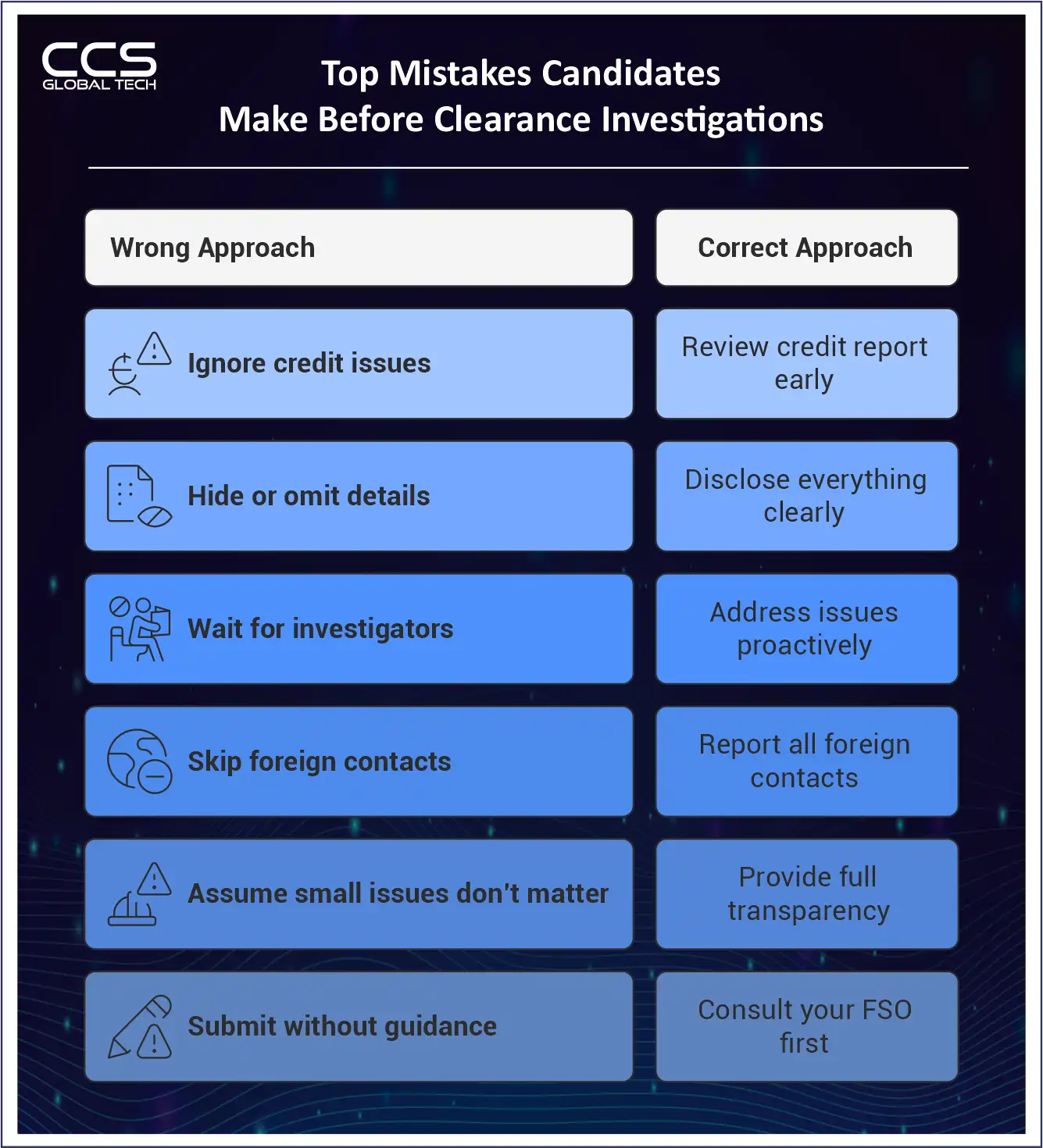
Top Mistakes Candidates Make Before Clearance Investigations

A Note on Appeals and What They Actually Accomplish

Every candidate denied a security clearance has the right to appeal. For contractors, the Defense Office of Hearing and Appeals (DOHA) handles the process. For military members and civilian employees, the Personnel Security Appeals Board (PSAB) governs. The process exists because adjudication is not a mechanical exercise decision can be contested, new information can be presented, and outcomes can change.
That said, the 2024 DOHA data offers a realistic perspective on what appeals accomplish in practice. Financial issue cases upheld on appeal represented the majority of the cases involving that adjudicative guideline meaning that most initial denials related to financial concerns were sustained, not overturned. The appeals process works best when the underlying concern was correctly identified but the initial adjudication did not fully account for mitigating information. It works least well when the denial rested on a finding of dishonesty or intentional omission.
The most effective appeal is one where new documentation or context genuinely changes the picture. A candidate who addresses an outstanding debt after a denial, enrolls in a repayment program, and presents evidence of six months of consistent payments has materially improved their position. A candidate who resubmits the same information with a different framing has not.
CCS Global Tech helps cleared candidates and federal contractors navigate the security clearance process with confidence. With over 25 years of experience in the federal hiring ecosystem, we support organizations and professionals through security clearance readiness consulting, SF-86 preparation guidance, FSO advisory, and cybersecurity certifications such as Security+, CISSP, CCSP, CEH, and CMMC-aligned credentials. Our services also include Recruit-Train-Place programs for contractors, cleared workforce certification assessments, veteran transition support into cleared federal roles, and continuous vetting compliance training for cleared teams.

FAQs

Q1. Why do most security clearance denials happen in 2026?

A – Denials are driven by financial issues, drug involvement, and personal conduct such as incomplete or false SF-86 disclosures. 

A: Around 1–2 percent are formally denied, but many more cases are withdrawn, delayed, or dropped before final decision.

A: Unresolved or undisclosed financial issues increase risk. Documented repayment and corrective action improve outcomes. 

A: Yes. Undisclosed use or intent to continue creates risk. Honest disclosure and stopping use strengthen your case.

A: Incomplete or inaccurate SF-86 disclosures. Omissions often create bigger issues than the original concern. 

A: Yes. TS and TS/SCI roles involve deeper scrutiny and stricter evaluation of the same issues. 

A: The process may continue, but many employers pause or withdraw offers based on interim results. 

A: Secret takes about 4–6 months. Top Secret often takes 8–12 months or longer. 

A: Yes. You can appeal or reapply after resolving the issue and showing clear mitigation. 

 A: Resolve debts, stop disqualifying behavior, and provide complete and accurate disclosures upfront.