

The AI Arms Race in Federal Hiring: How Automated Screening is Filtering Resumes (And How to Beat It)

The AI Arms Race in Federal Hiring How Automated Screening is Filtering Resumes
Marcus had fifteen years of federal program management experience under his belt. His resume was thorough, well-formatted, and documented every major accomplishment with measurable outcomes. He applied for a senior program analyst position with a large civilian agency. He customized the application. He followed every best practice he knew.
He never heard back.
Six weeks later, a colleague with comparable experience, but a resume structured differently, with language pulled directly from the job announcement, received a call within four days.
The difference wasn’t qualifications. It wasn’t an experience. It was whether an automated screening system, working through hundreds of applications before a human ever opened a single file, recognized Marcus’s resume as a match.
If you work in federal hiring as a candidate, an HR professional, or a staffing partner- stories like this are no longer rare. They are becoming the norm. And understanding what’s driving this shift is no longer optional. It’s essential.

What's Actually Happening in Federal Hiring Right Now?

Automated resume screening isn’t new. Federal agencies and their contractors have used Applicant Tracking Systems for years. What has changed dramatically in the last eighteen months is the sophistication of those systems. Modern screening tools don’t just scan for keywords.
They analyze career narratives, evaluate the progression of experience, flag formatting inconsistencies, and assess whether the language in an application mirrors the language of the job posting.
The numbers behind this shift are striking:
  • 83% of companies will use automated tools to screen resumes by 2025, up from just over half two years prior.   
  • 99% of hiring managers now report using some form of automated assistance in the hiring process, with 98% citing significant efficiency improvements.  
  • Applications surged more than 45% year-over-year in 2025, with approximately 11,000 applications submitted every minute on LinkedIn alone.   
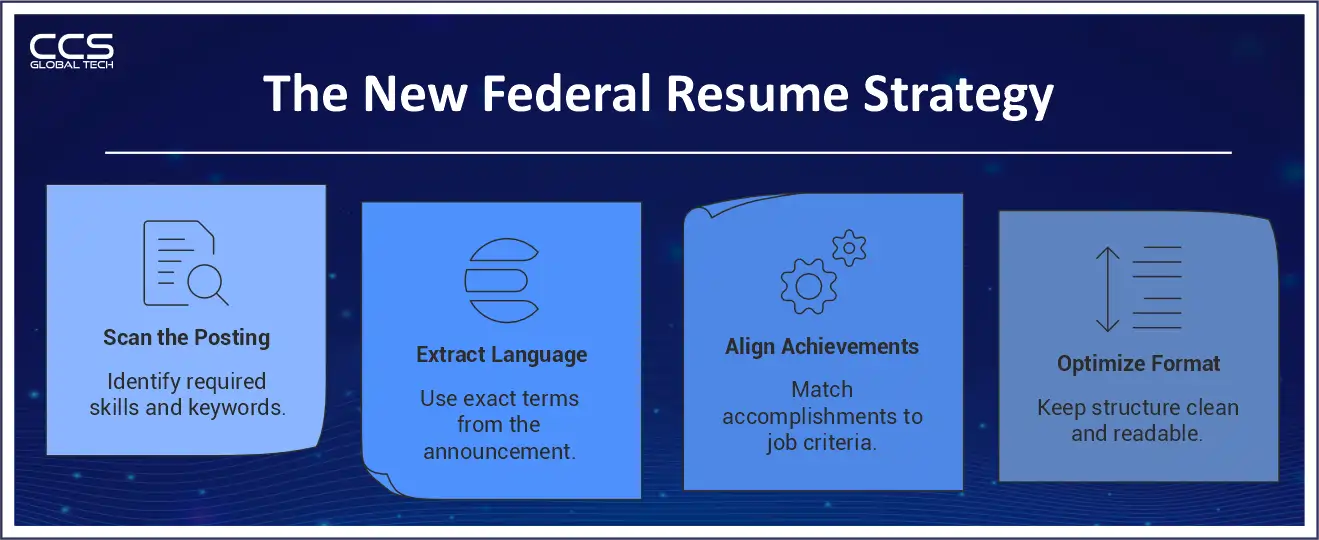
The New Federal Resume Strategy

How These Screening Systems Actually Work?

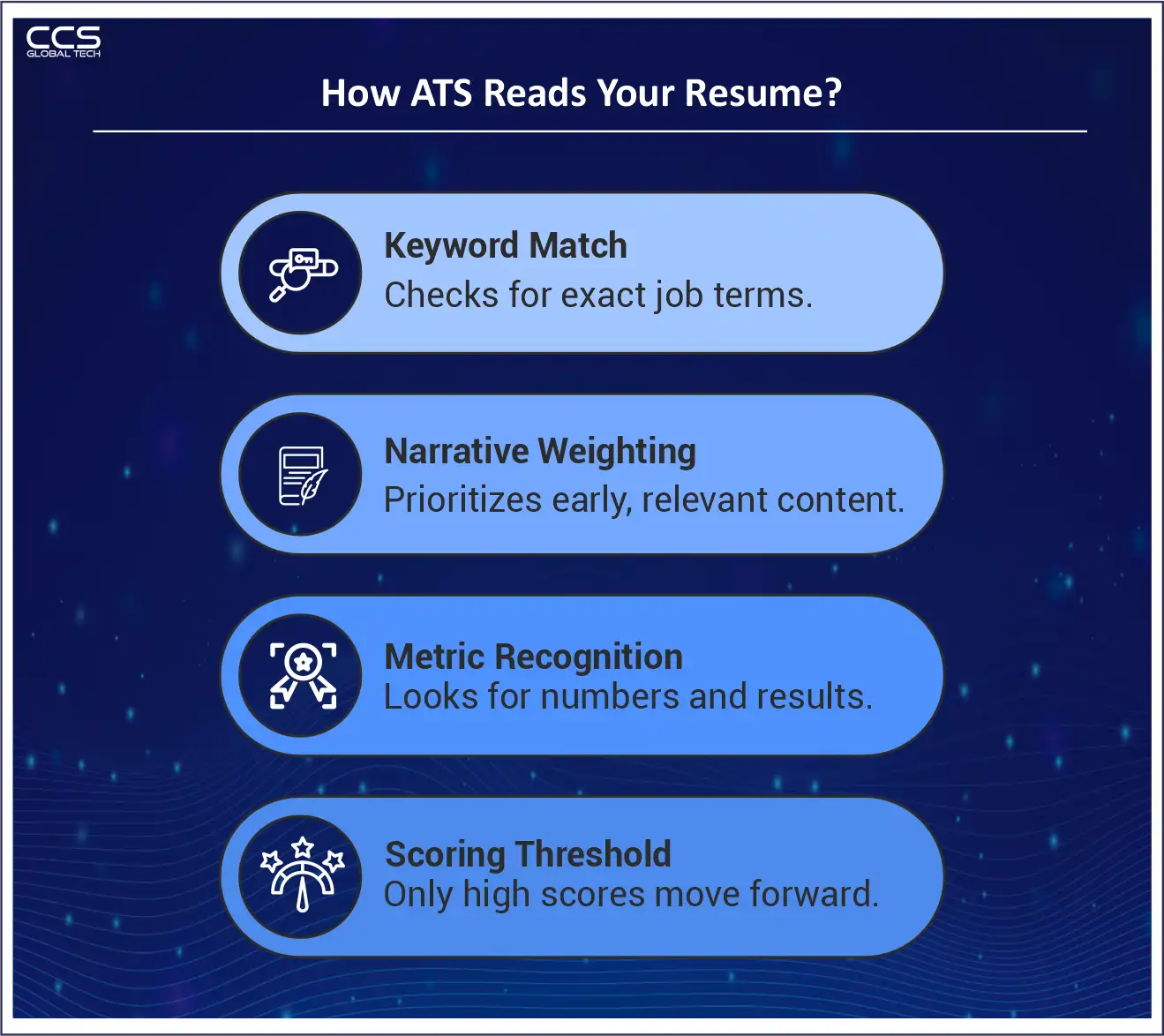
Understanding the mechanics of automated screening is the first step toward navigating it effectively. Modern systems don’t simply look for a list of keywords. They operate on several layers simultaneously.

Language and Terminology Alignment

Federal job announcements are written with very specific language, language drawn from OPM competency frameworks, position classification standards, and agency-specific terminology. Screening systems are tuned to recognize that language. When a candidate’s resume uses synonyms or informal equivalents rather than the exact terms from the announcement, the system may score it lower or filter it out- even if the underlying experience is identical.
Example: A resume that says “managed vendor relationships” may score lower than one that says “administered contracting officer representative (COR) duties” for a federal acquisition role, even if both describe the same work.

Structural Consistency Checks

Automated systems are built to parse information efficiently. Resumes with unconventional formatting, embedded tables, graphics, text boxes, or unusual fonts are frequently misread or rejected outright by parsing algorithms. The system may fail to extract experience dates, education credentials, or position titles accurately, resulting in an incomplete candidate profile.

Semantic Relevance Scoring

More advanced screening tools go beyond matching terms and evaluate whether the overall narrative of the resume aligns with the role requirements. They assess career progression, identify gaps or inconsistencies, and weight experience based on relevance to the specific position being filled.
56% of companies acknowledge their screening tools may inadvertently filter out qualified candidates. Yet adoption continues to accelerate because the efficiency gains for high-volume hiring are too significant to ignore.

The Look-Alike Problem: When Everyone Optimizes for the Algorithm

Here’s an unintended consequence that’s playing out across federal hiring right now: as more candidates optimize their resumes specifically for automated screening- matching language, formatting for parsing, and structuring applications around job announcements- the resulting pool of screened candidates starts to look increasingly uniform.
64% of hiring managers and recruiters reported seeing a significant increase in look-alike, nearly identical applications in 2024–2025, which actually increased manual screening workload.
62% of hiring managers say they are more likely to reject resumes that feel automated or lack genuine customization, even if they pass initial screening.
This creates a two-stage challenge for federal candidates. You must first get past the automated filter, which requires strategic language alignment and clean formatting. But then you must stand out to human reviewers who have spent the morning reading a stack of applications that all sound remarkably similar.
The candidates who navigate both stages successfully are the ones who understand the system well enough to work within it while bringing enough specificity and authenticity to their experience narratives that human reviewers stop and pay attention.

A Real-World Example: The Resume That Two Systems Evaluated Differently

One of our recent placement engagements illustrates this dynamic precisely. 

A well-qualified IT security specialist applied for a GS-13 information security position with a federal agency. Her resume documented deep technical experience, multiple industry certifications, and a strong track record in vulnerability assessment and incident response. She applied to the same position twice, first with her existing resumé, then six weeks later (after the vacancy was reposted) with a revised version that we helped her restructure.
The first application: no response. The second application, with the same experience, restructured for parsing clarity, language aligned to the OPM cybersecurity competency framework, and specific terminology mirroring the announcement, resulted in an interview invitation within eight days.
Nothing about her qualifications changed. What changed was how those qualifications were communicated in a way that both the automated screening system and the human reviewer could immediately recognize as relevant.
The resume is not just a document. It is a translation exercise, translating your real experience into the language that the systems and the people evaluating you are specifically looking for.

Five Strategies That Actually Move Federal Candidates Through Screening

Based on our experience placing candidates across federal civilian agencies and defense contractor environments, here are the approaches that consistently produce better screening outcomes.

1. Mirror the Job Announcement — Precisely

Federal job announcements are not marketing documents. They are specification sheets. Read them as such. Identify the exact competency language, required qualifications, and preferred qualifications. Use those exact phrases, not synonyms in your resume, particularly in your summary statement and in the descriptions of your most relevant experience.
If the announcement says “experience with the Federal Acquisition Regulation (FAR),” your resume should say “Federal Acquisition Regulation (FAR)”, not just “federal procurement” or “government contracting.”

2. Eliminate Formatting That Confuses Parsing Systems

For federal applications submitted through USAJOBS or a contractor’s ATS, formatting simplicity is not a limitation, it is a strategic advantage. Remove text boxes, tables used as layout tools, graphics, and headers embedded in design elements. Use clean section breaks, standard fonts (Arial, Calibri, Times New Roman), and consistent date formatting throughout.

3. Lead Every Position with the Most Relevant Accomplishment

Automated systems that evaluate career narratives weight early information in each section more heavily. Don’t bury your most compelling, role-relevant accomplishment three bullet points into a position description. Lead with it. Make the system and the human reviewer see your value immediately.

4. Quantify Outcomes Wherever Possible

Federal resumes that include specific metrics — budget amounts managed, number of personnel supported, percentage improvements in process outcomes, contract values administered — score better in both automated semantic analysis and human review. Numbers create specificity that generic language cannot replicate.
Only 8% of job seekers believe automated tools make hiring more fair — yet 88% of organizations cite time savings as the primary reason for continued adoption.

5. Treat the KSAs and Self-Assessment Questions as Part of Your Resume
In USAJOBS applications, the Questionnaire and Knowledge, Skills, and Abilities (KSA) responses are often the first data points processed by screening systems. Candidates who give superficial answers to KSA questions, even when their resume is strong, frequently score themselves out of consideration before a human reviews their qualifications.
Answer every question with specificity. Reference your resume. Provide supporting context.

The Bias Issue: What Federal Candidates and Agencies Should Understand

The efficiency gains of automated screening come with documented trade-offs that the federal hiring community cannot afford to ignore.
Research from the University of Washington found that automated screening tools favor White-associated names 83% of the time and male-associated names 52% of the time.
67% of organizations acknowledge their automated screening tools could introduce bias into hiring decisions, yet adoption continues to accelerate.
For federal agencies committed to merit-based hiring and equal employment opportunity, these findings represent a serious compliance consideration. Human oversight at every stage of the screening process is not just a best practice, for many federal hiring actions, it is a legal requirement. Automated tools should be configured to support human decision-making, not replace it.
Federal contractors working on staffing programs have a responsibility to understand these limitations and to advise agency clients accordingly.

A Federal Agency That Got the Balance Right

A mid-sized regulatory agency facing a surge in retirement-driven vacancies needed to fill multiple contracting officer roles quickly. Initial attempts using a commercial screening platform alone produced a shortlist that human reviewers found underwhelming technically qualified candidates on paper who lacked the mission-specific context the agency needed.
The agency, working with a federal staffing partner, reconfigured their screening approach: the automated tool filtered for baseline qualifications and formatting compliance, while human reviewers with subject matter expertise in federal acquisition evaluated the actual experience narratives. The sourcing process was supplemented by direct outreach to candidates who may not have applied through standard channels.
The result: time-to-fill dropped by over 30%, and 90-day retention for the placed candidates exceeded the agency’s historical average by a significant margin.
The lesson isn’t that automated screening doesn’t work. It’s that automated screening works best when it’s part of a thoughtfully designed process, not the entire process.

How CCS Global Tech Helps Federal Candidates and Agencies Navigate This Environment?

At CCS Global Tech, our Federal Staffing practice is built on a foundational understanding of how federal hiring actually works not just how it’s supposed to work. That means we understand the screening systems, the USAJOBS application architecture, OPM qualification standards, and the specific language frameworks that federal resume reviewers are trained to evaluate.
For candidates we represent, we bring that knowledge directly into the resume development and application process. We help translate genuine, hard-earned experience into the language and format that federal hiring systems are designed to recognize. And we help candidates understand the difference between optimizing for the algorithm and communicating authentically to the human decision-makers who make the final call.
For federal agencies and prime contractors we support, we bring a structured approach that combines the efficiency benefits of modern screening tools with the judgment and accountability that federal hiring demands. We help our clients build applicant pools that are genuinely competitive, not just algorithmically filtered.
The federal talent market is more competitive, more complex, and more technology-mediated than it has ever been. Navigating it effectively requires a partner who understands both sides of the table.
That’s exactly what we do.

Ready to Navigate Federal Hiring with Confidence?

Whether you’re a federal agency facing critical vacancies, a contractor building a mission-ready workforce, or a candidate ready to make your move, let’s have a real conversation about what it takes to win in today’s federal hiring environment.

FAQs

Q1: How do automated screening systems filter federal resumes?

A: Automated systems compare resumes against job announcements, analyze keyword alignment, evaluate career progression, and assign a match score. Only candidates above a scoring threshold move to human review.

A: Many qualified candidates are filtered out before human review because their resumes do not mirror the exact language or structure used in the job announcement. 

A: Most agencies and contractors use Applicant Tracking Systems and automated tools to screen applications before a hiring manager reviews them. These systems prioritize alignment and relevance.

A: Use exact phrases from the job announcement, including required competencies, certifications, regulations, and specialized experience. Avoid relying on synonyms. 

A: Yes. Text boxes, graphics, tables, and inconsistent formatting can confuse parsing systems and reduce your match score. 

A: Quantified outcomes such as budgets managed, percentage improvements, contract values, and team sizes improve both automated scoring and human evaluation.

A: The most common mistake is failing to align resume language directly with the job announcement and underestimating the importance of KSAs and self-assessment responses. 

A: Yes. KSA and questionnaire responses are often scored alongside resumes. Weak or generic answers can lower your ranking before a human reviews your file.


A: Yes. Customizing your resume to reflect the exact language and requirements of each posting significantly improves visibility in automated screening systems. 

A: No. Automated tools determine which candidates move forward. Final hiring decisions are still made by human reviewers.