


Let’s be direct about something most organizations learn the hard way: the security clearance process is one of the most consequential, least forgiving workflows in the entire federal contracting universe. One wrong move, a missing document, an undisclosed financial issue, a poorly timed job posting and you are looking at months of delays, lost contract performance, and in some cases, losing the bid entirely.
We have spent over 25 years inside this world, placing cleared professionals across hundreds of federal agencies and defense programs. And we have seen the same mistakes surface again and again. Not because organizations are careless, but because the clearance process is genuinely complex, and guidance on the specifics is hard to find.
This article breaks down the seven most costly mistakes we see with real data behind each one and explains exactly what to do differently.
DCSA’s background investigation inventory peaked at 291,200 pending cases in September 2024 – the highest backlog since FY2019. As of Q3 FY2025, the average end-to-end processing time for a Top Secret clearance stands at 243 days.
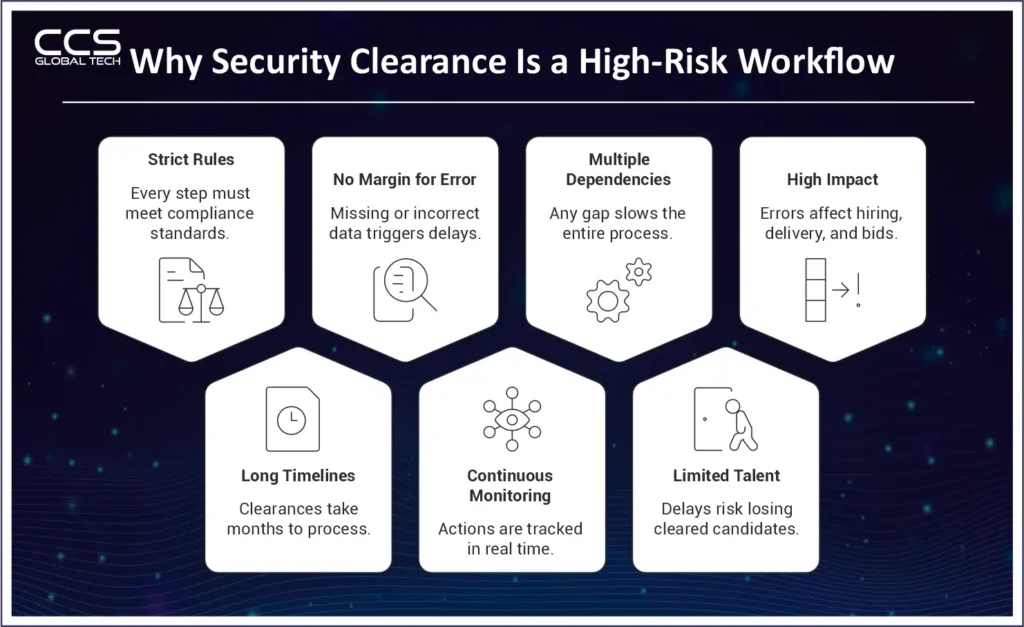
Now let’s have a look at the mistakes to be considered.
Top Security Clearance Mistakes to avoid
Mistake #1: Ignoring Financial Red Flags Before Applying
This is the single most common reason clearances get denied, and it is almost entirely preventable. Year after year, financial issues top the DCSA’s list of disqualifiers, yet applicants continue to walk into the process with unresolved debt, unpaid collections, and financial histories they have not addressed.
DCSA has reported that nearly 30% of all clearance denials involve financial concerns under Adjudicative Guideline F making it the leading disqualifier by a wide margin.
The concern here is not hardship everyone faces financial difficulty at some point. The concern is irresponsibility or unaddressed vulnerability. Adjudicators are trained to ask: could this person be coerced because of financial pressure? The answer to that question shapes the outcome far more than the dollar amount owed.
What to do instead?
Conduct an internal financial review of every clearance candidate well before submission. Candidates who proactively address debt enrolling in repayment plans, settling outstanding collections, showing six or more months of consistent payment behavior demonstrate the kind of reliability adjudicators are looking for. Documentation is everything here.
Mistake #2: Submitting Incomplete or Inaccurate SF-86 Forms
The SF-86 is a 136-page document. That alone should signal the level of precision required. And yet, incomplete or inaccurate SF-86 submissions remain one of the most consistent sources of delay and denial.
DCSA reported that FCL sponsorship packages currently carry a rejection rate of over 50%, and initial/upgrade FCL packages face a rejection rate of 70% largely due to missing, incorrect, or incomplete information.
What makes this mistake particularly damaging is what it signals to adjudicators: a pattern of omission often looks like deliberate concealment, even when it was simply poor preparation. An issue that might otherwise be mitigated gets reframed as a credibility problem and credibility problems are far harder to overcome.
What to do instead?
Give candidates structured preparation support before they touch the SF-86. This means reviewing their employment history, residential history, foreign contacts, financial records, and any reportable incidents well in advance. Organizations working with experienced federal staffing partners gain a significant advantage here, the preparation process is managed, not ad hoc.
Mistake #3: Treating Drug Use Disclosures as Optional
This one has become significantly more complicated in recent years, and it catches a growing number of candidates off guard. The widespread legalization of cannabis at the state level has created a false sense of clearance safety. Candidates assume that because something is legal where they live, it is not a problem for their federal clearance.
DOHA cases tied to drug use rose steadily through 2023 and 2024. The primary driver: candidates failing to disclose prior use on the SF-86, or stating intent to continue use because it is legal in their state. Cannabis remains a Schedule I substance under federal law and federal law governs the clearance process, not state law.
The denial is almost never about the use itself. It is about the non-disclosure and the intent to continue. Both raise serious concerns about an applicant’s willingness to comply with federal rules exactly the kind of concern that disqualifies a candidate regardless of their technical qualifications.
What to do instead?
Educate candidates clearly and early. Create a pre-submission briefing that covers exactly what must be disclosed, why federal law governs regardless of state law, and what the difference is between a mitigatable disclosure and an indefensible omission. The earlier this conversation happens, the better the outcome.
Read more- Security Clearance Denial Rates in 2026: What Federal Candidates Should Know
Mistake #4: Waiting Too Long to Start the Clearance Process
This is perhaps the most operationally damaging mistake we see, and it plays out the same way every time. An organization wins a contract. They begin recruiting. They find strong candidates. And then they realize those candidates are not yet cleared and the clock on project performance has already started.
As of Q3 FY2025, the average end-to-end processing time for a Top Secret clearance is 243 days more than eight months. For Tier 3 (Secret) clearances, the investigation alone averages 73 days, with adjudication adding another 47 days.
Eight months is not a planning buffer. It is an operational crisis waiting to happen. For organizations that bid on contracts expecting to hire and clear new talent after award, that gap between expectation and reality can jeopardize the entire engagement.
What to do instead?
Build your cleared talent strategy before you need it. This means maintaining relationships with cleared professionals who are actively seeking opportunities, working with staffing partners who keep pre-cleared benches, and building contingency plans for key personnel well before contract milestones require them.
Real-World Example: The TS/SCI Hiring Crunch
A federal contractor supporting a national security project needed to hire 10 cybersecurity analysts with TS/SCI clearances plus full-scope polygraph on a tight timeline.
Rather than waiting for candidates to clear from scratch – a process that could have taken well over a year they engaged CCS Global Tech, which was able to deploy pre-vetted, active TS/SCI professionals within weeks. The contract launched on time. The project did not miss a single milestone.

Mistake #5: Confusing Facility Clearances with Personnel Clearances
These are two distinct processes with two distinct sets of obligations and conflating them creates compliance problems that surface at the worst possible times, usually mid-contract.
A Facility Security Clearance (FCL) authorizes an organization to perform classified work. A Personnel Security Clearance (PCL) authorizes an individual to access classified information. Organizations need both, and they are processed separately.
Only organizations actively performing on or about to perform on, a classified contract can sponsor employees for PCLs. You cannot pre-clear a bench ‘just in case.’ There must be a documented, bona fide need tied to contract performance.
FCL sponsorship packages have a rejection rate of over 50%. Initial and upgrade FCL packages face a 70% rejection rate. The average FCL sponsorship package requires 1.93 review cycles before approval and initial packages average 2.5 cycles.
What to do instead?
Assign dedicated industrial security personnel or a qualified external partner to manage FCL and PCL compliance separately. Understand the sequencing requirements, documentation standards, and DCSA submission procedures before you submit, not after a rejection that sends you back to the beginning of the queue.
Mistake #6: Letting Clearances Lapse Due to Poor Lifecycle Management
A cleared professional who has not been actively using their clearance can lose it. This is not a theoretical risk, it happens with regularity, and it hits organizations hardest during periods of high demand when they need talent fast and discover their bench is no longer current.
Clearances are not permanently maintained without active use. When a cleared employee moves to a non-cleared role, takes an extended leave, or transitions between employers without proper transfer, the clearance can fall into an inactive status that requires re-investigation to restore effectively restarting the clock.
Security clearance processing timelines of 6–12 months for full approval are now the norm in 2025, with some TS/SCI cases taking significantly longer. A lapsed clearance that requires reinvestigation enters the same queue as a new application.
What to do instead?
Implement a clearance lifecycle tracking system. Know the reinvestigation windows for every cleared employee – Tier 3 clearances require reinvestigation every 10 years, Tier 5 every 5 years. Flag candidates approaching those windows proactively. Sponsor clearance renewals before they expire, not after.
Read more- Federal Pay Raise 2026: What It Means for Agencies, Contractors, and Cleared Talent
Mistake #7: Underestimating the Cost of a Failed Clearance Process
Organizations tend to think about clearance failures as administrative setbacks. The reality is that they carry significant financial and operational consequences, consequences that rarely appear in a project budget until they are already unavoidable.
Consider what a failed clearance actually costs: a position left open during an investigation that ran 6–12 months. A candidate who discloses at the final stage an issue that should have been caught in pre-screening. A contract deliverable delayed because a key personnel slot cannot be filled. An appeal process that adds months to an already strained timeline.
Approximately 2% of security clearance applications are denied annually. In practical terms, roughly 80,000 applications from a pool of 4 million result in denial, each representing months of lost time and real cost to the sponsoring organization.
What to do instead?
Build clearance risk into your project planning from the start. This means identifying roles that require clearance, mapping expected timelines against contract milestones, and maintaining a contingency pipeline of pre-cleared talent for roles where a failed clearance would create critical gaps. Organizations that plan for this scenario avoid it far more often than those who do not.
Real-World Example: What Happens When Financial Issues Are Caught Late
A software engineer applied for a Secret clearance through a mid-size defense contractor. His financial history included a credit card default from three years prior and an outstanding medical collections balance he had been ignoring.
The investigation flagged both. The delay pushed the project timeline by six months. Had the contractor conducted a basic pre-submission financial review, standard practice for experienced staffing partners, the issue would have been identified and addressed long before it derailed the program.
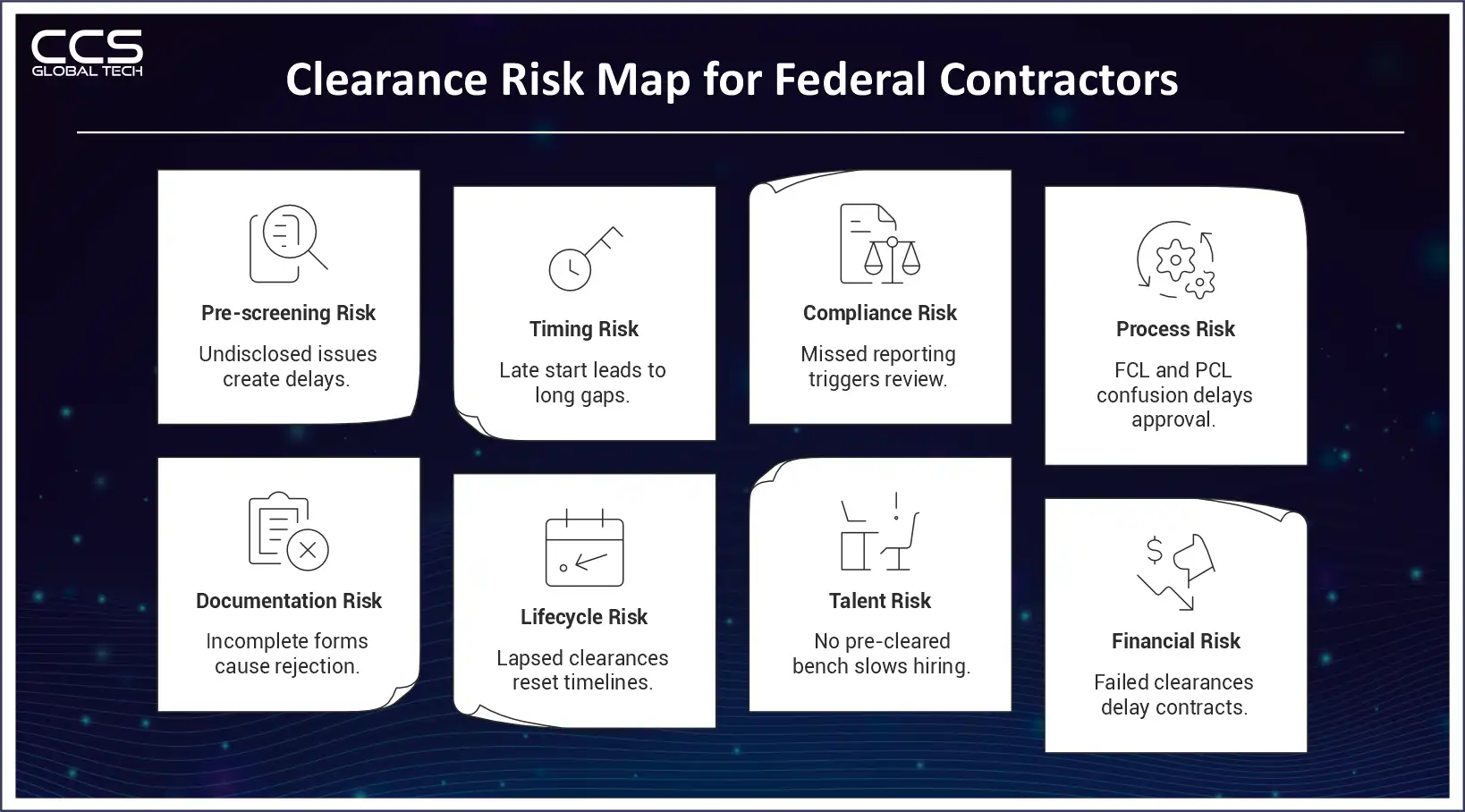
The Common Thread Across All Seven Mistakes
Preparation. Every single mistake on this list is preventable with the right combination of preparation, process discipline, and expertise. None of them require exceptional circumstances to occur, they occur regularly, in well-resourced organizations, when the clearance process is treated as a formality rather than a managed workflow.
The security clearance process is one of the few areas in federal contracting where the difference between doing it right and doing it almost right is measured in months and millions. It deserves the same level of strategic attention as proposal development, contract negotiation, and program management.

Ready to Take the Guesswork Out of Security Clearance Hiring?
Ready to take the guesswork out of security clearance hiring? At CCS Global Tech, we’ve spent over 25 years helping federal agencies, defense contractors, and government primes navigate the most complex parts of cleared talent acquisition, including the costly delays, denials, and compliance gaps that derail missions.
Whether you’re hiring for a mission-critical contract, managing your first clearance sponsorship, or trying to fill a TS/SCI role in weeks instead of months, our team gets it done with access to 100,000+ pre-vetted cleared professionals, 100+ full-time recruitment specialists, and deep partnerships across veteran communities and DoD programs, so you’re never starting from zero.
We deliver pre-cleared talent from Public Trust through Top Secret/SCI, clearance sponsorship strategy with compliance guidance, DoD Directive 8570/8140-aligned training through CCS Learning Academy, veteran-first hiring pipelines via 200+ military base and non-profit partnerships, and rapid deployment that puts candidates on mission in days, not months.
Have a cleared hiring challenge putting your project at risk?
FAQs
A- The most common mistakes include failing to report foreign travel, hiding financial problems, undisclosed foreign contacts, substance misuse, criminal conduct, and providing incomplete or false information. These actions raise trust concerns under continuous evaluation.
A- Yes. Not reporting foreign travel on time is a serious compliance issue. It signals lack of transparency and can trigger additional review or clearance suspension.
A- Unmanaged debt, late payments, or unexplained financial activity can raise concerns about reliability and potential vulnerability to coercion. Consistent financial discipline is critical.
A – You must report any meaningful, ongoing, or repeated contact with foreign nationals. Casual or one-time interactions usually do not require reporting unless they become significant.
A- Yes. Sharing sensitive information, controversial content, or foreign connections online can raise red flags during background checks and continuous monitoring.
A- Inaccurate or incomplete information can damage credibility. Even small omissions can lead to denial or revocation if seen as intentional.
A- Yes. Illegal drug use or misuse of controlled substances is a major risk factor. Even legal substances can raise concerns if they impact judgment or reliability.
A- Yes. Repeated minor offenses or unresolved legal issues can signal poor judgment. All legal matters should be disclosed and properly resolved.
A- Continuous evaluation reviews financial records, criminal activity, travel patterns, and other data points in real time. It detects risks early and ensures ongoing compliance.
A- Report the issue immediately to your security officer. Provide complete and accurate details. Early disclosure reduces the impact of the mistake.