
Public Trust Clearance in 2026: Requirements, Forms, and Red Flags Every Federal HR Leader Needs to Know

Public Trust Clearance
The offer letter had already gone out. A newly hired IT program manager at a mid-sized federal contracting firm was two weeks from her start date when her onboarding coordinator called with an uncomfortable message: the background investigation required for her Public Trust designation had stalled.
Nobody could say exactly why. Her forms had been submitted correctly. Her record was clean. But the case was sitting in a growing queue, and nobody could give a firm timeline for when it would move.
She waited eight weeks before receiving clearance. The project she was hired to support had already begun without her. Her first month on the job was spent catching up on decisions made in her absence, and her supervisor spent that same month explaining to a client why the role had been empty so long.
This story is not an isolated frustration. It is a routine operational reality for federal agencies, government contractors, and the HR professionals who manage hiring pipelines that depend on Public Trust determinations. And in 2026, the landscape around this process has shifted enough that what worked two years ago may not serve you well today.
This article breaks down the current state of Public Trust clearance in plain, practical terms- what the levels mean, which forms apply, what disqualifies candidates, and what HR leaders and business decision-makers need to know right now to keep their hiring timelines from falling apart.

What Public Trust Actually Is and What It Is Not?

There is persistent confusion in federal hiring circles about the difference between a Public Trust designation and a security clearance. They are related but not the same thing, and treating them interchangeably creates problems at every stage of the hiring process.
A security clearance grants access to classified national security information. A Public Trust designation, by contrast, applies to positions where the individual’s role carries significant responsibility for the welfare of the public, sensitive but unclassified government data, financial systems, or critical infrastructure. It is governed not by national security law but by Title 5 Code of Federal Regulations, Part 731 – a framework that underwent significant revision effective January 17, 2025.
Under the current framework, all federal positions are assigned both a sensitivity designation and a risk level. Public Trust applies specifically to positions rated Moderate Risk or High Risk. Low-risk positions are non-Public Trust, though they still require basic background checks.
The three tiers of position risk:
  • Low Risk (non-Public Trust): Entry-level or administrative roles with minimal access to sensitive data or systems. Background investigation conducted using SF-85. 
  • Moderate Risk Public Trust (MRPT): Roles involving program administration, access to sensitive but unclassified records, or responsibility over government databases. Requires SF-85P and a Tier 2 investigation. 
  • High Risk Public Trust (HRPT): Positions with major decision-making authority, oversight of critical IT systems, control of significant financial resources, or access to large volumes of personally identifiable information. Requires SF-85P and a Tier 4 investigation. 
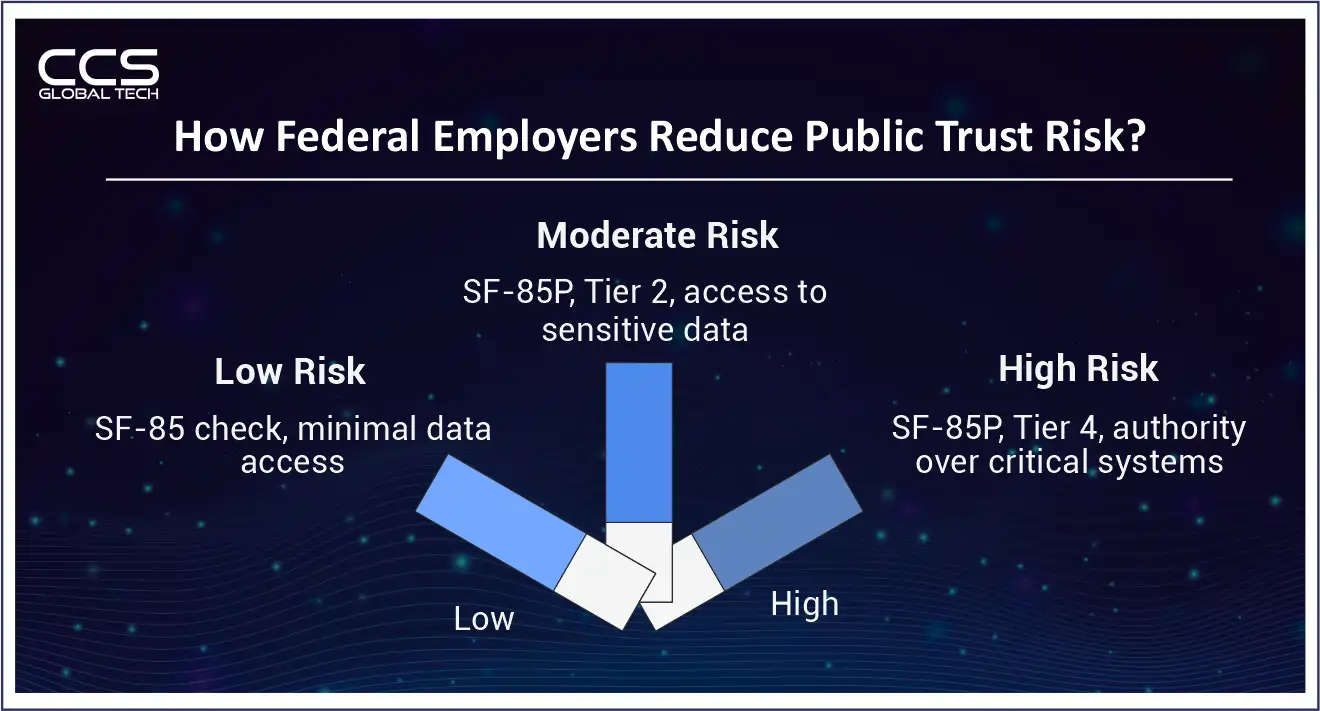
The distinction matters enormously from an HR planning standpoint because Tier 2 and Tier 4 investigations carry very different processing timelines, documentation requirements, and scrutiny levels. Mislabeling a position or failing to designate it accurately before hiring begins is one of the most common sources of delay in federal onboarding.
How Federal Employers Reduce Public Trust Risk

The Forms Landscape in 2026: What Has Changed and What Is Coming?

For years, Public Trust positions were processed using three Standard Forms: the SF-85 for non-sensitive low-risk roles, the SF-85P for moderate and high-risk Public Trust positions, and the SF-85P-S as a supplemental questionnaire for selected positions requiring additional disclosure.
In 2026, those forms are still in use but the landscape around them is actively shifting, and HR professionals who are not tracking the changes are walking into avoidable problems.
Updated February 2024 versions of the SF-85, SF-85P, SF-85P-S, and SF-86 rolled out via eApp. As of August 1, 2025, any submission on a previous version of these forms is rejected and must be resubmitted on the current version.
That deadline created real problems for organizations that were slow to update their internal processes. Cases initiated before May 12, 2025 that were still in process past August 1 had to be completely resubmitted on the updated forms including fresh fingerprints if the originals were more than 120 days old. For HR teams managing large onboarding cohorts, that was not a minor inconvenience. It was a cascading delay.
Looking ahead, the bigger structural change is the planned replacement of all Standard Forms with a single consolidated document called the Personnel Vetting Questionnaire, or PVQ.
The PVQ is modular, divided into Parts A through D, with the applicable sections determined by the sensitivity and risk level of the position. It is being developed as part of the National Background Investigation Services program, and its full implementation has been repeatedly delayed.
“DCSA is currently projecting full PVQ implementation in late 2026 or early 2027, replacing the SF-85, SF-85P, SF-85P-S, and SF-86 across all federal agencies and cleared contractors.”
The practical implication for HR teams in 2026: you may be operating with legacy SF forms for part of the year and transitioning to PVQ for new hires later in the same period. Building flexibility into your onboarding documentation workflows is not optional. It is necessary.
Additionally, the eApp system has now fully replaced the older e-QIP platform across all federal agencies. As of late 2024, all submissions flow through eApp. If your organization is still referencing e-QIP in onboarding guides or vendor contracts, those documents need to be updated immediately.

The Processing Reality: Timelines, Backlogs, and What to Plan For

One of the most operationally significant things HR leaders can understand about Public Trust investigations right now is the processing environment they are working within. It is improving in some respects. It is still challenging in others.
As of Q3 fiscal year 2025, the average end-to-end processing time for background investigations was 243 days, including 19 days to initiate a case, 215 days to investigate, and 9 days to adjudicate.
Two hundred and forty-three days is more than eight months. For a federal agency that has designated a role as High Risk Public Trust and needs someone in it, that timeline is not an inconvenience. It is an operational constraint that has to be built into project planning, staffing models, and contract performance schedules.
The good news is that DCSA’s tiger team – a working group commissioned in late 2024 to address the rising backlog has made measurable progress. However, a government shutdown in late 2025 introduced new delays, and DCSA itself acknowledged that reopening after a shutdown creates a surge effect that takes months to absorb.
The realistic planning guidance for 2026: assume Tier 2 investigations will average three to five months for straightforward cases. Assume Tier 4 investigations will average six months to a year. Build those windows into your hiring pipeline, not as worst-case scenarios, but as baseline assumptions.

A Federal Contractor’s Hard Lesson in Position Risk Designation

A government technology contractor in the Mid-Atlantic region won a new task order in early 2025 that required standing up a team of twelve professionals to manage a federal agency’s IT infrastructure. Eight of the twelve positions involved administering systems that processed large volumes of agency personnel records.
During position designation, the firm’s HR director classified all twelve roles as Moderate Risk Public Trust, reasoning that none of the positions had independent policy-making authority. The contracting officer at the agency reviewed the designations six weeks later and identified four positions that should have been designated High Risk Public Trust, based on the level of access to sensitive personnel data those roles required.
“We had people reporting to work, completing their first two weeks of general onboarding, and then finding out they couldn’t access the systems central to their job functions. That’s a retention problem as much as it is a compliance problem.”
The four affected employees had to submit new SF-85P forms and wait for Tier 4 investigations rather than Tier 2. Two of them resigned during the extended wait. The contractor absorbed the cost of re-recruiting, re-hiring, and re-vetting two positions, a process that ultimately delayed full task order staffing by nearly five months.
The lesson is not subtle: position risk designation is a legal and operational responsibility that demands accurate analysis before the hiring offer goes out, not after onboarding begins. Agencies and contractors that treat this step as a formality pay for it in ways that go well beyond paperwork.

Red Flags: What Gets Cases Flagged, Delayed, or Denied

The question HR leaders and candidates ask most often is a simple one: what actually disqualifies someone from a Public Trust position? The honest answer is that very few things are automatic disqualifiers. Most issues are evaluated under a totality-of-circumstances standard that weighs the nature and recency of the issue, the individual’s candor in disclosing it, and evidence of rehabilitation or mitigating factors.
That said, certain patterns consistently generate flags that slow cases down or result in unfavorable adjudications. HR teams that understand these patterns can do a much better job of counseling candidates before they submit forms which reduces surprises and shortens overall timelines.

Financial Issues

Financial history is one of the most common sources of adjudicative concern for Public Trust positions. Delinquent debts, unpaid tax obligations, bankruptcies, and patterns of financial irresponsibility are all reviewed. The concern is not poverty. The concern is vulnerability to external pressure and evidence of poor judgment regarding obligations.
  • Significant outstanding delinquent debt (especially to the federal government).
  • Unexplained gaps between reported income and lifestyle indicators. 
  • Multiple bankruptcies within a short period without clear mitigating circumstances. 
  • Failure to file required tax returns.  
One important clarification: a single financial hardship, particularly one with a documented cause such as a medical crisis or job loss, is generally not disqualifying when the individual has taken clear steps to address it. Patterns of avoidance are what concern adjudicators, not isolated setbacks.

Criminal History

A criminal record does not automatically disqualify a Public Trust applicant. The adjudicative standards under 5 CFR 731 consider the nature of the offense, how recent it was, whether there was a pattern of behavior, and whether the individual has demonstrated rehabilitation. That said, certain criminal histories carry more weight than others.
  • Felony convictions, particularly those involving fraud, theft, or violent offenses.
  • Recent drug-related offenses. 
  • Domestic violence convictions (which can also affect firearms eligibility in federal facilities). 
  • Outstanding warrants or unresolved charges at the time of application.  

Foreign Influence and Contacts

For High Risk Public Trust positions in particular, foreign ties receive significant scrutiny. This does not mean that foreign-born applicants or those with family members abroad are disqualified. It means that any foreign influence that could create a potential divided loyalty or vulnerability to coercion is weighed carefully.
  • Close relatives who are foreign nationals in countries of concern.
  • Significant financial interests or business relationships in foreign countries. 
  • Failure to report foreign travel on the questionnaire. 
  • Prior foreign government employment not disclosed.  

The Single Biggest Red Flag: Dishonesty on the Form
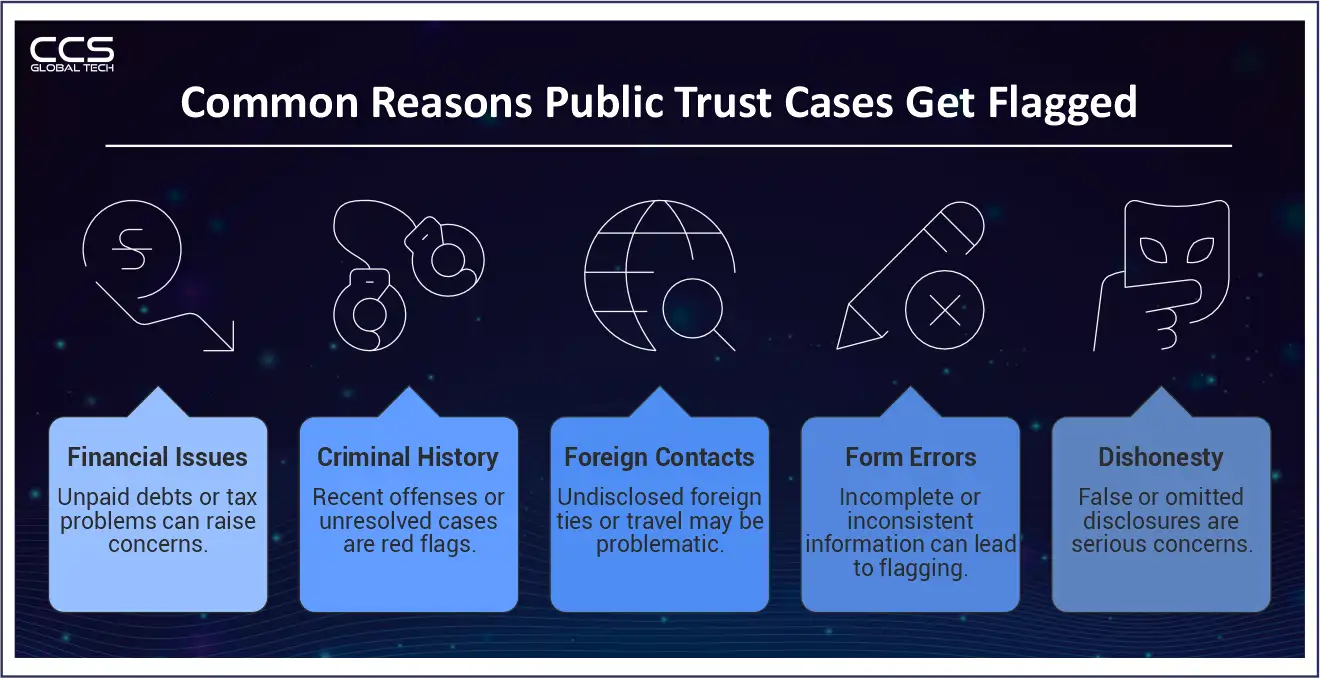
Across all risk levels and all categories of concern, the one factor that consistently turns a potentially manageable issue into a case-ending one is dishonesty during the investigation. Applicants who omit information they are legally required to disclose, provide inconsistent answers across interviews, or actively misrepresent their history face a far more serious adjudicative outcome than those who disclosed the same underlying facts accurately.
“Providing false information on Standard Form 85 or SF-85P is a federal crime punishable by up to five years in prison. Omissions are treated with the same severity as active misrepresentation.”
This is the guidance that HR professionals and managers should be sharing with candidates early and often: when in doubt, disclose. Issues that are disclosed can often be mitigated. Issues discovered through investigation that were not disclosed cannot be found.

The New Normal: Continuous Vetting and What It Means for Current Employees

One of the most consequential changes introduced under the Trusted Workforce 2.0 initiative and now effectively operational across the government is the shift from periodic reinvestigations to continuous vetting. Under the old model, employees in Public Trust positions were reinvestigated on a fixed cycle: typically every five years for Moderate Risk and every five years for High Risk as well. Those full reinvestigations were expensive, time-consuming, and by design backward-looking.
Continuous vetting replaces that periodic model with ongoing automated checks against criminal records databases, credit reporting systems, and other relevant record sources. When a potential issue surfaces – an arrest, a significant financial delinquency, a change in foreign contacts, it generates an alert that triggers a review. The review is targeted, not a full reinvestigation, which makes it faster and more responsive.
Major changes to 5 CFR731 effective January 17, 2025 extended the standards for investigations, reciprocity, and continuous vetting to apply to everyone employed by or doing work on behalf of the federal government including contractor personnel in Public Trust positions.
The practical implication for HR and managers: employees in Public Trust positions are being monitored on an ongoing basis, and significant life changes a DUI, a substantial new debt, a foreign contact can trigger a review at any point, not just at a scheduled reinvestigation interval. Employees need to understand this, and organizations need to have clear policies around self-reporting obligations under Security Executive Agent Directive 3 (SEAD-3).
Organizations that have not briefed their Public Trust workforce on self-reporting requirements are operating with an unacknowledged compliance gap. That gap tends to become visible at the worst possible moment.

Getting Ahead of the Process Is the Only Strategy That Works

Public Trust requirements continue to shift. With continuous vetting expanding, updated forms already in use, and the PVQ rollout ahead, organizations that treat vetting as a core part of hiring strategy are better positioned to avoid delays, compliance gaps, and staffing disruption.
That starts with accurate position designation, better candidate preparation before forms are submitted, and internal processes aligned with current requirements. CCS Global Tech’s federal staffing practice supports agencies and contractors with cleared and non-cleared talent solutions, including Public Trust roles, backed by more than 25 years of experience in federal staffing.
If your team is preparing for Public Trust hiring in 2026 and needs support building a stronger staffing pipeline, CCS Global Tech is ready to help. Need support hiring for Public Trust and other sensitive federal roles?

FAQs

Q1. How long does a Public Trust clearance investigation take in 2026?

A – Processing times vary based on the investigation tier and case complexity. Moderate Risk Public Trust investigations typically take three to five months for straightforward cases, while High Risk Public Trust investigations can take six months or longer.

A: Delays usually occur due to incomplete forms, missing employment history, undisclosed financial issues, slow responses from references, or incorrect position risk designation that requires resubmitting investigation paperwork. 

A: Investigators review delinquent debts, unpaid federal taxes, repeated bankruptcies, and unexplained financial discrepancies. The focus is on patterns that may indicate financial irresponsibility or vulnerability to external pressure.

A: Yes. A criminal record does not automatically disqualify an applicant. Adjudicators evaluate the seriousness of the offense, how recent it was, whether there is a pattern of behavior, and evidence of rehabilitation.

A: Omitting required information can trigger additional investigation and may lead to an unfavorable determination. Investigators often treat omissions as seriously as intentional misrepresentation.

A: Continuous vetting replaces periodic reinvestigations with ongoing automated monitoring of criminal records, financial indicators, and other relevant databases. Alerts can trigger targeted reviews when new issues appear.

A: The Personnel Vetting Questionnaire is a new modular background investigation form being developed under the Trusted Workforce 2.0 initiative. It will eventually replace the SF-85, SF-85P, SF-85P-S, and SF-86. 

A: In some cases candidates may begin work under an interim determination or with limited system access, depending on agency policy and contract requirements. 

A: Incorrect position risk designation is a common issue. When a role is classified at the wrong risk level, the investigation often has to restart under the correct tier, which can delay onboarding. 

 A: Contractors can reduce delays by designating position risk levels correctly, preparing candidates before forms are submitted, verifying form accuracy, and coordinating closely with security officers during the investigation process.