
The date is January 16, 2026. A mid-tier defense contractor supporting a mission-critical AI surveillance program has just received a Cure Notice. The reason? A 20% vacancy rate in “Key Personnel” slots that has persisted for 90 days, stalling deliverable schedules and triggering a downward spiral in Past Performance ratings.
The internal recruiting team is paralyzed; they are waiting on a dozen TS/SCI background investigations that are currently entering their 14th month of the standard 12-18 month processing cycle.
In this climate, the “wait-and-see” approach to cleared talent is no longer a viable business strategy, it is a contractual liability. Federal contractors who survive 2026 have moved beyond traditional job boards to leverage the only high-readiness talent pool capable of immediate deployment: the transitioning veteran.
For the modern executive, veteran hiring is no longer a corporate social responsibility initiative; it is a primary risk-mitigation tool for Contract Performance.
Quantifying the High-Stakes Talent Deficit
The federal market in 2026 is defined by a stark operational paradox: we are witnessing record-breaking defense budgets and a historic surge in contract awards, yet these are paired with a critical, systemic shortage of personnel who possess the clearances and technical credentials to actually “touch the work”.
As the Department of Defense shifts its focus toward high-complexity domains like JADC2, autonomous systems, and zero-trust architecture, the demand for specialized, cleared labor has decoupled from the available supply.
For federal contractors, this means that winning a contract is no longer the finish line; it is the beginning of a high-risk race against deliverable schedules and staffing-mandated stop-work orders.
The following data highlights why the traditional “post-and-pray” status quo in staffing has reached a breaking point, transforming human capital from an administrative function into a core pillar of Contract Performance and corporate survival.
The Federal Labor Landscape by the Numbers
| Metric | 2026 Reality | Impact on Federal Contractors |
|---|---|---|
|
TS/SCI Initial Adjudication |
12–18 Months |
Delays revenue recognition; creates “at-risk” staffing gaps. |
|
Veteran Unemployment Rate |
3.8% (Dec 2025) |
Indicates a highly liquid, competitive market for veteran talent. |
|
Cleared Position Vacancies |
500,000-700,000 |
Drives up labor rates and increases “poaching” risk among primes. |
|
National Veteran Hiring Benchmark |
5.1% (July 2025) |
Mandatory compliance threshold for VEVRAA-subject contractors. |
Mastering the Cleared Talent Bottleneck
For a contractor operating on an IDIQ (Indefinite Delivery, Indefinite Quantity) or a major GWAC (Government-wide Acquisition Contract), the primary friction point is “Time-to-Floor.” If a task order competition requires a surge of 50 cleared engineers in 30 days, relying on the interim clearance process is a gamble that rarely pays off for Top Secret requirements.
The TS/SCI Reciprocity Friction
While the federal government has pushed for clearance reciprocity under the Trusted Workforce 2.0 framework, the reality on the ground remains fragmented. A veteran transitioning from the Navy with an active TS/SCI should, in theory, be “crossover ready” in 30 days. However, administrative delays in DISS (Defense Information System for Security) or agency-specific suitability checks often extend this to 90 days.
Boosting Win Rates Through Talent
In 2026, Source Selection Boards have moved beyond “best-case scenario” staffing, adopting a stance of aggressive skepticism toward traditional incumbent capture strategies. Evaluators now recognize that “intent to hire” is not a substitute for a verifiable pipeline, especially as the cleared labor market remains in a state of extreme scarcity.
When responding to a Request for Proposal (RFP), your staffing plan’s credibility is no longer a secondary administrative check; it is a primary determinant in the technical evaluation and overall risk assessment.
To survive this scrutiny, a modern staffing plan must demonstrate three critical pillars of credibility:
- Verified Readiness: Boards are looking for named personnel with “current” status in DISS or Scattered Castles. Relying on “contingent” hires without a clear path to clearance reciprocity or a current polygraph is frequently flagged as a high-performance risk.
- The “Day 1” Mobilization Guarantee: The 2026 acquisition landscape emphasizes speed. Your proposal must prove that your team can achieve full billability within 30 days of award and not just initiate the recruiting process. This requires showing a “shadow bench” of pre-vetted veteran talent already in your SkillBridge or internal talent pool.
- Mitigation of Adjudication Lag: Because TS/SCI processing remains at a 12-18 month average, a credible plan must include specific contingencies for “Administrative Hang.” Evaluators award higher technical scores to firms that explicitly map out how they will utilize interim clearances or unclassified work-streams to maintain deliverable schedules during the “waiting period.”

Proposed Approach: The High-Readiness Staffing Model
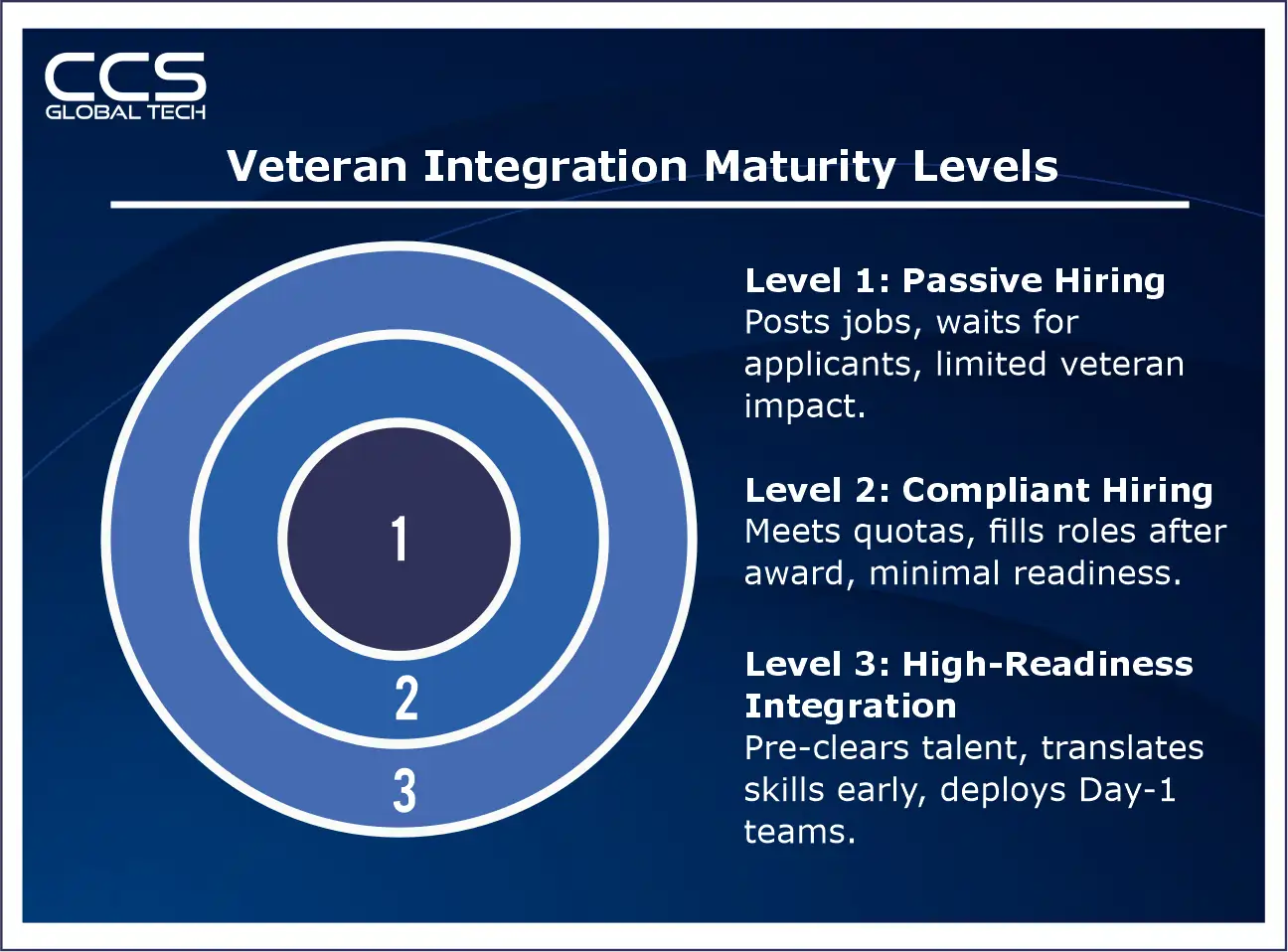
Implementing a successful veteran hiring program in 2026 requires a fundame`1`qantal shift in perspective: moving away from the passive “veteran-friendly” marketing of the past decade and moving toward a model of high-readiness integration. In the current federal landscape, “veteran-friendly” is often perceived by the workforce as mere goodwill: a badge on a website that does little to address the systemic friction of the transition. High-readiness integration, by contrast, is an operational mandate.
It involves institutionalizing a “veteran-ready” infrastructure that proactively addresses the three primary barriers to contractor success: clearance mobility, skill translation, and cultural synchronization.
By shifting the focus from “hiring veterans” to “integrating military-grade talent”, firms can move from a compliance-driven HR metric to a performance-driven staffing strategy.
Step 1: Tactical Skill Translation
Contractors must move beyond surface-level keyword matching and adopt a rigorous “capability-first” lens: stop looking for generic “Project Managers” and start recruiting “Operations Officers”.
A veteran who has orchestrated the multi-modal logistics for a 500-person deployment, often in contested or austere environments, possesses the exact high-stakes risk-management and crisis-response skills required to lead a complex federal IT rollout or a multi-site infrastructure modernization.
These individuals are hard-wired for mission success; they view a deliverable schedule not merely as a project milestone, but as a non-negotiable operational requirement. By translating military leadership into corporate technical management, you are not just filling a vacancy, you are installing a leader who is psychologically and professionally equipped to navigate the high-pressure compliance and performance mandates that define the 2026 federal contracting landscape.
Step 2: Aggressive Use of SkillBridge
In 2026, the DoD SkillBridge program has become the premier pipeline for contractors. By bringing on transitioning service members during their last 180 days of service, contractors can “test-drive” talent while the government still pays their salary. This allows for a seamless transition into a billable role the moment they hang up the uniform.
Step 3: Proactive Crossover Management
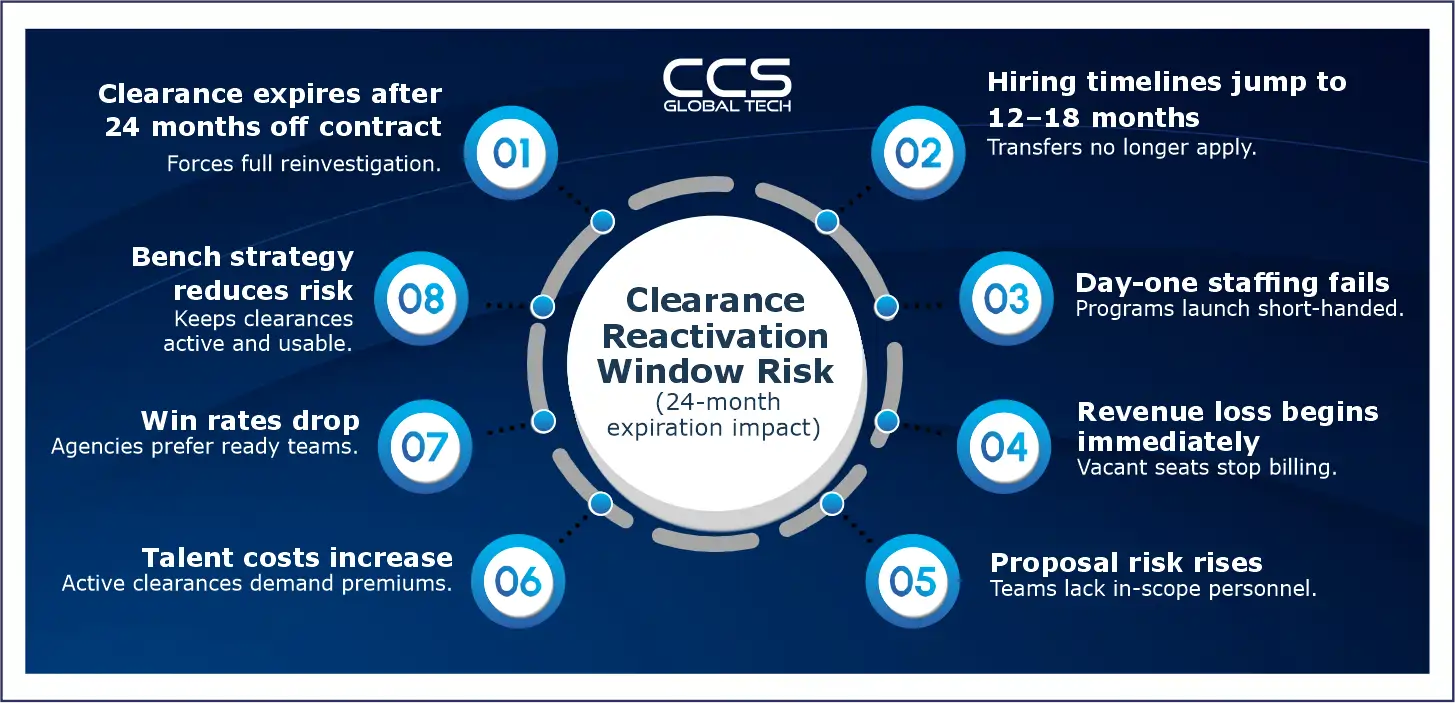
To maximize your competitive stance, proactive clearance management must precede the contract award. Waiting for a formal “Notice to Proceed” to begin the clearance crossover process is a strategic failure that often leads to immediate schedule slippage. Leading contractors in 2026 mitigate this by maintaining a “cleared bench”: a pre-vetted pool of veteran talent whose clearances are actively held in the company’s “cage” (Facility Security Clearance) even during the pursuit and proposal phases.
By sponsoring these veterans as “contingent” or “indirect” employees before an award is finalized, you effectively bypass the 12-18 month adjudication backlog. This maneuver ensures that the 24-month window for clearance re-activation never expires, and more importantly, it allows you to hit the floor with billable staff on Day 1.
In a high-stakes Source Selection environment, being able to prove that your proposed team is already “in-scope” and held within your security cognizance is a powerful technical differentiator that can dramatically increase your win rates on competitive task orders.
2026 Veteran Onboarding & Clearance Crossover Checklist
To move from strategy to execution, contractors must institutionalize a protocol that accelerates a veteran’s ‘Time-to-Floor.’ Use the following framework to audit your current onboarding readiness:
Phase 1: Pre-Exit Engagement (180 Days to Exit)
- SkillBridge Authorization: Confirm the candidate has command approval to participate in the DoD SkillBridge program.
- Security File Verification: Obtain the candidate’s social security number to check their status in DISS (Defense Information System for Security) or Scattered Castles. Verify the “Investigative Close Date” is within scope (5-6 years for TS/SCI).
- Certification Audit: Map current military certifications (e.g., Security+, CISSP, CEH) against DoD 8140/8570 manual requirements for the specific contract labor category.
- Training & Ethics Brief: Ensure the candidate has attended a service-mandated ethics briefing within the last 12 months.
Phase 2: The Security Crossover (The “Administrative Bridge”)
- Facility Security Officer (FSO) Initial Action: Initiate the “Take Ownership” or “Subject Nomination” request in DISS on the candidate’s first day of intent.
- Polygraph Waitlist Management: If the contract requires a Full Scope or CI Polygraph, schedule the exam immediately upon nomination. In 2026, the polygraph waitlist remains the primary bottleneck for TS/SCI roles.
- Interim Clearance Risk Matrix: For Secret-level roles, evaluate if an Interim Clearance is viable for unclassified project work while the final adjudication/reciprocity transfer completes.
- “Perfect File” eApp Review: If a reinvestigation is triggered, conduct an internal audit of the candidate’s SF-86 (eApp) submission. Correct any inconsistencies in foreign travel or residence history before it hits the DCSA investigative tier.
Phase 3: Contractual & Legal Integration
- VEVRAA/VETS-4212 Documentation: Properly tag the new hire in your HRIS to meet the 5.1% veteran hiring benchmark for 2026 compliance reporting.
- Labor Category Verification: Cross-reference the veteran’s DD-214 or military experience with the specific labor category qualifications in the Section J attachments of your contract.
- Knowledge Transfer Protocol: If the veteran is replacing an incumbent (Successor Contractor), document the skills transfer process to satisfy FAR 52.222-41 (Service Contract Act) and continuity requirements.
Integrating this checklist into your operational workflow does more than just speed up a single hire; it builds contractual resilience. By standardizing the ‘Time-to-Floor’ protocol, federal contractors can provide government clients with a level of predictability that is increasingly rare in the 2026 labor market.
This systematic approach effectively de-risks your staffing plan, transforming what is typically a bureaucratic bottleneck into a high-velocity engine for contract performance and revenue stability.
Case Study: Recovering a Failing IDIQ
The Challenge: A prime contractor on a major GWAC was facing a Cure Notice after failing to staff a specialized cybersecurity cell at Fort Meade. The ‘Time-to-Fill’ for civilian candidates with TS/SCI + Full Scope Polygraphs was averaging 210 days, leading to missed deliverable schedules and a “Marginal” CPARS rating.
The Implementation: The contractor shifted its strategy to focus exclusively on veterans from the 780th Military Intelligence Brigade. By leveraging a specialized staffing partner, they identified 12 transitioning specialists who already held the required polygraphs and certifications (CISSP, CEH).
The Result: * Onboarding Time: Reduced from 210 days to 24 days.
- Contract Performance: The Cure Notice was rescinded within 45 days as staffing levels hit 100%.
- Financial Impact: Saved an estimated $1.2M in potential penalties and secured a follow-on task order valued at $15M due to the dramatic turnaround in performance reliability.

Executing the Proposed Plan of Action
To modernize your veteran hiring engine, follow this 90-day execution roadmap:
- Audit Current Pipeline (Days 1–30): Identify every open role requiring a TS/SCI. Categorize them by “mission criticality”. If a vacancy threatens a CPARS rating, it is a Priority 1.
- Partner with Cleared Staffing Experts (Days 31–60): Do not expect generalist recruiters to understand the nuances of reciprocity or DD-214 codes. Engage partners who specialize in the veteran-to-contractor transition.
- Optimize Onboarding (Days 61–90): Streamline your security crossover paperwork. Every day a veteran sits on the “unbilled” side of the ledger is a loss of potential revenue.
Ask yourself:
- What is the current “revenue leakage” your firm is experiencing due to cleared positions remaining vacant for more than 90 days?
- If your primary contract were issued a Cure Notice today due to staffing shortfalls, how would your current pipeline respond – and is that response fast enough to protect your Past Performance rating?
- Are you losing out on IDIQ task orders because your staffing plans lack the “Day 1 Readiness” that only pre-cleared veteran talent can provide?
Converting Veteran Talent into Contractual Certainty
The federal acquisition market of 2026 does not reward potential; it rewards performance. As TS/SCI processing timelines remain stagnant and the cleared talent pool continues to shrink, the ability to rapidly integrate veterans into your delivery teams is no longer a secondary HR goal: it is the only way to maintain a competitive edge and protect your Past Performance legacy. In an environment where task order awards are often decided by “Day 1 Readiness”, a robust veteran pipeline serves as a critical hedge against Cure Notices and stop-work orders.
Beyond mere staffing, veterans bring a “mission-first” cultural alignment that matches the high-stakes demands of modern agencies like the DoD and DHS. By institutionalizing veteran hiring as a core component of your Proposal Positioning, you demonstrate to Contracting Officers that your firm has a repeatable, low-risk strategy for scaling technical expertise.
In 2026, the firms that dominate the landscape will be those that view veteran talent as a strategic asset capable of stabilizing revenue, ensuring deliverable continuity, and ultimately securing the “Exceptional” CPARS ratings required for long-term growth.
CCS Global Tech: Your Federal Staffing Advantage
CCS Global Tech is the premier partner for federal contractors navigating the complexities of the 2026 talent market. We specialize in providing pre-vetted, high-readiness veteran talent that ensures your contract performance exceeds expectations and your proposal win rates remain elite.
Would you like to see how we can stabilize your cleared talent pipeline?
FAQs
Q1- Why does veteran hiring fail after onboarding in federal contracts?
A: Most failures come from poor skill translation, delayed clearances, and lack of role alignment, not from lack of veteran talent.
Q2- How important is clearance mobility in 2026 veteran hiring?
A: Clearance mobility drives speed to billable work. Veterans with transferable or active clearances reduce ramp time by months.
Q3- What skills translate best from military to federal IT and cyber roles?
A: Operations leadership, risk management, logistics planning, cyber defense, systems integration, and compliance execution translate directly.
Q4- Is SkillBridge still effective for contractors in 2026?
A: Yes. SkillBridge remains the fastest pipeline to evaluate, train, and deploy cleared-ready talent with zero salary cost during transition.
Q5- How do leading contractors reduce Key Personnel replacement risk?
A: They maintain a pre-cleared bench, sponsor crossover early, and secure contingent staff before contract award.
Q6- What hiring signals do federal programs value most from veterans?
A: Mission leadership, audit readiness, incident response experience, and ability to operate under compliance pressure.
Q7- Why do resumes undersell veteran capability?
A: Military roles map poorly to corporate titles, hiding scale, authority, and technical exposure unless translated properly.
Q8- Should contractors hire veterans before contract award?
A: Yes. Early sponsorship protects clearance windows and enables Day-1 staffing, which improves technical scores and win rates.
Q9- How do veterans outperform in regulated commercial industries?
A: Veterans bring discipline, documentation rigor, and security mindset that reduce audit risk and delivery failures.
Q10- What hiring model works best in 2026?
A: High-readiness integration with early clearance control, SkillBridge pipelines, and capability-first role mapping.