

The Current State of Global Staffing
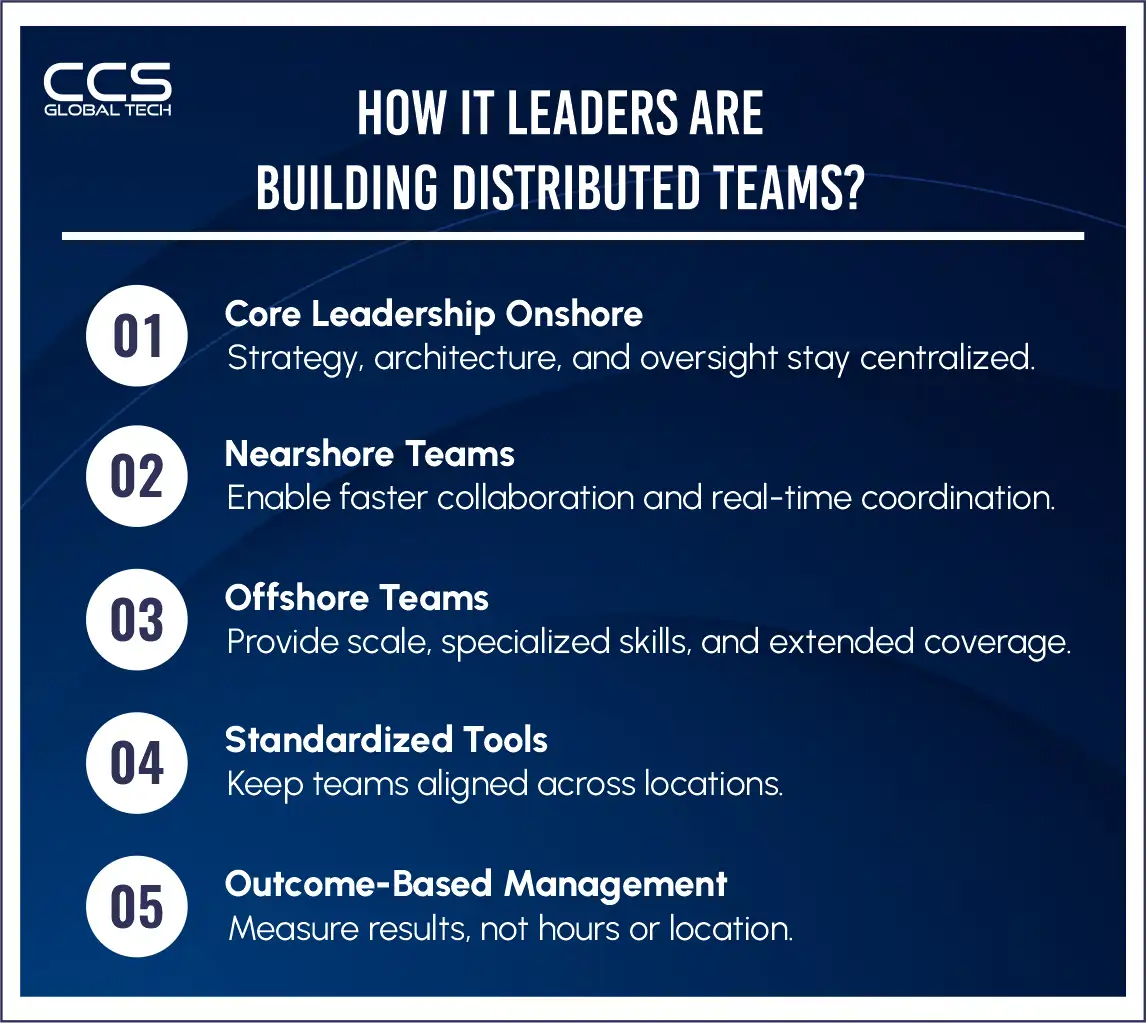
Understanding the Three Models
Onshore Staffing
- Zero time zone barriers enabling real-time collaboration.
- Shared language and cultural context reducing communication friction.
- Simplified legal and regulatory compliance within single jurisdiction.
- Easier face-to-face meetings when needed for strategic initiatives.
Nearshore Staffing
- Overlapping working hours enabling real-time collaboration.
- Significant cost savings compared to onshore while maintaining strong communication.
- Similar cultural context and work practices reducing coordination friction.
- Reasonable travel times for periodic face-to-face meetings.
Nearshore Staffing
- Overlapping working hours enabling real-time collaboration.
- Significant cost savings compared to onshore while maintaining strong communication.
- Similar cultural context and work practices reducing coordination friction.
- Reasonable travel times for periodic face-to-face meetings.
Offshore Staffing
- 45-70% cost savings on labor compared to onshore rates.
- Access to vast talent pools with specialized skills.
- 24/7 operational capability through "follow the sun" models.
- Rapid scalability for large team requirements.
Strategic Considerations for Building Global Teams
Role Classification Framework
- Software Engineers (front-end, back-end, full stack)
- Quality Assurance Engineers
- DevOps Engineers (with defined infrastructure requirements)
- Data Engineers and Analysts
- UI/UX Designers
- Technical Support Specialists
- Scrum Masters and Agile Coaches.
- Product Owners requiring stakeholder interaction.
- Technical Leads needing frequent team coordination.
- Business Analysts bridging technical and business domains.
- Customer Success Engineers.
- Executive Leadership
- Strategic Project Managers
- Principal Architects defining technical direction
- Compliance Officers navigating regulatory requirements
- Business Development roles requiring market expertise
Real-World Application: Financial Services Company
- Onshore (NY): 1 Lead, 1 Product Owner, 1 iOS Sr. Dev ($950K)
- Nearshore (Colombia): 5 devs + Scrum Master ($1.04M)
- Offshore (India): 6 backend/QA/DevOps ($1.25M)
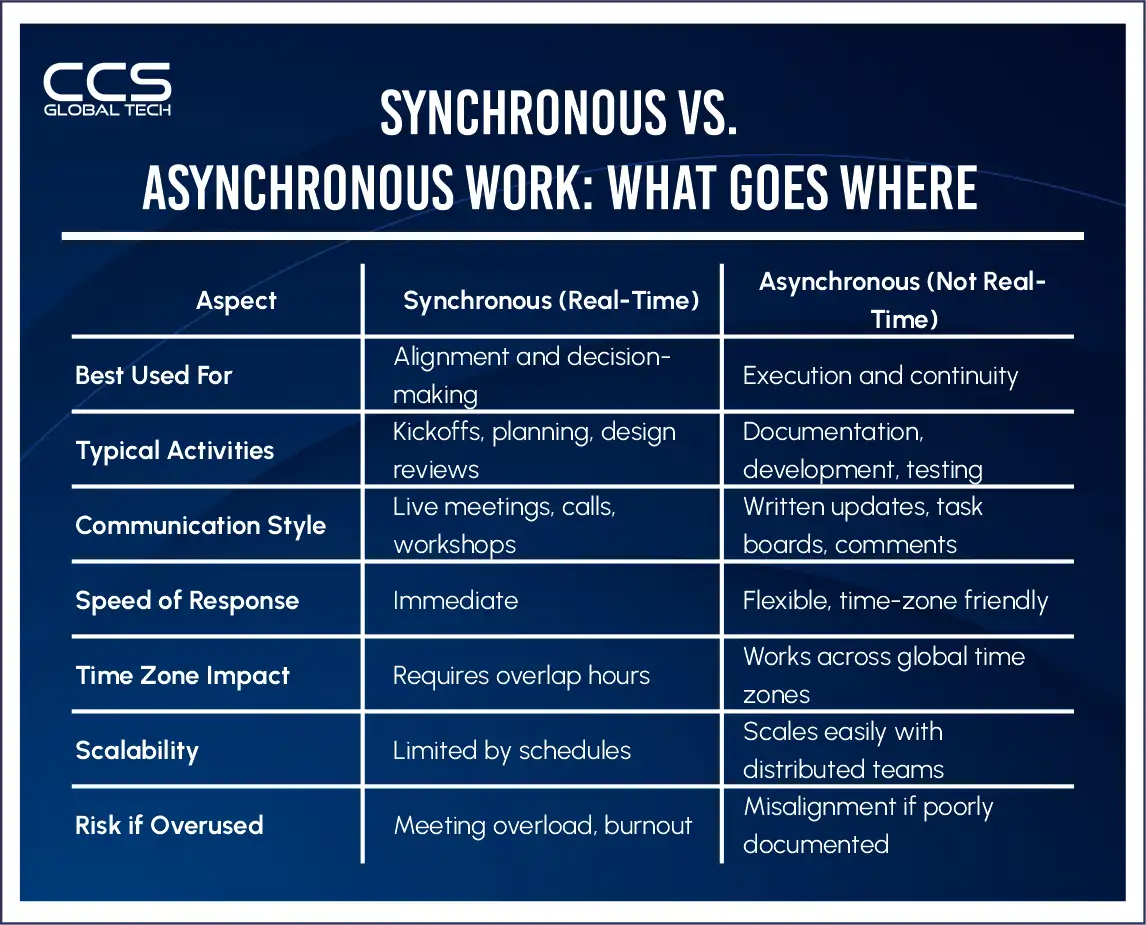
Time Zone Strategy and Communication Architecture
Quality Assurance in Distributed Teams
- Definition of Done: Distributed teams need clear, measurable completion criteria agreed upon across locations.
- Automated Testing: Reduce time-zone delays by emphasizing automation over manual coordination.
- Code Reviews: Set expectations for review turnaround, depth, and how to handle blocked work.
- Architecture Sync: Hold regular reviews to prevent drift and maintain technical consistency.
Legal and Compliance Considerations
Cost-Benefit Analysis Framework
- Direct compensation (salary/hourly rate)
- Benefits and statutory contributions (varies dramatically by country)
- Recruitment and onboarding expenses
- Management overhead and coordination costs
- Technology and communication infrastructure
- Legal and compliance costs
- Quality impact and rework expenses
- Time zone coordination inefficiency costs
Building Successful Global Staffing Partnerships
- Start Small and Prove Value: Begin with pilot projects of 2-4 offshore/nearshore resources on non-critical paths. Prove the model works before scaling to larger teams or critical functionality.
- Invest in Relationship Building: Send onshore team members to offshore/nearshore locations periodically. Bring offshore/nearshore team members onshore annually if possible. Personal relationships dramatically improve distributed team effectiveness.
- Provide Career Development: Offshore and nearshore team members want professional growth opportunities. Organizations with strong retention provide training, certification support, and clear advancement paths.
- Cultural Sensitivity Training: Provide cross-cultural communication training for both onshore and offshore/nearshore teams. Understanding communication style differences prevents misunderstanding and conflict.
- Measure and Optimize: Track metrics including deployment frequency, defect rates, velocity, and customer satisfaction. Use data to identify where distributed teams excel and where they need support.
The Strategic Imperative
FAQ
Q1. “How do I decide whether onshore, nearshore, or offshore staffing is the right fit for my project?”
A: Choosing the right model depends on timeline, budget, security requirements, collaboration needs, and complexity. Onshore excels in high-touch, regulated work; nearshore balances cost with real-time collaboration; offshore provides scale and cost efficiency for well-structured projects.
Q2. “What roles are best suited for offshore vs. nearshore vs. onshore teams?”
A: Offshore works well for standardized engineering, QA, support, and repeatable tasks.
Nearshore is ideal for agile development, analytics, and design that require frequent touchpoints. Onshore is best for strategic, client-facing, regulated, or high-ambiguity roles.
Q3. “How do companies maintain quality when working with distributed global teams?”
A: Quality is maintained through clearly defined processes, strong documentation, automated testing, SLAs, shared KPIs, and overlapping work hours. Mature teams also use structured handoff rituals and unified tooling to avoid fragmentation.
Q4. “What are the hidden risks of scaling offshore or nearshore teams too quickly?”
A: Rapid scale can create communication gaps, architecture drift, duplicated work, and technical debt. Without governance, companies face rising rework costs and declining delivery velocity.
Q5. “How do I calculate the true cost of global staffing beyond hourly rates?”
A: True cost includes productivity ramp-up, coordination overhead, management time, turnover, workflow delays, and potential rework. A cost model should factor in both direct and indirect operational expenses.
Q6. “Why do some companies fail when building offshore teams while others succeed?”
A:Failures usually stem from lack of structure—unclear requirements, poor onboarding, inadequate overlap hours, inconsistent leadership engagement, and misaligned incentives. Successful teams treat offshore as an integrated extension, not a silo.
Q7. “What governance model works best for hybrid onshore–nearshore–offshore deliveries?”
A: A hub-and-spoke model with the onshore product owner as the hub and regional teams as spokes works best. It ensures decision clarity, backlog hygiene, standardized tooling, and smooth cross-time-zone collaboration.
Q8. “How do I protect IP and ensure compliance when using offshore or nearshore teams?”
A: Use secure VPC/VPN access, device management, SOC-2-aligned workflows, restricted Git permissions, role-based access, and NDAs. Choose partners familiar with FedRAMP, ISO, HIPAA, or government-specific compliance.
Q9. “What KPIs should I track to measure success of global staffing models?”
A: Key KPIs include cycle time, defect rate, sprint predictability, code review throughput, utilization rate, onboarding speed, and cost per delivered story point or feature.
Q10. “How do I integrate offshore and nearshore engineers into Agile processes without slowing teams down?”
A: Use time-zone-aligned ceremonies, rotating demo schedules, strong grooming sessions, async-first communication, and a unified Definition of Done. Clear documentation prevents blockers between time zones.