
Salary Transparency in Federal Hiring: What ‘120k–120k–150k’ Really Means for Cleared Roles

Salary Transparency in Federal Hiring
Imagine this: A mid-sized defense contractor in Northern Virginia posts a job for a cleared cybersecurity engineer. The listing reads, “Salary: $120k–$150k.” The role demands an active Secret clearance, DevSecOps experience, and DoD 8140 compliance.
Applications flood in-veterans transitioning from service, IT pros with lapsed clearances, and a few with Top Secret pedigrees. Interviews move forward. Then, offers go out, and reality hits.
The base lands at $118k for most, with the $150k ceiling reserved for that rare polygraph holder with 15 years in classified programs. Candidates balk, counteroffers fly, and the hiring manager scrambles as contract deadlines loom.
This isn’t fiction. It’s a scene playing out across federal hiring in 2026, where salary transparency laws promise clarity but deliver ranges so wide they feel like guesses. At CCS Global Tech, we’ve seen it firsthand through our federal staffing partnerships.
Those broad bands—like the puzzling ‘120k–120k–150k’ format popping up in postings, raise real questions: What does the low end actually mean for day one? Where does clearance level fit? And why do so many cleared pros end up negotiating in the dark?
Let’s unpack this story, backed by the latest data, to help federal employers and contractors hire smarter in a market where cleared talent averages $119,131 in total compensation—an all-time high, per the 2025 Security Clearance Compensation Report from ClearanceJobs.

The Rise of Ranges: A Timeline of Change

Picture federal hiring a decade ago. Salaries were whispered in back channels, tucked into NDAs, or buried in collective bargaining agreements. Cleared roles, tied to classified contracts, amplified the secrecy. Then came the transparency wave.
It started with states like California (SB 642, effective 2023) mandating “good faith” pay scales in job ads – what employers reasonably expect to pay upon hire. By 2026, 16 states plus D.C. enforce similar rules, covering over 50% of U.S. workers. New York requires ranges for any role “performed in-state or reporting to NY,” hitting federal contractors nationwide. Employers with 25+ staff must disclose upon promotions or transfers too.
Federally, no nationwide law exists yet—the Salary Transparency Act lingers in Congress—but OPM’s push for GS pay table visibility (no 2026 raise announced, holding scales steady around 2-4% locality bumps) sets the tone. For contractors, FAR clauses now scrutinize postings against prevailing wages, especially for H-1B cleared roles. Misalign a LinkedIn ad with a visa petition? Expect audits.
In cleared hiring, these laws clash with reality. A ClearanceJobs survey found 68% of cleared pros got raises last year (14% over 10%), driving averages to $119,131—up 4% from 2024. Yet postings list $110k–$160k, masking that TS/SCI talent pulls $141k+ while Secret-level starts closer to $115k. The ‘120k–120k–150k’ quirk? It’s shorthand some firms use: base-minimum, likely offer, ceiling. But without context, it’s noise.
How to Write a Transparency Range That Works

What Those Ranges Really Mean, and Why They Frustrate Everyone?

Let’s humanize the math. Take our Virginia contractor example. The $120k floor reflects GS-13 equivalent base for a mid-career engineer (OPM 2026 scales: $98k–$128k nationally, $120k+ in NoVA locality). The repeated $120k signals “our budgeted offer,” while $150k is the aspirational top for polygraph wizards. Candidates see it as bait; employers defend it as flexibility.
Data bears this out. Paycor’s 2026 guide recommends traditional ranges of ~30% around midpoint (e.g., $42.5k–$57.5k for $50k mid), aligning with 30-50% spreads in practice. The Interview Guys 2026 map notes common wide ranges like $45k–$75k (67% span) and entry/mid hires at lower 25-40%. For cleared roles:
  • Secret Clearance: $110k–$135k typical. Average total comp: $115,342 (2025 ClearanceJobs data). 
  • Top Secret/SCI: $130k–$170k. Averages $141,299, with 20% bonus potential.  
  • Polygraph Holders: $150k+. Virginia tops states at $131,612 average.   

Why the spread? Federal contracts fix labor categories (e.g., “Computer Systems Engineer III” at $125/hr fully burdened). Employers pad ranges for negotiation, but transparency laws demand “good faith”—what you’d pay this candidate on day one. Post too narrow, miss talent; too wide, invite ghosting.
Real example: In Q1 2026, a DoD prime in Huntsville posted “Cleared DevSecOps: $125k–$160k.” They targeted Security+ holders. Offers averaged $128k—but 40% of shortlists lacked certs, forcing rejections. Timeline slipped 60 days, echoing the staffing shortages we detailed in our recent blog. Applicants felt misled; the firm blamed pool limits.

The Hidden Factors Stretching Every Range

Salary isn’t base alone. Cleared roles bundle total rewards, widening bands further.
  1. Clearance Adjudication Risk: “Clearance-eligible” hires wait 3-12 months. Postings bake in 10-15% premiums for active holders. ODNI reports 4.2 million cleared Americans, but only 20-30% job-hunt actively due to non-competes or embeds.
  2. Certifications & Compliance: DoD 8140 mandates Security+, CISSP for cyber roles. BLS projects 29% growth for security analysts through 2032—cleared slice shrinks it to 10%. Uncertified? You’re at range bottom.  
  3. Location & Hybrid: NoVA commands 15% locality over national; Huntsville 10%. Remote? Rare for SCIF work, adding 5-10% mobility premiums. 
  4. Benefits Black Box: Transparency laws hit NY/CA require benefits disclosure pre-interview. Cleared perks—clearance sponsorship ($20k+ cost), 8% 401k match, 25 PTO days—bridge 15-20% gaps. 

Stories from the Front Lines: Wins and Warnings

Meet Sarah, a TS/SCI engineer in Colorado Springs. She saw “$135k–$165k” for a cloud security role. Interview revealed: Active TS only? $142k offer. Her SCI + AWS certs? $158k + 10% bonus. Transparent? Yes. But the range hid leverage.
Contrast with Mike, a veteran transitioning via our pipeline. A D.C. posting: “$115k–$145k.” No certs mentioned. He applied, aced tech screens, then learned Security+ was non-negotiable. Offer: $117k post-training. He walked for a firm posting “$120k base + cert reimbursement.”
These aren’t outliers. In 2026, transparent postings get 2x qualified apps, per talent studies—but only if ranges reflect market reality. Federal contractors ignoring this risk recompete losses; candidates waste time.

Employer Strategies: Turn Transparency into Your Edge

Smart firms don’t just comply—they compete.
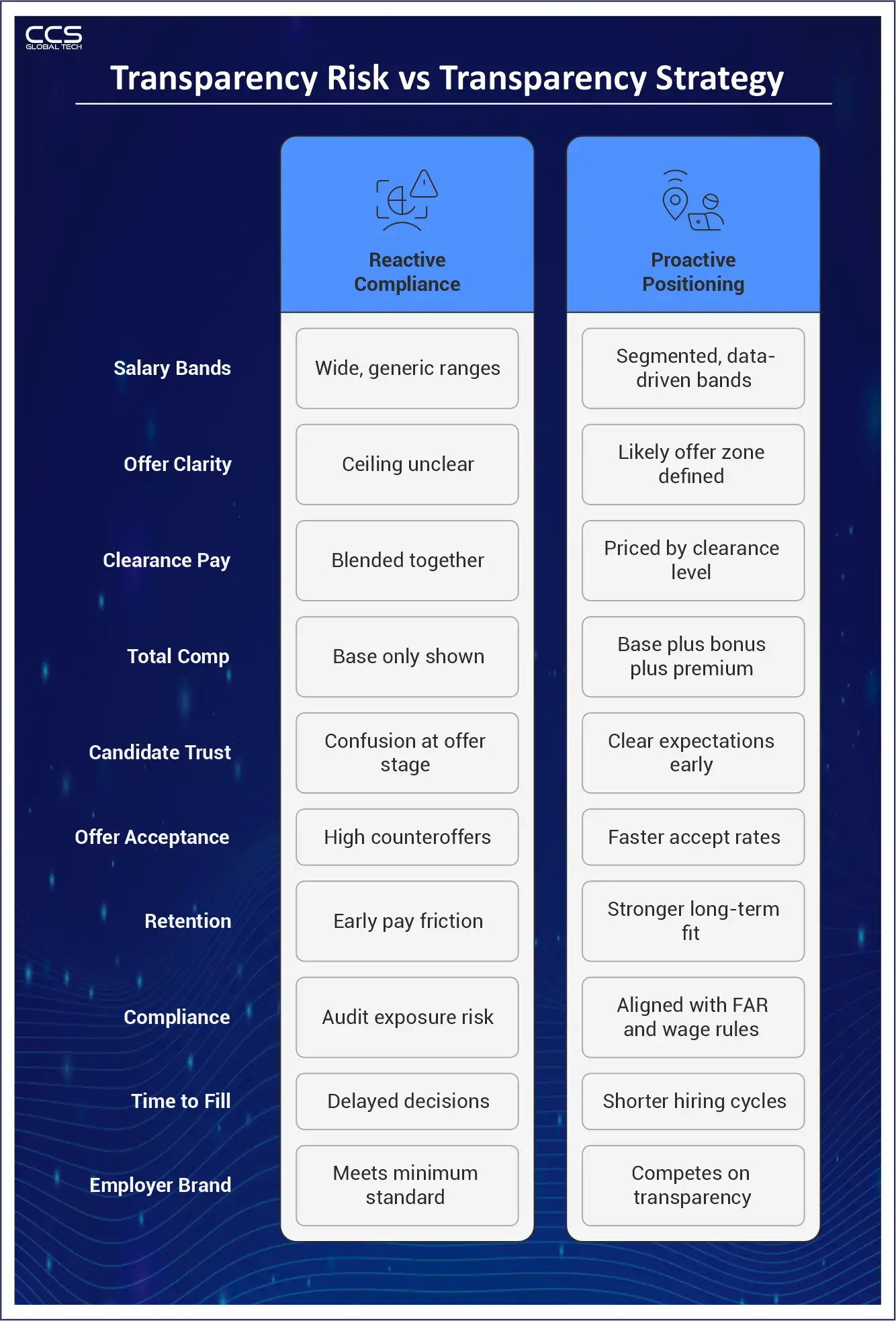
  • Narrow Smartly: Use data: $119k cleared average as midpoint. Segment by clearance: Secret $115k–$130k; TS $135k–$160k. 
  • Layer Total Value: “Base $120k–$150k + 15% bonus potential + clearance sponsorship.” 
  • Audit Internally: Annual pay scale requests rise 25% under new laws—fix gaps via privileged audits.  
  • Forecast Pipelines: Pre-vet talent. Platforms cut fill times 40%, as we see with specialized marketplaces.
OPM’s flat 2026 GS scales amplify this: Contractors must outpace 2.5% inflation with premiums.
Transparence Risk Vs Transparency Strategy

Why It Matters Now and What’s Next?

In 2026, salary transparency isn’t a checkbox; it’s table stakes amid shortages. Cleared demand outpaces supply – cyber roles hardest hit. BLS: 29% growth; cleared reality: Half that. Ranges like ‘120k–120k–150k’ signal intent but erode trust if mismatched.
Candidates gain power: 75% check ranges before applying. Employers win loyalty: Transparent firms see 30% lower turnover.
Federal law looms, expect OPM mandates by 2027. Until then, state patchwork rules the day.

Partner with CCS Global Tech for Compliant, Competitive Hiring

At CCS Global Tech, we bridge this gap as your trusted federal staffing partner. Our pipelines deliver pre-vetted, DoD 8140-compliant cleared talent—1M+ strong—40% faster than traditional methods, with 10% fees and 90-day guarantees. We’ve helped contractors shave months off timelines, aligning ranges to real offers that stick.
So, are you ready to decode ranges and fill roles without the guesswork? Or want to discuss your 2026 staffing needs, salary benchmarking, and how we secure TS/SCI pros at competitive rates?

FAQs

Q1: Why do federal job postings show ranges like 120k–120k–150k?

A: Some contractors structure ranges with three markers: minimum base, typical offer band, and maximum ceiling. The first reflects entry pay, the middle reflects where most hires land, and the last is reserved for rare profiles such as TS SCI with poly and deep classified experience. 

A: The low end aligns with minimum contract labor category requirements. It often assumes a Secret clearance, baseline experience, and no premium add-ons. 

A: Clearance level shifts pay significantly. Secret roles trend toward the lower band, TS moves higher, and TS SCI with poly often reaches the upper tier. 

A: The ceiling is reserved for high scarcity profiles. Contractors balance labor category caps, margin, and prevailing wage rules, so most hires fall within the realistic offer zone. 

A: Yes. Most state laws require good faith ranges based on what the employer expects to pay at hire. Inaccurate postings increase audit and compliance risk. 

A: Contract labor categories define experience thresholds and role scope. Compensation must align with those definitions to remain compliant. 

A: Contractors compete for scarce cleared talent. Poly requirements, contract urgency, and retention pressure drive market increases independent of GS tables. 

A: Define a likely offer zone, segment by clearance, and separate base from bonus. Clear structure reduces counteroffers and declined offers.


A: In most cases, yes. Programs requiring CI or Full Scope poly limit supply, which increases compensation premiums. 

A: Ask where most hires land within the band, how clearance level impacts pay, and whether bonuses or premiums are included in the total number.