
Your firm has secured a slot on a $15 Billion Government-Wide Acquisition Contract (GWAC), giving you access to hundreds of potential Task Orders (TOs) across the DoD and Civilian agencies.
The strategic challenge is no longer winning the contract vehicle, but staffing and winning the subsequent, high-velocity TO competitions. One Task Order demands immediate deployment of 10 Top Secret/SCI-cleared cloud architects for a 12-month mission, while a second TO solicitation, due in 30 days, requires a completely different profile: five NIST (National Institute of Standards and Technology) RMF (Risk Management Framework)/CMMC (Cybersecurity Maturity Model Certification) 2.0-certified compliance specialists.
The core dilemma is capital allocation: Do you absorb the overhead of Bench Staffing, hiring and maintaining cleared, high-salary experts before winning the Task Order, or do you rely on the On-Demand Strategy, trying to recruit the talent after the win?
The wrong choice translates directly into unacceptable risk: a Stop-Work Order due to staff failure, a disastrous Past Performance rating, or a crippling decline in your competitive win rate.
Staffing Failures: The Prime Contractor's Greatest Threat
For IDIQ holders, the staffing strategy must be built on the principle of mission readiness. The IDIQ structure, designed for rapid procurement, punishes contractors who treat TO staffing like standard commercial hiring.
The Clearance Bottleneck: The primary constraint is the time required to onboard cleared professionals. The process for a new TS/SCI clearance can take 12 to 18 months, and even Secret clearances average 4-8 months for the fastest 90% of applicants. Relying on On-Demand staffing for cleared work means your proposed team is immediately non-deployable, rendering your proposal technically non-compliant.
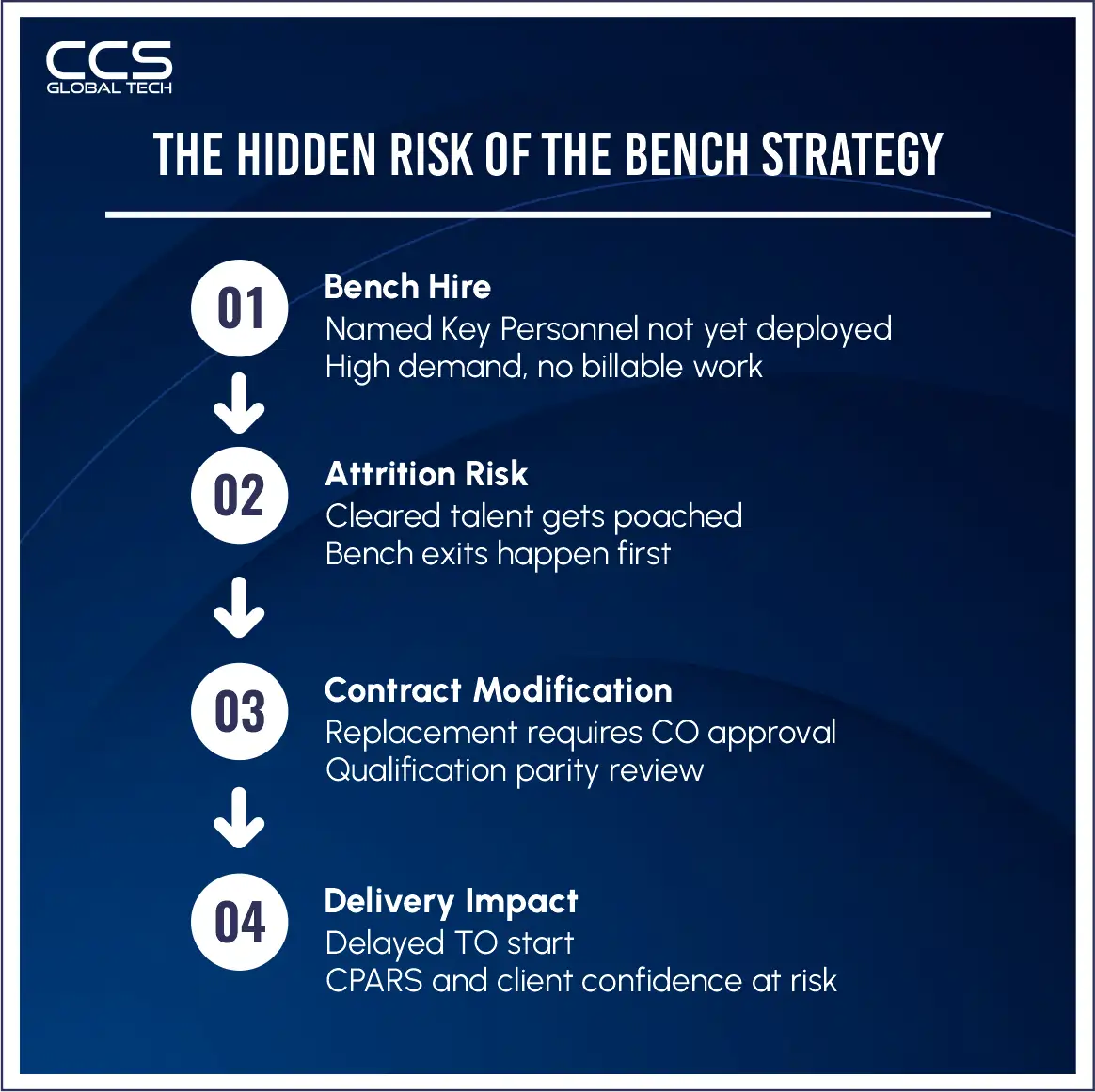
The Key Personnel Risk: TO solicitations frequently designate Key Personnel. Your proposal must name these individuals, and the contract (under FAR clauses) demands their presence and performance. If these individuals are not on your payroll (the Bench Strategy), they are at risk of being poached, forcing you into a costly Contract Modification negotiation for replacement approval with the Contracting Officer (CO), which can delay the project start and lead to a negative Past Performance report.
Compliance Framework Pressure: Modern IDIQ work is increasingly defined by the necessity of adhering to highly specialized federal security and compliance frameworks, such as implementing the mandates of CMMC 2.0 or achieving rigorous FedRAMP authorization.
Effectively executing these contracts demands certified, experienced staff, like Registered Practitioners and authorized assessors, whose specialized skill sets are simply not held in surplus within the general labor market.
Consequently, if a contractor attempts to staff these roles using the volatile On-Demand model, they face near-certain delays and gaps in expertise. This inherent staffing failure is critical because it immediately exposes the client agency to significant and intolerable audit risk and potential security vulnerabilities.
Furthermore, such compliance failures severely damage the contractor’s Past Performance record, eroding their eligibility to bid on future high-value Task Orders. Ultimately, the cost of staffing failure on compliance-driven contracts far outweighs the overhead cost of securing this niche talent proactively.
The Speed-to-Staff Imperative
The strategic volatility inherent in managing multiple, high-value Task Orders (TOs) under a Government-Wide Acquisition Contract (GWAC) or Indefinite Delivery/Indefinite Quantity (IDIQ) vehicle demands an approach that transcends the limitations of pure Bench or pure On-Demand staffing.
For the seasoned federal contractor, the optimal strategy is a Hybrid Staffing Model, a sophisticated resource allocation framework that strategically blends the guaranteed readiness of a small, core bench with the scalability of a dedicated, contracted surge capability.
This model is engineered to address the fundamental challenge of IDIQ contracting: the necessity of fielding a confirmed, highly-cleared team in a competitive 30-day proposal window while simultaneously minimizing the financial burden of large-scale, unbillable overhead.
By segmenting required roles into tiers based on risk, clearance level, and scarcity, the Hybrid Model allows the Prime to maximize proposal win rates and maintain impeccable Past Performance by ensuring immediate deployment capability for the highest-risk positions.
| Metric/Requirement | Verified Data/Goal | Strategic Staffing Implication |
| Top Secret (TS) Clearance Processing Time (Fastest 90%) | ~ 249 days (Q4, FY2024 average) | The On-Demand model is functionally impossible for cleared work; Bench or immediate subcontracting is mandatory. |
| TS/SCI Total Processing Time | 8 to 15 months for initial grant, often longer for complex cases. | Requires the ability to use Clearance Reciprocity for immediate deployment, which demands a pre-existing talent relationship. |
| IDIQ Competition Strategy | Focus on winning ~ 70% of targeted Task Orders. | Credible staffing plans increase technical evaluation scores, which is the key differentiator in competitive TO pricing. |
Navigating Cleared Talent Scarcity and Performance Risk
The decision between maintaining a Bench Strategy and employing an On-Demand Strategy is fundamentally a high-stakes calculation of risk tolerance versus financial overhead, a dichotomy that is particularly acute and unique within the high-velocity, multi-Task Order (TO) environment of an IDIQ contract vehicle.
The Bench Strategy: Cost as a Competitive Weapon
The Bench Strategy involves absorbing the overhead cost of maintaining critical personnel on the payroll, often referred to as “underutilization.” While this incurs immediate G&A costs, it provides the ultimate technical evaluation discriminator in a TO competition.
- Opportunity: When a TO solicitation requires a rapid 30-day start, a proposal built entirely on staff currently on your bench (or guaranteed via a dedicated subcontract) scores significantly higher on staffing plan credibility and risk reduction than one based on contingent offers. This increased technical score translates directly into a higher win rate for the Task Order.
- Mitigation: The inherent risk of carrying unbillable staff, often referred to as underutilization, can be strategically mitigated through careful resource planning and internal investment. This involves maintaining a lean, highly focused bench, limiting personnel to only the most critical roles, such as Key Personnel who are mandatory for proposal credibility, or specialists with niche, scarce skills like CMMC assessors or TS/SCI-cleared architects.
Beyond simply limiting headcount, firms must actively utilize any resulting idle hours by assigning bench personnel to high-value, internal projects. These projects should be directly related to market competitiveness, such as developing or updating corporate compliance frameworks, securing internal certifications (like updating FedRAMP authorization packages), or developing intellectual property (IP) and technical solutions that can be proposed as proprietary advantages in future Task Orders.
This approach transforms the bench cost from a pure liability into a strategic investment in future win rates and organizational maturity.

Add Your Heading Text Here
The On-Demand Strategy, or the “just-in-time” approach, relies on recruiting only after the TO award. While this minimizes overhead, it exposes the contractor to intolerable execution risk.
Challenge: The time-to-clearance reality means that un-cleared On-Demand staff will miss the crucial initial deliverable schedules, leading to a Cure Notice from the CO and a poor Contract Performance rating. For a multi-award IDIQ, a single poor CPARS rating can effectively shut your firm out of future TO competitions.
The ultimate goal for a successful IDIQ Prime is not to eliminate overhead, but to strategically leverage controlled overhead (the Bench) as an investment in the win rate and contract performance, thereby mitigating the catastrophic, long-term financial consequences of staffing-induced failure.
The Hybrid Staffing Model
The optimal strategy for a multi-TO IDIQ environment is a Hybrid Staffing Model that strategically combines the strengths of both approaches.
| Staffing Tier | Role/Skill Set | Strategy | Rationale for IDIQ Success |
| Core Bench (10%) | Key Personnel, Program Manager, Solution Architect (TS/SCI/Poly) | Full-Time Employee (FTE) on Bench | Eliminates Key Personnel risk; ensures immediate proposal commitment; essential for rapid TO initiation. |
| Flex/Surge (40%) | Niche Compliance Experts (CMMC, FedRAMP), Cleared Engineers | Dedicated Staffing Partner/Subcontract | Provides immediate, pre-vetted, cleared talent on-demand without absorbing the FTE overhead costs. |
| Ad-Hoc (50%) | General Support, Tier 1/2 Help Desk, Non-Clearing Administrative Staff | Traditional On-Demand Recruiting | Lowest risk for late deployment; skills are abundant and do not require lengthy security processing. |
Compliance Framework Staffing
For contracts tied to specific frameworks:
- CMMC 2.0: Maintain at least one certified Registered Practitioner (RP) on the core bench to rapidly staff proposals and lead the initial assessment phases of awarded TOs.
- NIST: Use the bench for architects with expertise in the relevant NIST Special Publications (e.g., SP 800-53 or 800-171) to ensure the technical approach in the proposal is fully compliant and auditable.
Staffing Success and Failure: Case Examples
Staffing Success and Failure: Case Examples
A Prime is bidding on a $50M, 5-year IDIQ Task Order requiring a cleared Chief Security Architect (Key Personnel) and a 45-day start.
Action: The Prime utilized the Core Bench Strategy, keeping a fully-cleared Security Architect on staff who was used for proposal writing and internal certification updates.
Outcome: The proposal won the technical evaluation due to the confirmed availability of the Key Personnel, while competitors used contingent hires. The architect deployed on Day 1. The TO was staffed successfully, resulting in an “Exceptional” CPARS rating for timely execution, dramatically increasing the Prime’s win rate on future Task Orders.
Failure Scenario: The On-Demand Risk
A Prime wins a $12M Task Order requiring five TS-cleared data scientists. They opted for the On-Demand strategy to save initial overhead.
Action: The firm issued contingent offers, only to discover the scientists could not obtain Clearance Reciprocity for the specific agency requiring a two-month administrative delay.
Outcome: The two-month delay resulted in a missed key deliverable. The CO issued a Cure Notice, and the subsequent CPARS rating noted failure in “Schedule and Quality.” This singular performance failure subsequently led to the Prime losing three out of the next four competitive Task Order bids on the IDIQ, validating the long-term cost of short-term savings.

Executing the Staffing Strategy: Four Mandates
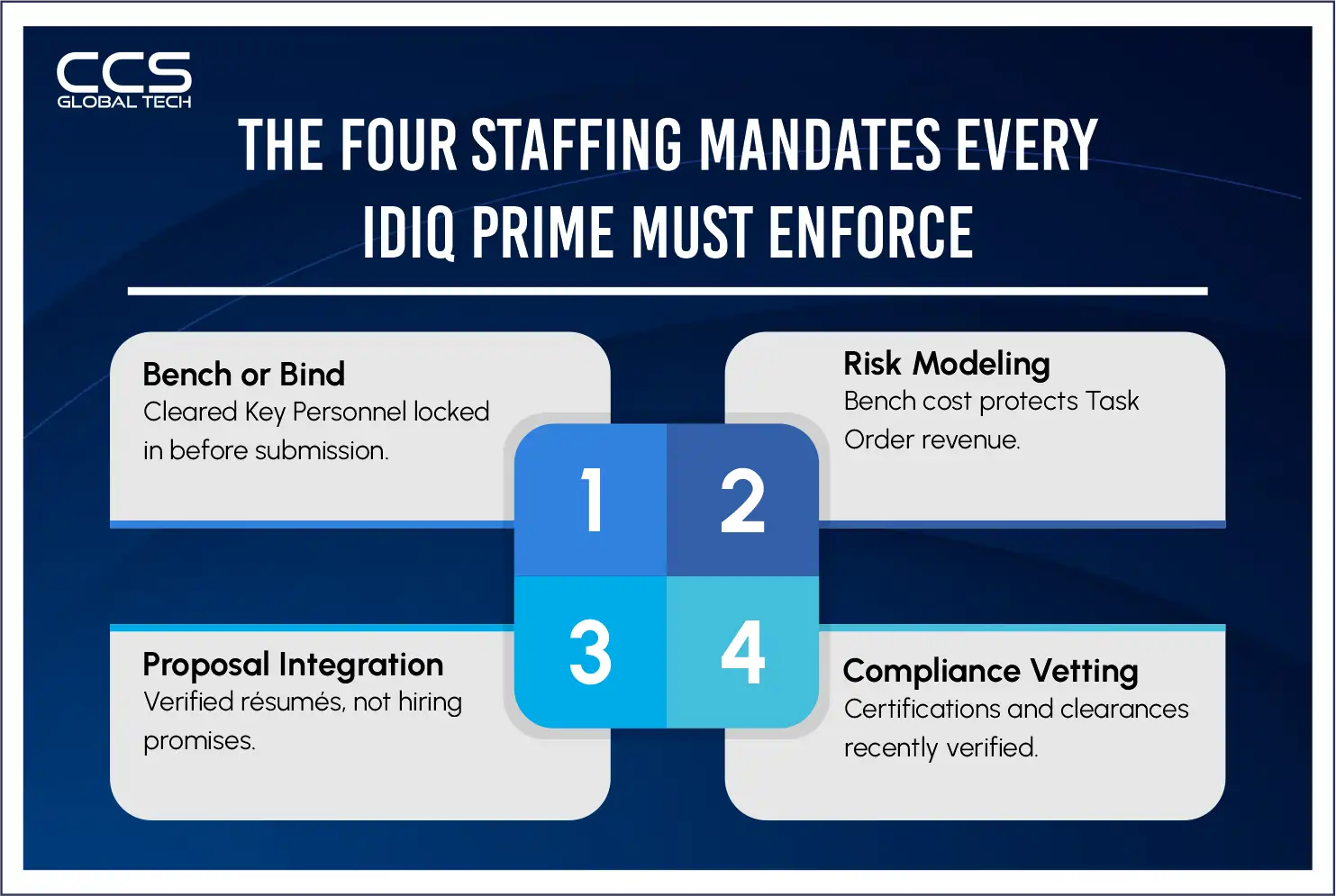
For Prime Contractors operating under the rapid tempo of IDIQ and GWAC task order competition, success is measured not just by the win, but by the efficiency with which execution risk is neutralized. The following steps are not suggestions; they are mandatory operational procedures designed to insulate your firm from the debilitating consequences of staffing failure, specifically, poor Past Performance ratings, costly turnover, and contract termination.
By proactively integrating staffing decisions with compliance mandates and financial modeling, firms can transform the instability of the cleared talent market into a predictable asset that consistently supports a high-velocity bidding strategy.
- Mandate Bench/Subcontract for All Cleared Key Personnel: Establish a rule that any Key Personnel role requiring a Secret or TS clearance must be filled by a current FTE or via a binding, exclusive subcontracting agreement before the TO proposal is submitted.
- Quantify Underutilization Risk: Treat bench overhead as an investment in a guaranteed win rate increase. Model the cost of losing a single TO (average value) against the cost of maintaining a limited core bench (average salary + burden). The analysis will often favor the bench.
- Integrate Staffing and Proposal Teams: Your dedicated recruiting and staffing experts must be embedded within the proposal writing team to confirm résumés are immediately available, not just available “upon award,” providing the technical detail necessary to beat competitors on staffing credibility.
- Proactive Compliance Vetting: For compliance-driven roles (CMMC, FedRAMP), only use candidates whose certifications and current clearances have been independently verified within the last 30 days to mitigate rejection during the agency’s technical review.
Final Strategic Assessment: Key Takeaways
The federal contracting landscape, particularly on IDIQ vehicles, prioritizes mission readiness over all else. The time disparity between the speed of Task Order competition (often 30-60 days) and the time-to-clearance (6-18 months) transforms staffing into a critical competitive lever. Contractors who fail to strategically secure their cleared talent pool through a Bench or Hybrid model are effectively ceding TO wins and risking the integrity of their long-term Past Performance record.
Here are the questions you need to keep in mind:
- What is the current, verifiable Time-to-Deploy for every Key Personnel role in your current Task Order pipeline, and are you prepared for a Cure Notice if that time exceeds your first deliverable deadline?
- Have you accurately modeled the financial cost of losing three high-value Task Orders due to a poor CPARS rating against the overhead cost of maintaining a pre-vetted, cleared Core Bench for one year?
- Does your current staffing plan ensure that every proposed engineer for a CMMC-related TO is already compliant and readily available, or are you gambling your Proposal Positioning on uncertain, On-Demand recruiting?
CCS Global Tech specializes in architecting IDIQ staffing strategies, providing immediate access to a pre-vetted bench of cleared, compliance-certified personnel to eliminate deployment risk. We enable our partners to confidently bid and win Task Orders by transforming the volatility of the cleared talent market into a predictable, available resource.
FAQs
Q1. Why does on-demand staffing fail in IDIQ task order environments?
A: On-demand staffing fails because IDIQ task orders require immediate deployment. Clearance timelines, key personnel commitments, and compliance roles make post-award hiring non-deployable on Day 1.
Q2. How does a bench strategy improve IDIQ task order win rates?
A: A bench strategy increases win rates by allowing primes to name cleared, deployable personnel in proposals, strengthening technical scores and reducing execution risk.
Q3. When is on-demand staffing acceptable in federal IDIQ contracts?
A: On-demand staffing may work for non-cleared, non-key roles with flexible start dates, but it is high-risk for cleared or compliance-critical positions.
Q4. Why are cleared key personnel incompatible with on-demand hiring?
A: Cleared key personnel are contract commitments under FAR. Without benching or exclusive agreements, they are vulnerable to poaching and substitution delays requiring Contracting Officer approval.
Q5. How does the bench strategy reduce execution risk after award?
A: Bench strategies enable Day-1 execution, avoid clearance delays, and eliminate last-minute substitutions that can trigger compliance findings or schedule slips.
Q6. Is bench staffing more expensive than on-demand hiring?
A: Bench staffing has predictable overhead, while on-demand failures result in lost task orders, delayed starts, CPARS risk, and higher long-term costs.
Q7. How should primes model the cost of bench staffing?
A: Primes should compare bench cost against the average value of a lost task order and the impact on future IDIQ competitiveness, which often favors maintaining a limited bench.
Q8. How does staffing strategy impact Past Performance ratings?
A: Delays, substitutions, and compliance gaps caused by on-demand staffing directly affect CPARS ratings, reducing eligibility for future task orders.
Q9. What staffing approach best supports high-velocity IDIQ bidding?
A: Bench or exclusive subcontract strategies support rapid bidding by ensuring personnel availability across multiple overlapping task orders.
Q10. How does the bench strategy support multiple task orders simultaneously?
A: A controlled bench allows redeployment across task orders, reduces hiring churn, and stabilizes delivery during overlapping start dates.