
Congratulations. Your firm has successfully navigated the complex solicitation process and secured its first major federal contract as a Prime Contractor (and Prime, henceforth).
This achievement is substantial, yet the transition from Proposal Positioning to Contract Performance is the most precarious phase for a new contractor. The initial euphoria of the win quickly yields to the cold reality of execution: a six-month, $5 million task order requires an immediate ramp-up of 15 personnel, including a Key Personnel slate of cleared systems engineers, a crucial Project Manager, and a deadline for the first deliverable that is just 60 days away.
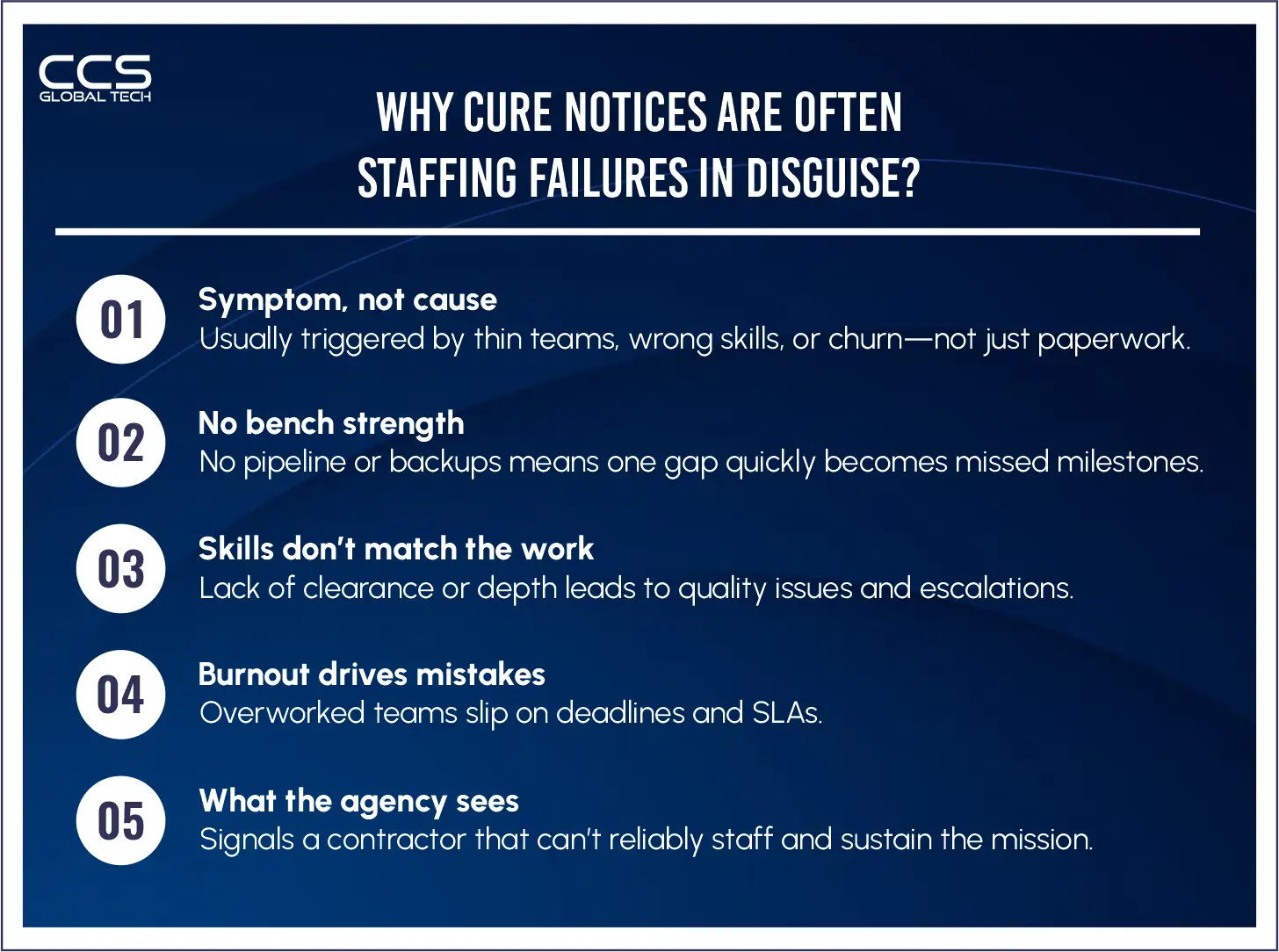
The biggest threat to this victory is not technical failure but staffing failure. The government does not grade proposals on intent; it scores performance based on a functional team delivering on time.
An inability to staff critical roles on day one immediately triggers risk of a cure notice, threatens your Past Performance rating, and jeopardizes your company’s future in the federal market.
Navigating the Contract-to-Performance Chasm
For the first-time Prime Contractor, the transition from proposal phase to contract execution transforms staffing from a standard human resources function into a complex, high-stakes risk management challenge.
This difficulty is not merely about finding qualified candidates; it is fundamentally defined by the dual pressures of strict federal regulatory requirements and the acute scarcity of specialized, cleared labor.
A new Prime lacks the institutional inertia and established pipeline of larger, seasoned firms. Consequently, every hiring decision, particularly those concerning Key Personnel or staff requiring high-level clearances like TS/SCI, is inherently tied to compliance with the Federal Acquisition Regulation (FAR) and the risk of immediate contractual failure. Failing to manage this staffing challenge correctly can trigger formal contractual remedies from the government, such as a Cure Notice or even a Stop-Work Order, threatening not only the current award but also crippling the firm’s mandatory CPARS (Contractor Performance Assessment Reporting System) Past Performance rating, which is the gateway to all future federal opportunities.
The Key Personnel Trap: Nearly all high-value federal contracts mandate Key Personnel, whose presence is contractually essential. The contract (often governed by FAR clauses like 52.237-10) requires the contractor to obtain the Contracting Officer’s (CO) written approval for any substitution.
Failure to secure and deploy these individuals immediately upon Notice to Proceed (NTP) creates a contractual breach and signals to the agency that the proposal staffing was merely a placeholder.
The Immediate Past Performance Risk: Past Performance ratings (tracked in databases like CPARS) are the lifeblood of a federal contractor. A first-time Prime has zero track record.
Any initial failure, such as a stop-work order due to late staffing or missed deliverable schedules, will result in a poor rating that can sink your win rate for the next five years.
Source Selection Scrutiny: Your successful proposal’s staffing plan was a critical component of the technical evaluation. Agencies assess the credibility of your team, and once awarded, they expect that exact team to appear.
The Cleared Talent Scarcity and Risk Profile
The staffing timeline in the defense and intelligence sectors is dictated by security clearance processing, not the open labor market. This reality forces a strategic shift from traditional HR practices to proactive talent acquisition pipelines.
| Metric/Requirement | Verified Data/Goal | Contractor Impact |
|---|---|---|
| Average Time to Process a Top Secret (TS) Clearance | ~ 8 to 15 months for TS/SCI, often longer for complex cases. | Requires 90% of contract staff to be identified, vetted, and already cleared prior to award. |
| Average Time to Fill Cleared Defense Position (FY2024) | 241 days for Top Secret positions, end-to-end processing. | Averages more than eight months, rendering traditional job postings useless for a 60-day start date. |
| Small Business Prime Contracting Goal | The government-wide goal is 23% of all prime contract dollars. | Win rates often depend on the credibility of the staffing plan to execute, proving the company can transition from winning a set-aside to executing the work. |
High-Leverage Staffing Opportunities for New Primes
The new Prime faces acute challenges that require specialized federal staffing strategies.
The Retention and RTO Challenge
The specialized cleared talent pool is currently navigating a significant retention crisis primarily driven by the friction between contract requirements and evolving workplace expectations, specifically the pressure from renewed Return-to-Office (RTO) mandates. During the pandemic, many highly skilled, cleared professionals, including those holding Top Secret/SCI access, were able to secure full or hybrid remote work arrangements for non-SCIF work, making career changes that prioritized flexibility.
The subsequent, often sudden, shift back to strict on-site presence, particularly the requirement to commute daily to secured facilities like Sensitive Compartmented Information Facilities (SCIFs), has resulted in measurable and significant attrition.
This is not a general workforce trend; it disproportionately affects the most highly-valued segment of the labor market. For a new Prime Contractor, this creates immense risk, as losing even a single cleared employee due to their refusal to accept an RTO mandate can trigger a recruitment cycle averaging over 240 days for a replacement, potentially leading to immediate project gaps and contractual underperformance.
Challenge: New Primes lack the organizational scale to absorb this attrition. Losing a single TS/SCI engineer who refuses an RTO mandate can result in a 241-day replacement clock and an unrecoverable gap in performance.
Opportunity: Strategic subcontracting allows the Prime to rapidly acquire a stable, ready-to-deploy cleared workforce from firms specializing in cleared staffing, bypassing the direct hiring bottleneck entirely.

Staffing Plan Credibility and Source Selection
In a competitive source selection, the agency’s evaluation team scrutinizes the realism of your staffing approach.
Opportunity: Presenting a staffing strategy that includes letters of commitment, not just résumés, from a specialized staffing firm demonstrates a proven ability to mitigate clearance risk.
This dramatically increases the credibility of your technical evaluation score compared to a competitor relying solely on a generic HR pipeline.
The 70/30 De-Risking Model
A successful first-time Prime must de-risk the initial staffing surge. We recommend a strategic 70/30 De-Risking Model for the first 12 months.
Category | Target Personnel Mix | Strategic Action for the New Prime |
Tier 1: Core/Key Personnel (70%) | Already identified, committed, and cleared personnel. | Secure firm, binding agreements or employment contracts before contract award. These individuals must be ready to start on Day 1. |
Tier 2: Subcontracted Surge (30%) | Staffing flexibility and specialized skills (e.g., TS/SCI engineers). | Partner with a Federal Staffing Expert via a Master Subcontract Agreement to mitigate the average 241-day hiring timeline. |
Key Personnel Compliance Protocol
The commitment to provide Key Personnel is not merely an HR function; it is a fundamental contractual obligation that directly impacts performance and compliance. For a new Prime, a single misstep in managing Key Personnel turnover can escalate rapidly from an administrative issue to a contract breach, jeopardizing the entire award. Therefore, the firm must establish a rigid, internal protocol that precisely mirrors the requirements set forth in the Federal Acquisition Regulation (FAR), specifically sections like FAR 52.237-10 (Identification of Key Personnel and Facilities) or similar agency-specific clauses.
The internal process for managing Key Personnel turnover must execute the following critical steps:
Immediate notification to the CO upon knowledge of resignation:
- This action must be performed before the departing employee’s exit date and immediately upon confirmation of their intent to resign (or upon any action that renders them unable to perform, such as a clearance suspension).
- The notification should be formal, in writing (e.g., via email or official letter), and explicitly reference the contract number, the specific Key Personnel position, and the expected departure date. Proactive transparency minimizes the perception of non-compliance.
Rapid identification of a pre-vetted replacement candidate with equal or superior qualifications:
- The firm must maintain a contingency pipeline, either internally or via a staffing partner, specifically for Key Personnel roles. This pre-vetted candidate should possess not only the necessary technical skills but also the required security clearance and any certifications stipulated in the contract.
- The replacement must demonstrably meet or exceed the qualifications of the departing individual. Any reduction in qualification level is almost certain to be rejected by the CO.
Formal submission of a Contract Modification request to the CO for approval:
- This step is mandatory and cannot be skipped. The submission package must be comprehensive, including the replacement candidate’s résumé, clearance verification (if applicable), and a detailed written justification explaining why the replacement meets the contract’s Key Personnel requirements.
- Crucially, the replacement cannot begin work in the Key Personnel capacity until the CO grants formal, written approval of the contract modification. Working without this approval is a contractual violation.
Consequence of Unilateral Action:Add Your Heading Text Here
Any attempt to unilaterally replace Key Personnel without the CO’s formal, written consent is explicitly a violation of the contract’s terms. This serious failure in compliance is grounds for:
- Contract Breach: The CO may issue a Cure Notice, demanding that the contractor immediately correct the deficiency.
- Termination for Default: If the contractor fails to cure the deficiency within the allotted time, the CO has the contractual right to terminate the contract for default, leading to severe financial penalties and a disastrous Past Performance rating (CPARS).
Contract Execution: Hypothetical Outcomes Analysis
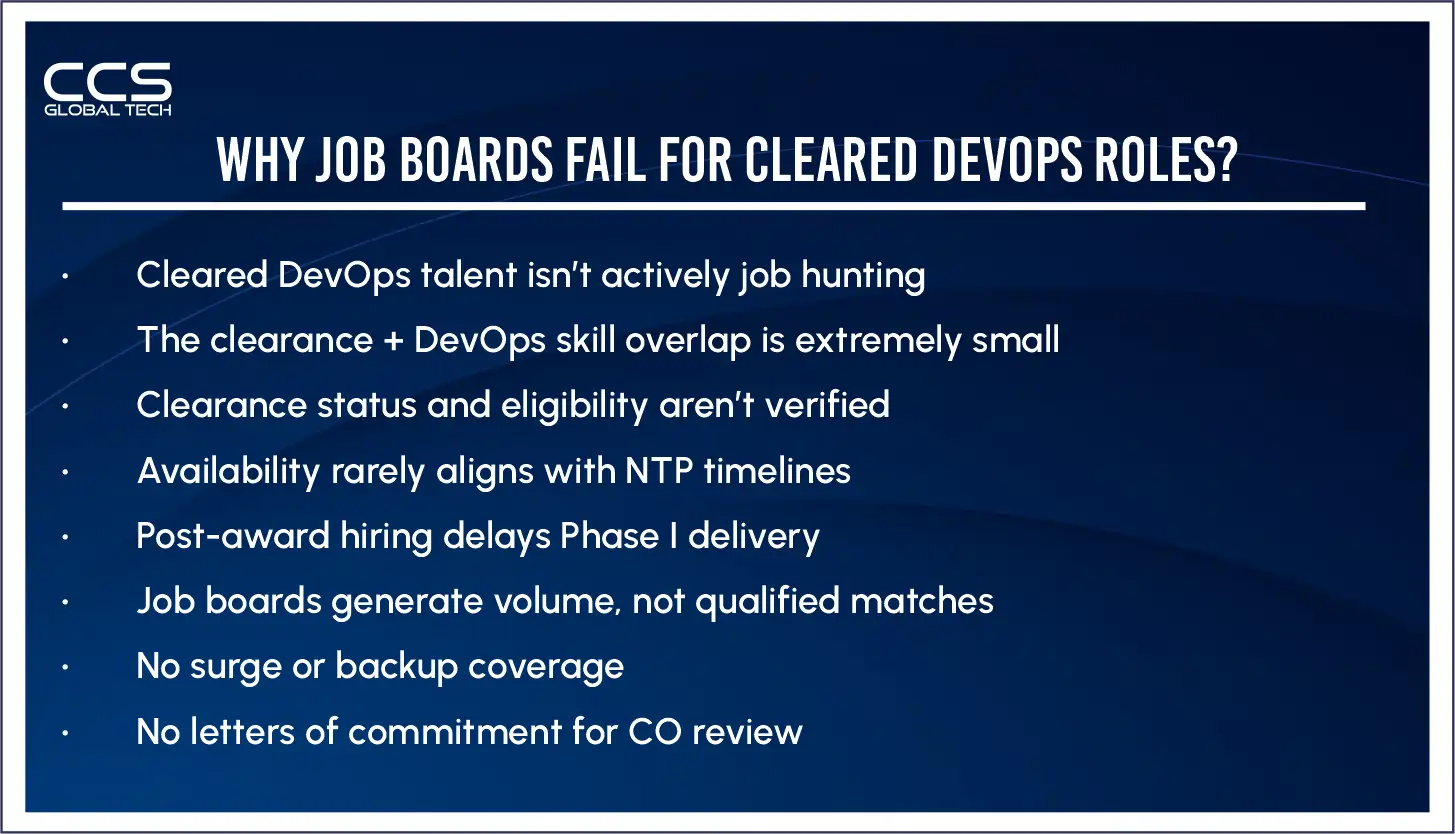
A newly awarded $7 Million Firm-Fixed Price (FFP) contract for a high-priority DoD application development project required five Key Personnel with active Secret clearances and specialized DevOps experience. The Prime won the contract but only had three of the five Key Personnel on staff.
* Failure Scenario (Traditional HR): The Prime posts the two missing roles on job boards. After 45 days, they have zero qualified candidates due to the scarcity of cleared DevOps talent.
The Phase I deliverable is missed. The CO issues a Cure Notice, demanding immediate remediation. The resulting negative Past Performance rating cripples the firm’s ability to win any follow-on work.
* Success Scenario (Staffing Strategy): Thirty days prior to the NTP, the Prime engages a federal staffing expert. The expert identifies the two required Key Personnel and three surge candidates within two weeks.
The Prime includes letters of commitment from the staffing firm for all five individuals in its pre-award documentation. All Key Personnel are in place on Day 1.
The Phase I deliverable is accepted on time, resulting in a positive initial CPARS rating. The Prime converts a high-risk situation into a foundation for strong Past Performance.
Actionable Steps for Contract De-Risking
a) Staffing Credibility in the Proposal: Commit to Letters of Intent (LOI) or Teaming Agreements with staffing partners for all roles that require a security clearance, validating the credibility of the entire proposed team.
b) Establish a Key Personnel Contingency Fund: Dedicate a specific budget (e.g., 2% of direct labor) to cover the costs of retention bonuses or premium recruiting fees to ensure zero turnover among Key Personnel in the first 12 months.
c) Audit the RTO Risk: For all incumbent and proposed cleared staff, formally audit their willingness to meet the contract’s physical presence requirements to preemptively identify and backfill potential attrition due to RTO impacts.
d) Onboard for Compliance: Ensure the transition process emphasizes not just technical orientation but also mandatory compliance training on topics like timekeeping (DCAA), OCI management, and Key Personnel replacement protocols.

Mitigating Risk: Questions Contractors Must Ask
Here’s what you need to ask:
- Do you have pre-signed, binding agreements with staffing partners that guarantee Day 1 deployment of your cleared Key Personnel, or is your contract performance hostage to the 241-day average time-to-hire?
- Have you established a formal Key Personnel replacement protocol and secured CO approval contingency to mitigate the risk of a contract-killing cure notice?
- Is your current staffing budget optimized to pay a premium for cleared, committed talent today, or are you risking your long-term Past Performance rating to save on short-term labor costs?
CCS Global Tech specializes in high-stakes federal staffing, providing immediate access to pre-vetted, cleared talent pipelines that eliminate the initial execution risk for first-time Prime winners. We architect staffing solutions that satisfy stringent Key Personnel requirements and secure positive CPARS ratings by ensuring 100% compliance from Notice to Proceed.
FAQs
Q1. What staffing mistakes do first-time federal prime contractors make most often?
A: The most common mistakes are relying on post-award hiring, naming non-deployable key personnel, and underestimating clearance and compliance timelines, all of which delay execution.
Q2. Why is staffing risk higher for first-time prime winners?
A: First-time primes lack established cleared talent pipelines and redeployment options, making them more vulnerable to delays, turnover, and performance issues after award.
Q3. When should a first-time prime lock in key personnel?
A: Key personnel should be secured before proposal submission through FTE benching or exclusive subcontracting to avoid substitution approvals and start-date delays.
Q4. How does staffing strategy impact Past Performance for new primes?
A: Delays caused by staffing gaps often result in poor CPARS ratings, which directly affect a new prime’s ability to win future task orders.
Q5. Can first-time primes rely on teaming partners for staffing?
A: Yes, but only if teaming agreements clearly define personnel commitments, exclusivity, replacement rights, and cost responsibility to protect the prime.
Q6. How should new primes budget for bench staffing?
A:Bench costs should be modeled against the value of a lost task order and future opportunity loss, which often justifies maintaining a small, cleared bench.
Q7. Why is “available upon award” a red flag in federal proposals?
A: It signals staffing uncertainty and non-deployability, reducing technical scores and increasing perceived execution risk during evaluation.
Q8. What roles should first-time primes never staff on-demand?
A: Cleared key personnel, compliance-critical roles, and positions tied to agency certifications should never be filled on-demand due to approval and clearance constraints.
Q9. How can first-time primes protect themselves from talent poaching?
A: Through exclusivity and non-solicitation clauses, verified personnel commitments, and bench or bound staffing models prior to award.
Q10. How does clearance timing affect staffing strategy for new primes?
A: Clearance timelines make post-award hiring impractical, forcing new primes to secure cleared talent before bidding to remain deployable.