
What Is Clearance Sponsorship, and Why Does It Matter?
Federal agencies require contractors (primes and subs) with access to classified information to hold Facility Security Clearances (FCLs) and sponsor eligible employees for Personnel Security Clearances (PCLs). Sponsorship is the organization’s formal request and commitment to vet and manage the clearance of its team.
- Only organizations actively performing on, or about to perform on, a classified contract can sponsor employees.
- Contractors cannot self-initiate clearances just to “get ahead”, there must be a bona fide need tied to contract performance.
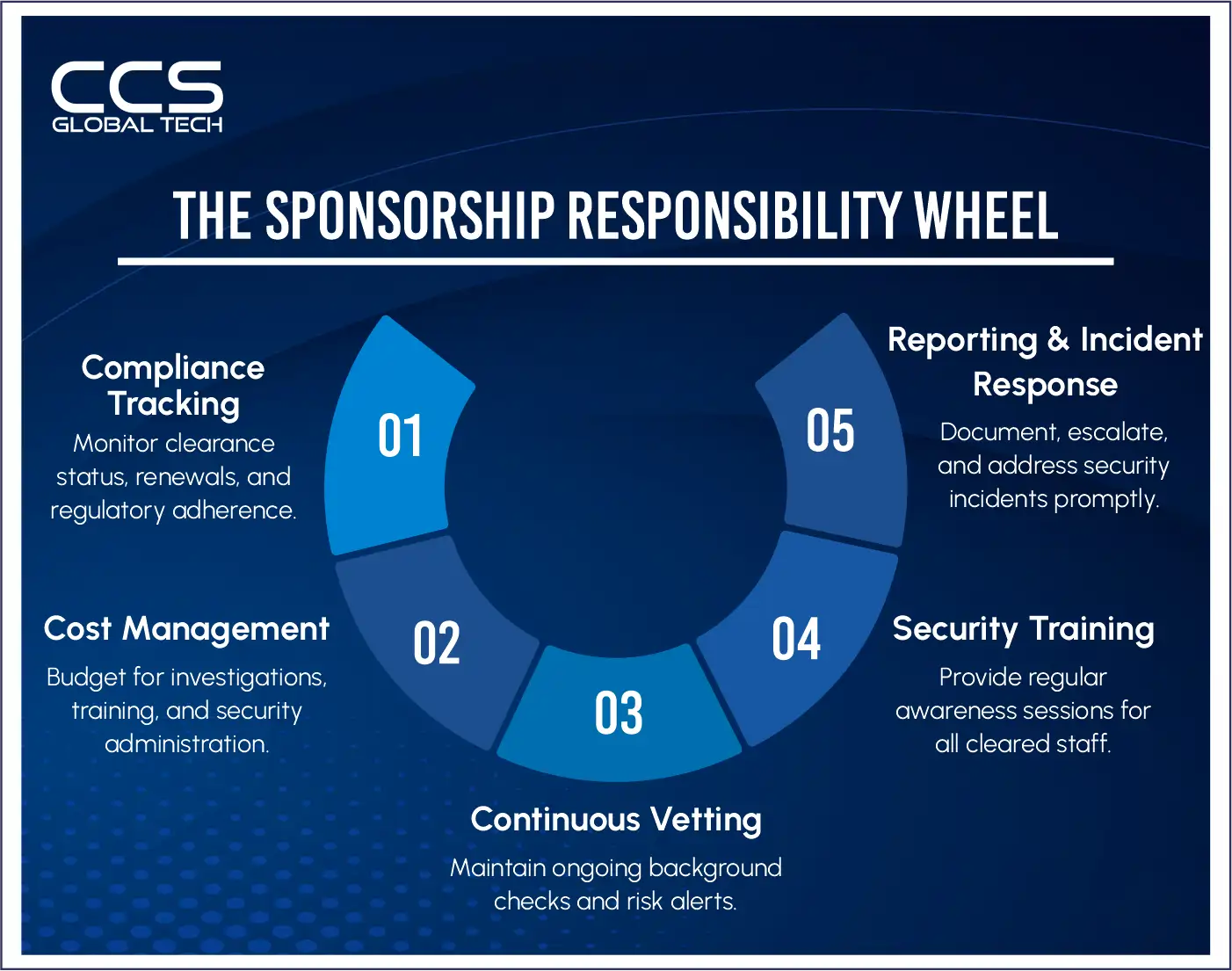
- Sponsorship brings responsibilities: tracking compliance, managing risk, and incurring real costs, not just for the government background investigation, but for onboarding, ongoing training, and monitoring.
Sponsorship Responsibilities: Prime vs. Subcontractor
Prime Contractor
- Holds contractual responsibility for overall delivery and compliance.
- Sponsors its own employees for clearances required by the contract.
- Responsible for verifying all subs and their employees hold appropriate FCLs and PCLs.
- Often sets expectations about who bears the financial and administrative burden for clearances.
Subcontractor
- Must hold (or rapidly obtain) an FCL as a condition of working on classified programs.
- Sponsors its own employees for PCLs.
- Complies with all security/review obligations just as a prime would, but must coordinate with the prime on timelines, documentation, and status.
The report also notes that over 50% of protests result in some form of relief for the protester, including voluntary corrective actions by agencies, showing that contract delays are often due to procedural or compliance disputes
The Money Question: Who Pays for Security Clearances?
Federal Funding for Background Checks
Cost Categories for Contractors
Direct Costs:
- FSO (Facility Security Officer) salary and training: $60,000–$120,000 annually.
- Security infrastructure (IT controls, document storage, SCIF build): $10,000–$1M+.
- Security equipment: e.g., containers ($3,000–$8,000 each).
Indirect Costs:
- Compliance/labor hours for documentation, prep, and annual audits.
- Productivity lost during employee investigation and adjudication.
- Ongoing mandated security training ($5,000–$20,000 per year).
- Continuous evaluation, incident response, and reporting protocols.
Example:
A prime staffing a new intelligence contract spent $185,000 in the first year on security infrastructure and FSO labor during facility stand-up, costs not covered by the government investigation but paid by the company.
Industry Insight:
The cost to sponsor, onboard, and retain a new TS/SCI-cleared candidate is often quoted at $12,000–$25,000 per person, factoring both direct and latent productivity losses.
How Primes and Subs Handle Cost Allocation in 2026?
Common Models
- Prime covers all upfront: Prime assumes all costs as part of broader project mobilization, often passed through in negotiated fee structures.
- Sub responsible for its team: Each party (prime or sub) covers their own internal clearance costs, including FSO, onboarding, compliance, and direct labor losses.
- Hybrid model: Prime pays for shared infrastructure and corporate compliance, while each sub covers only its own staff (often incentivized through negotiated rates).
Contract language often spells out these expectations, but miscommunication is common.
Timelines, Risks, and Role of Sponsorship in Project Delivery
Typical Clearance Processing Times (2025)
- Secret clearance:
Interim: 5–10 business days
Final: 3–6 months, up to 12 months for “complex” cases. - Top Secret/SCI:
Interim: 10–20 business days
Final: 6–12+ months, with some requiring an additional 2–4 months. - Facility clearance:
Sponsorship to approval: 45–90 days, longer for complex or FOCI cases. - Cycle and rejection rates:
Defense Counterintelligence and Security Agency (DCSA) states that the average cycle for sponsorship packages is 1.93 times per package with a 53% rejection rate. For initial and upgrade FCL (Facility Clearance) packages the average cycle is 2.5 times with a 70% rejection rate.
The Sponsorship Bottleneck
Delays often result from:
- Incomplete packages from subs, resulting in rework.
- Poor communication on FCL updates between prime and sub.
- Changing role requirements, requiring new or upgraded clearances mid-contract.
The Prime’s Risk Management Dilemma
Primes are incentivized to keep clearance sponsorship in-house where possible, retaining control and minimizing risk. However, overly restrictive policies can shrink talent options or delay task order execution, especially in high-demand fields like cybersecurity or intelligence analysis.

Real-Life Example: Cyber Contract Mobilization Snafu
A large systems integrator was awarded a $100M DoD IT contract requiring 40+ TS/SCI staff within six months. The firm relied on a sub that claimed all staff had “active clearances.
Upon onboarding, the integrator discovered that nine staff had expired credentials or clearances pending transfer, triggering delays, costly resets, and tense conversations.
The project lead implemented a new process: all new subs had to provide up-to-date clearance documentation before onboarding. Result: next task order mobilization met staffing targets three weeks ahead of schedule and minimized pass-through productivity losses.
Best Practices for Primes, Subs, and Shared Success
For Primes:
- Communicate clear expectations in contracts for clearance sponsorship and cost responsibility.
- Audit and verify all sub clearances and FCL status prior to kick off.
- Invest in compliance automation and training for FSO teams.
For Subs:
- Maintain up-to-date FCL and proactive tracking of all staff clearance statuses.
- Discuss cost and risk openly with clients and upstream primes.
- Budget for administrative costs, not just for new contracts, but ongoing maintenance and compliance.
Joint Recommendations:
- Use workflow systems that provide status tracking for all sponsored clearances.
- Build extra time at least 90 days into schedules for complex clearance scenarios.
- Align on confidentiality, risk-sharing, and incident response plans in advance.
The Bottom Line: Clearance Sponsorship Is a Strategic Lever
In the federal contracting world, the question isn’t “if” you’ll need to navigate clearance sponsorship, but “how well” you’ll master prime and sub responsibilities and cost allocation.
Smart organizations treat this not as an afterthought or annoyance, but as a critical component of risk reduction, project delivery, and margin protection.
With billions on the line and personnel in short supply, investing in clear, proactive, and honest sponsorship strategies sets the most successful firms apart.
Federal IT and staffing leaders turn to CCS Global Tech for streamlined, compliant contract hiring and effective clearance sponsorship strategies. With over 25 years in federal recruiting, access to 100,000+ cleared professionals, and a veteran-first approach, CCS Global Tech accelerates talent acquisition for mission-critical projects, while controlling costs and reducing risk.
Whether you’re a prime or sub navigating complex sponsorship and cost allocation, our agile team delivers tailored solutions and strategic workforce planning designed for federal environments. Want rapid cleared placements? Expert compliance support? We deliver those, backed by proven expertise, scalable resources, and dedicated support for veterans, minority-owned businesses, and government contractors of all sizes.
Ready to discuss your next cleared hiring challenge or need a consult on sponsorship strategy?
FAQ
Q1. Who is typically responsible for sponsoring a security clearance—the prime or the subcontractor?
A: The prime contractor usually determines who sponsors the clearance. If the subcontractor has an active Facility Clearance Level (FCL) and manages the candidate directly, they may take on sponsorship. Otherwise, the responsibility stays with the prime.
Q2. How do primes decide whether they or the subcontractor should sponsor a clearance?
A: Primes consider urgency, cost, clearance level, and the subcontractor’s talent pipeline. If timing is critical, primes may sponsor directly. If the sub has strong cleared resources, sponsorship may be delegated to the subcontractor.
Q3. Can a subcontractor sponsor a clearance without a Facility Clearance Level (FCL)?
A: No. Subcontractors must hold a valid FCL at the required level or higher. Without an FCL, they cannot sponsor candidates, and the responsibility automatically shifts to the prime.
Q4. What costs are involved in sponsoring a security clearance?
A: While the government covers investigation costs, contractors bear expenses such as administrative labor, candidate processing time, onboarding delays, and the opportunity cost of waiting for adjudication.
Q5. How do primes and subcontractors usually allocate clearance sponsorship costs?
A: Cost allocation depends on the subcontract. Some primes absorb the expense, others share costs with the subcontractor, and some pass costs through bill rate adjustments or negotiated terms.
Q6. Why do primes sometimes avoid sponsoring new clearances for subcontractor candidates?
A: Primes may avoid sponsorship due to timeline risks, higher liability, and the possibility that the cleared individual remains tied to the subcontractor rather than the prime after the clearance is granted.
Q7. How does clearance sponsorship affect staffing flexibility for contractors?
A: Sponsoring a clearance often ties the candidate to the sponsoring organization, limiting mobility. Both primes and subs must plan to avoid losing cleared talent after investing in the process.
Q8. What risks do subcontractors face when they agree to sponsor clearances?
A: Subs may face cash flow pressure, slow candidate deployment, increased overhead, and the risk that the prime could change staffing needs before the clearance process finishes.
Q9. Can clearance sponsorship decisions impact pricing on federal proposals?
A: Yes. Taking on sponsorship costs can influence bill rates and indirect costs. This can affect competitiveness during proposal pricing and task order negotiations.
Q10. How can primes and subcontractors prevent disputes over clearance responsibilities and cost sharing?
A: Clearly defining sponsorship responsibilities, cost allocation, and reimbursement terms in the subcontract helps both parties avoid misunderstandings and reduce risk.