

In late 2024, a mid-tier defense integrator secured a $150 million Navy systems engineering contract, only to see their projected margins evaporate within six months. The culprit was not a lack of technical expertise, but a failure to account for the “shadow costs” of federal staffing: a 15% surge in the market rate for TS/SCI talent, an unexpected 4-month delay in clearance reciprocity for three Key Personnel, and a stop-work order on a primary CLIN that left high-cost cleared engineers “on the bench” without billable coverage.
For federal prime contractors, staffing is not merely a line item; it is a complex risk management exercise where miscalculating a single labor category or clearance timeline can trigger a cure notice or permanent damage to a CPARS (Contractor Performance Assessment Reporting System) rating.
The Profitability Gap: Identifying the Hidden Staffing Burden
The primary challenge for federal Primes in 2025 is the widening gap between proposed labor rates and the actual cost of maintaining a contract-compliant workforce. While agencies increasingly move toward Best Value Trade-Off (BVTO) models, the fiscal reality is dictated by skyrocketing overhead for cleared personnel and the rigid requirements of Key Personnel (KP) clauses.
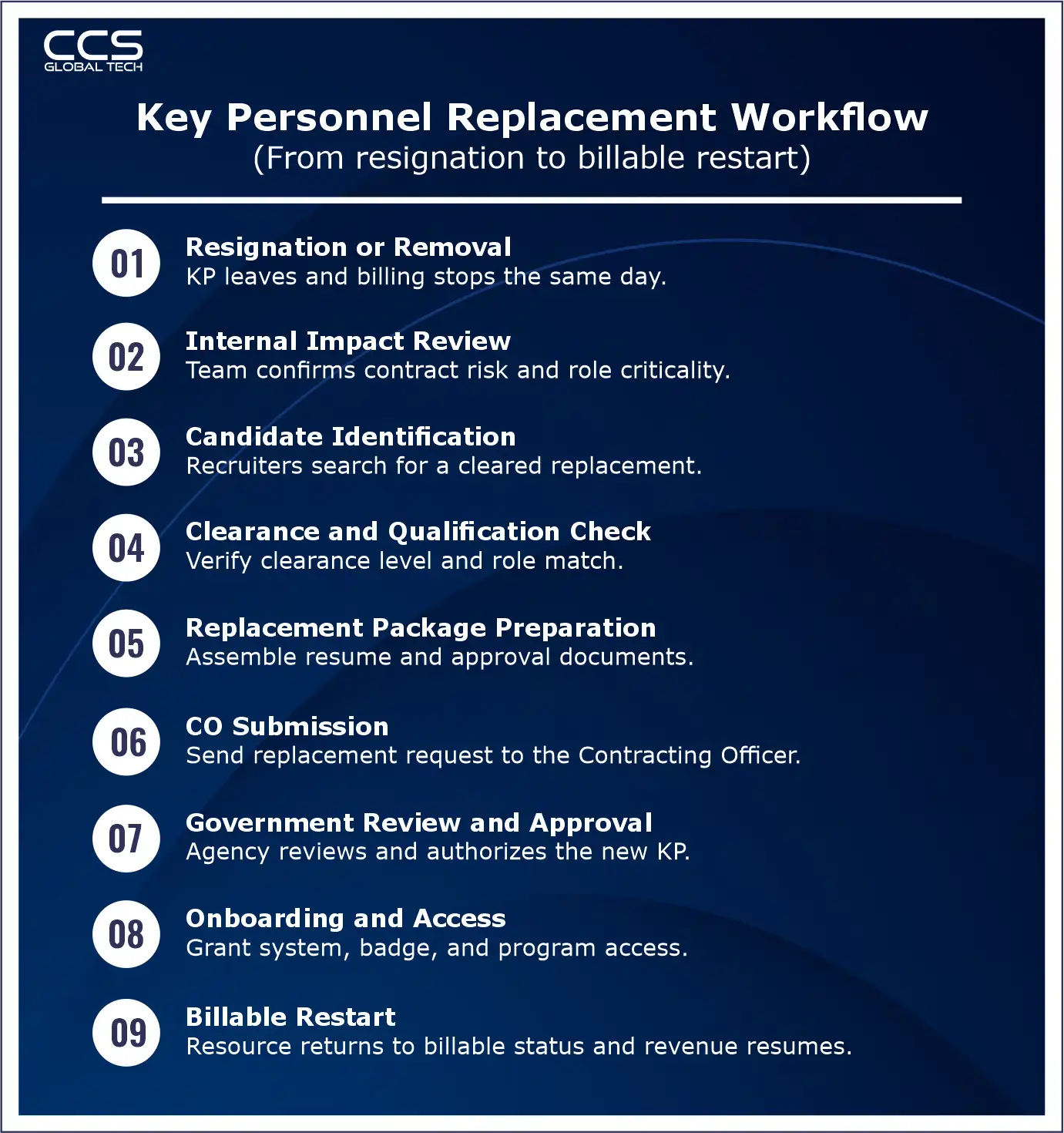
Prime contractors face a “compliance tax” that uncleared commercial firms do not. When a contract specifies a “Senior Systems Architect” with a TS/SCI and 15 years of experience, the prime is legally bound to that profile. If that individual resigns, the cost to replace them includes not just the salary premium, but the internal administrative burden of submitting a replacement approval request to the Contracting Officer (CO) and the potential for lost revenue during the seat’s vacancy.
2024-2025 Federal Staffing Data Benchmarks
Strategic budgeting requires grounding in current market realities. The following data reflects the most recent fiscal shifts in the federal landscape:
Security Clearance Processing & Market Premiums (FY 2024-2025)
| Clearance Level | Average Final Processing Time (2024-2025) | Estimated Market Salary Premium | Gov Investigation Cost (Tiered) |
|---|---|---|---|
|
Secret (Tier 3) |
82–100 Days |
10% – 12% |
$415 – $450 |
|
Top Secret (Tier 5) |
144–180 Days |
20% – 25% |
$5,355 – $5,785 |
|
TS/SCI w/ Poly |
12–18 Months (Full Process) |
35% – 45% |
$5,785+ (Agency Dependent) |
Key Market Statistics
- Total Contract Obligations: The federal government committed $755 billion to contracts in FY 2024. Despite a slight decrease from 2023 when adjusted for inflation, the demand for high-end technical labor remains at a record high.
- Protest Effectiveness: The GAO reported a 52% effectiveness rate for bid protests in FY 2024 and FY 2025, with “unreasonable cost or price evaluation” remaining a top reason for sustained protests.
- Clearance Backlog: The national security vetting backlog remains at approximately 180,000 cases, contributing to the 12-month+ timelines for SCI-level access.
Proposal Positioning: Engineering a Credible Staffing Narrative
In the 2025 federal procurement landscape, “Staffing Plan Credibility” has evolved from a secondary evaluation factor into a primary determinant of win rates. Source Selection Boards (SSBs) are increasingly skeptical of “paper resumes”: profiles of candidates who have not been pre-vetted or formally committed to the project.
To maximize technical evaluation scores, a Prime’s proposal must move beyond listing qualifications and instead demonstrate a low-risk execution strategy. This includes providing proof of clearance reciprocity for proposed staff and a detailed transition-in plan that accounts for the current 144-day average for Top Secret adjudications.
By aligning the staffing plan with specific LPTA (Lowest Price Technically Acceptable) or BVTO (Best Value Trade-Off) criteria, Primes can justify higher labor rates through the lens of risk mitigation, proving that a “ready-now” cleared workforce is more cost-effective than the potential fallout of a cure notice.

Critical Dimensions of Federal Staffing Strategy
To maintain contract performance, Primes must navigate three distinct regulatory and operational pillars.
1. Key Personnel (KP) and Modification Management
In the federal sector, “Key Personnel” are not just employees; they are contractual obligations.
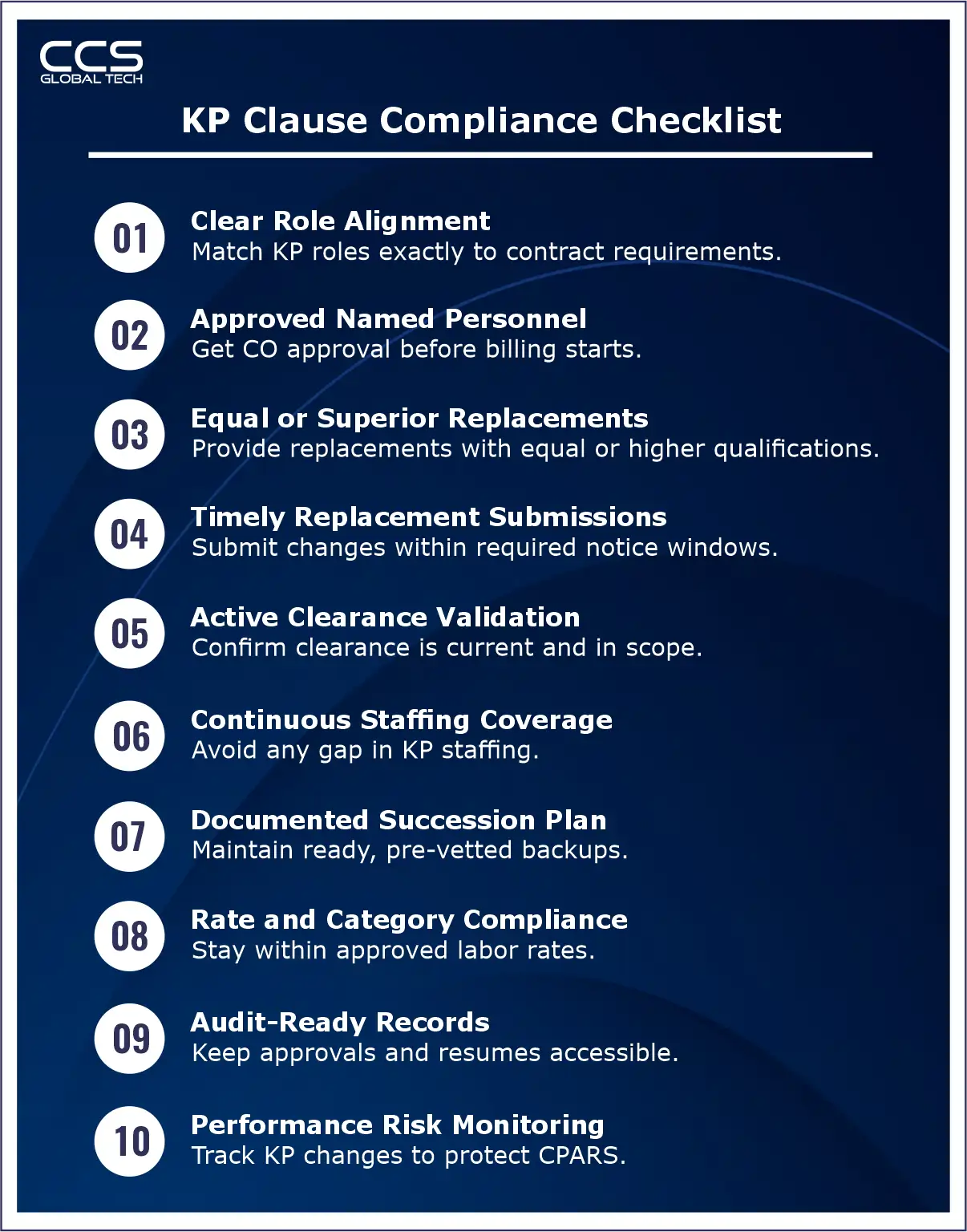
- Replacement Approval: Most solicitations require CO approval for any KP replacement. Primes often face 30-day “no-compete” windows or the requirement to provide a replacement with “equal or superior” qualifications, often at a higher market rate than originally budgeted.
- Modification Negotiations: If a program’s scope shifts, the ability to negotiate labor rate adjustments (modifications) is vital. Failure to align internal salary increases with the contract’s Price Adjustment clauses leads to margin compression.
2. Contract Performance and Compliance Risk
A Prime’s Past Performance rating is their most valuable asset. Poor staffing directly correlates with:
- Cure Notices: Issued when a contractor fails to provide the required number of cleared staff, threatening the contract for default.
- Stop-Work Orders: During a government shutdown or funding gap, Primes must decide whether to “hold” talent on overhead or risk losing cleared staff to competitors. In 2025, over $3 billion per week in small and mid-tier contract payments are at risk during budget uncertainties.
3. The TS/SCI "War for Talent"
The processing of a Top Secret clearance with Sensitive Compartmented Information (TS/SCI) access is the most significant bottleneck in GovCon.
- Timelines: While interim clearances for Secret levels may take 10 days, full TS/SCI adjudications still average 12 to 18 months.
- Reciprocity: Despite the “Trusted Workforce 2.0” initiatives, reciprocity, the ability to transfer a clearance from one agency to another, remains inconsistent, often taking 2 to 6 weeks of administrative limbo.
- Cleared Talent Pools: With the high cost of “growing” talent, Primes are increasingly reliant on specialized staffing partners who maintain pre-vetted pools of active clearance holders.
Implementation Guidance: Optimizing the Staffing Budget
To mitigate the risks identified above, prime contractors should adopt a multi-tiered staffing model.
- Bench Strength Ratios: Maintain a 5-8% “cleared bench” for critical labor categories. While this increases overhead, it prevents the loss of $10M+ CLINs due to a single resignation.
- Escalation Realism: Abandon the standard 3% annual escalation. Current data suggests that for specialized cyber and AI roles with TS/SCI requirements, annual market-rate inflation is closer to 6.5%-8%.
- Reciprocity Audits: Before onboarding a sub-contractor’s employee, perform a “DISS/Scattered Castles Check” to ensure their clearance is not only active but also within the periodic reinvestigation (PR) window.
Case Study: The Cost of Recruitment Failure
To understand the fiscal gravity of staffing mismanagement, consider the following hypothetical, yet frequent, scenario involving a mid-market Prime Contractor.
The Opportunity: $40M Cloud Modernization
A Prime won a $40 million IT modernization contract for a civilian agency transitioning legacy data centers to classified cloud environments. The Statement of Work (SOW) was rigorous: it required a core team of 12 Cleared Cloud Engineers, all holding active TS/SCI clearances, to be onsite and billable within 60 days of the contract award.
Because this was a “Best Value” award, the Prime had proposed aggressive labor rates to stay competitive, assuming their internal talent acquisition team could source the engineers from the commercial sector or via general job boards.
The Operational Failure: The “Generalist” Recruitment Trap
The Prime’s internal recruiting department, while successful in the commercial space, lacked a sophisticated cleared talent pool. They treated the TS/SCI requirement as a “preferred qualification” rather than a non-negotiable legal barrier.
As the 60-day clock ticked down, the reality of the 12-18 month TS/SCI processing timeline set in. Candidates without existing clearances were non-starters, and the existing pool of cleared engineers was already being aggressively retained by competitors. At the Day 60 milestone, the Prime had successfully onboarded only 4 of the 12 required seats, leaving a 66% vacancy rate on critical deliverables.
The Cascading Impact: Contractual and Financial Hemorrhage
The agency, citing a failure to meet Contract Performance milestones and a breakdown in the deliverable schedule, took immediate action:
- Issuance of a Cure Notice: The Contracting Officer (CO) issued a formal Cure Notice, notifying the Prime that they were in breach of contract. This triggered an immediate, high-stakes legal and administrative “fix-it” period of 10 days.
- The “Talent Buy-Back” Penalty: To “cure” the breach and avoid a Termination for Default, the Prime was forced to execute emergency subcontracts with a specialized competitor. To lure the 8 missing engineers, they had to pay a 30% premium over their own proposed labor rates.
- Margin Erosion: Because the contract was a Firm-Fixed-Price (FFP) model for those specific CLINs, the Prime could not pass these costs to the government. The 30% salary premium, combined with the administrative costs of the emergency modification, effectively zeroed out the profit margin for the first two years of the contract.

The Strategic Aftermath: The CPARS "Scar"
The most damaging consequence was not the immediate financial loss, but the long-term impact on the Prime’s Past Performance ratings. In the year-end Contractor Performance Assessment Reporting System (CPARS) evaluation, the agency rated the Prime as “Marginal” under the Management and Staffing categories.
In the federal ecosystem, a “Marginal” rating acts as a red flag for every future Source Selection Board. When the contract comes up for re-compete in three years, this Prime, despite having eventually fixed the technical issues, will likely be disqualified during the “Responsibility” determination phase, handing the $40M opportunity directly to a competitor.
Strategic Implementation Steps
Step 1: Labor Category Mapping. Audit your current “Key Personnel” vs. “Non-Key” staff. Ensure your compensation for KP is at the 75th percentile of the 2025 market to prevent poaching.
Step 2: Subcontractor Diversification. Avoid over-reliance on a single sub-contractor for cleared talent. Spread the risk across multiple vendors with different talent pipelines.
Step 3: Clearance Pipeline Management. Utilize “Interim” clearances where the contract allows (e.g., Tier 3) to start work immediately while full investigations proceed.
The Federal Contractor Executive Summary
Managing Prime contractor staffing costs in 2026 requires a fundamental shift from traditional “recruiting” to a model of Capacity Management. In an environment where the government’s demand for high-clearance talent exceeds the supply by a significant margin, the ability to rapidly deploy cleared personnel has moved beyond an HR function—it is now the ultimate competitive advantage and a primary protector of contract margins.
Traditional recruiting is reactive; it begins when a seat becomes vacant or a contract is awarded, often leading to the “talent buy-back” scenarios that erode profitability. Capacity management, conversely, treats cleared talent as a dynamic inventory. This shift involves three critical strategic pivots for federal Primes:
- Proactive Bench Integration: Rather than waiting for a Stop-Work Order or a Cure Notice to scramble for talent, Primes must maintain “warm” pipelines of candidates who have already cleared the TS/SCI processing timelines. Capacity management leverages a mix of internal cleared benches and specialized staffing partnerships to ensure that a 15% turnover rate doesn’t result in a 15% revenue loss.
- Predictive Clearance Mapping: Strategic capacity management tracks the “clearance lifecycle” across the entire contract portfolio. By anticipating when Periodic Reinvestigations (PR) are due or monitoring clearance reciprocity hurdles across different agencies (e.g., moving a candidate from a CIA program to an NSA program), Primes can mitigate the 30–75 day administrative “limbo” that often keeps highly-paid talent unbillable.
- Agile Deployment Resilience: In a landscape defined by fiscal volatility, the ability to shift cleared assets between contracts or Task Orders is vital. Capacity management ensures that when one program faces a funding gap, your cleared “inventory” is immediately redirected to other high-priority requirements, maintaining high utilization rates and preventing the permanent loss of talent to competitors.
Primes that master capacity management do more than just fill seats; they build a resilient operational infrastructure that can absorb the shocks of the federal market while maintaining the deliverable schedules essential for a “Blue Ribbon” Past Performance rating.
Strategic Context: The transition to capacity management is no longer optional for Primes seeking to protect long-term profitability. As clearance backlogs and market premiums continue to rise, the fiscal delta between those who “recruit” and those who “manage capacity” will define the next generation of federal market leaders.
A good checklist includes:
- Is your current “Price to Win” strategy accounting for the 25% salary premium required for TS/SCI talent in the 2025 market?
- What is the quantified financial impact on your primary contract if a “Key Personnel” seat remains vacant for more than 45 days?
- Do you have a verified, external “ready-pool” of cleared talent to offset the 12-month processing time for new clearances?
How CCS Global Tech Supports Federal Primes?
CCS Global Tech provides specialized federal staffing solutions designed to mitigate the risks of Key Personnel vacancies and clearance delays. By maintaining an active pipeline of pre-vetted, cleared professionals, we help Prime contractors meet deliverable schedules and maintain exceptional Past Performance ratings. Our expertise lies in bridging the gap between complex technical requirements and the rigid compliance standards of federal procurement.
FAQs
Q1. What are the biggest drivers of staffing cost overruns in federal prime contracts?
A: The largest cost drivers are clearance premiums, Key Personnel replacement delays, fringe and overhead growth, and unplanned bench time during contract transitions. Clearance processing and CO approval cycles create hidden non-billable periods that quickly erode margins.
Q2. How much do clearance requirements increase total labor costs for prime contractors?
A: Active Secret clearances typically add 8–12 percent to base labor rates, while TS/SCI talent can add 20–35 percent due to scarcity, adjudication delays, and retention bonuses required to prevent attrition.
Q3. Why do Key Personnel replacements create major budget risk on federal contracts?
A: KP replacements often trigger 30–60 day approval windows with no billable coverage. During this time, primes either carry overhead costs or risk cure notices and CPARS impact if positions remain unfilled.
Q4. How often do staffing costs exceed proposed rates after contract award?
A: In competitive labor markets, actual salaries exceed proposal rates in more than 40 percent of cleared labor categories within the first 12 months, driven by market adjustments, federal pay raises, and contractor poaching.
Q5. What is the true cost of a vacant cleared seat on an active contract?
A: A single vacant TS/SCI role can cost $25,000 to $60,000 per month in lost revenue, delayed milestones, and internal holding costs while approvals and replacements are processed.
Q6. How do stop-work orders and funding gaps affect prime staffing budgets?
A: During stop-work periods, primes must choose between carrying cleared staff on overhead or losing them to competitors. Both options reduce margin and increase re-staffing costs when work resumes.
Q7. Are bench strategies more cost-effective than reactive hiring?
A: Yes. Maintaining a cleared bench reduces time-to-bill by 60–90 days and lowers total replacement costs by 30–40 percent compared to reactive hiring after resignation or termination.
Q8. How do clearance reactivation windows impact long-term staffing costs?
A: When a clearance lapses beyond the 24-month reactivation window, full reinvestigation is required, adding 12–18 months of non-billable time and up to $15,000 per candidate in processing and holding costs.
Q9. What role do staffing partners play in controlling prime contractor labor risk?
A: Specialized cleared staffing partners provide pre-vetted talent pools, faster onboarding, and clearance continuity, reducing vacancy risk and stabilizing contract delivery timelines.
Q10. How should primes model staffing costs in BVTO and FFP proposals?
A: Successful primes model salary escalation, clearance premiums, bench buffers, KP replacement risk, and fringe growth explicitly rather than relying on static labor categories that understate real delivery costs.